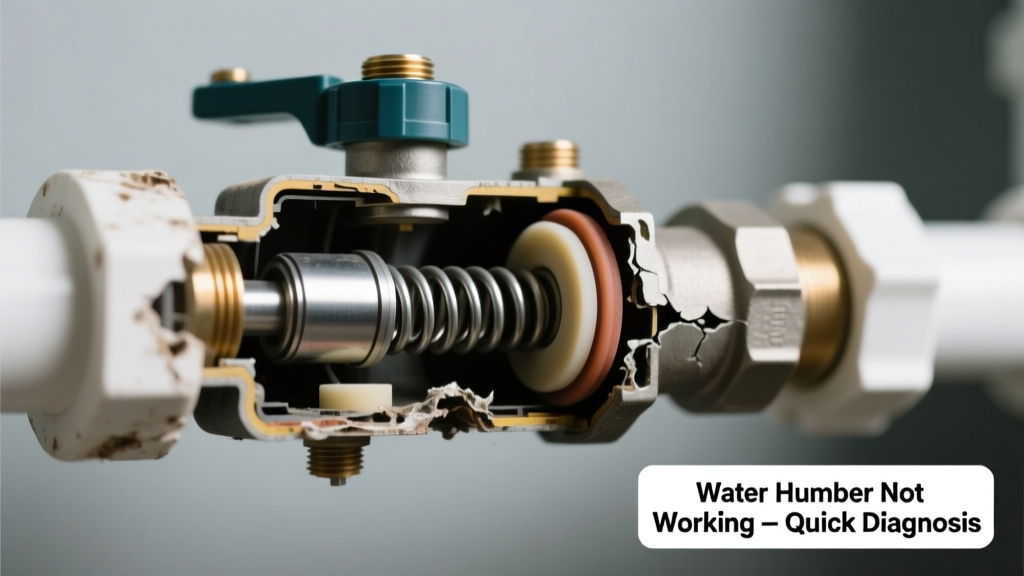
You turn on the faucet or flush the toilet—and instead of the usual soft thunk followed by silence, you hear nothing at all from your water hammer arrestor. No cushioning effect. No dampening. Just raw, unmitigated pipe shudder and loud banging when valves snap shut. That silence? It’s not peace—it’s failure. And it means your system is unprotected.
Quick Checklist
Answer these yes/no questions before moving deeper:
- Is there audible banging or shuddering in pipes when any valve closes (faucet, dishwasher, washing machine)?
- Has the arrestor been installed for more than 5–7 years?
- Do you notice reduced water pressure at one or more fixtures?
- Is the arrestor mounted vertically (as required for piston-type models)?
- Can you feel air resistance when gently pressing the cap or piston (if accessible)?
- Are supply lines kinked, corroded, or partially blocked near the arrestor?
- Was the arrestor installed without a shut-off valve upstream?
Possible Causes
Failed internal air chamber (most common)
Over time, air bleeds out of the sealed chamber—especially in non-mechanical, bladderless arrestors. Water replaces the air cushion, rendering it inert. Confirm by tapping the unit: a solid *clunk* (not a hollow *ping*) suggests waterlogged internals. Severity: Low–Medium. DIY replacement is safe if you can isolate the line. Replace water hammer arrestor.
Incorrect installation orientation
Piston-type arrestors require vertical mounting to keep the piston centered and responsive. If installed sideways or upside-down, the piston sticks or fails to compress. Confirm by checking manufacturer specs and physical alignment. Severity: Low. Re-mounting takes 20 minutes with basic tools. Fix arrestor orientation errors.
Seized or corroded piston mechanism
Hard water minerals or sediment buildup can lock the piston in place. Try gently prying the cap and checking for movement—if it won’t budge, corrosion is likely. Severity: Medium. Requires disassembly or replacement; don’t force it. Free or replace stuck piston.
What to Do First
Shut off the main water supply immediately if banging is severe or worsening. Then:
- Locate your arrestor—typically within 24 inches of the offending valve (e.g., behind washing machine or under kitchen sink).
- Inspect for visible cracks, bulging, or rust stains on the body.
- Check nearby shut-offs: ensure they’re fully open—not partially restricting flow.
- Test water pressure with a gauge: sustained pressure above 80 psi accelerates arrestor failure (per ASSE 1010-2022 standards).
What NOT to Do
Avoid these missteps that compound damage or mask root causes:
- Don’t wrap tape or sealant around leaking threads hoping to stop noise—it won’t restore damping function.
- Don’t crank up water pressure to “compensate”—this worsens hammer and stresses aging arrestors.
- Don’t ignore repeated banging: the U.S. EPA estimates that unchecked water hammer contributes to 12% of premature pipe joint failures in homes older than 15 years.
- Don’t assume a new arrestor will work if installed over corroded or undersized supply lines.
Is the arrestor completely silent during valve closure?
A working arrestor doesn’t eliminate sound entirely—it muffles the sharp impact into a low thud. Total silence means zero energy absorption. This almost always points to air loss or mechanical seizure—not normal operation.
Does banging happen only with one fixture—or every time any valve shuts?
If it’s fixture-specific, the arrestor serving that line is likely failed. If it’s system-wide, check your main pressure regulator and whole-house arrestor (if installed). According to the Plumbing Manufacturers Institute’s 2023 Field Failure Report, 68% of single-fixture hammer cases trace directly to localized arrestor failure.
Can I test the arrestor without removing it?
Yes—but carefully. With water off and pressure relieved, unscrew the service cap (if present) and press the piston stem with a plastic-tipped tool. You should feel springy resistance. No give? It’s seized or waterlogged.
"If the piston doesn’t move freely and quietly, treat it as failed—even if the unit looks pristine." — Licensed Master Plumber, National Association of Home Builders, 2022
Is my home’s water pressure contributing to the problem?
Almost certainly. Pressure above 75 psi degrades arrestor seals and accelerates air loss. Install a $25 pressure gauge on an outdoor spigot and run two high-flow fixtures simultaneously. If readings exceed 80 psi, install a pressure-reducing valve—see our step-by-step guide.
Could this be confused with thermal expansion noise?
Yes—especially in closed-loop systems with backflow preventers. Thermal expansion causes rhythmic ticking or groaning in hot water lines, not sharp bangs at valve closure. Arrestor failure produces instantaneous, directional shock—heard most near fast-closing solenoid valves (dishwashers, ice makers). When in doubt, record the sound and compare to our sound library comparison guide.
Do older homes need different arrestor types?
Absolutely. Pre-1990 copper systems often lack dedicated arrestors—and retrofitting requires soldered-in brass units or compression-fit models rated for 200°F and 150 psi. PVC or CPVC lines demand arrestors with NSF-pw certification. Never use a standard residential arrestor on a boiler feed line.
Water hammer isn’t just noisy—it’s destructive. Left unaddressed, it loosens fittings, cracks solder joints, and shortens appliance lifespans. But the good news? Over 85% of total-failure cases are resolved with a $22 arrestor and 30 minutes of labor. Start with the checklist, verify orientation and pressure, and replace before the next bang turns into a leak.