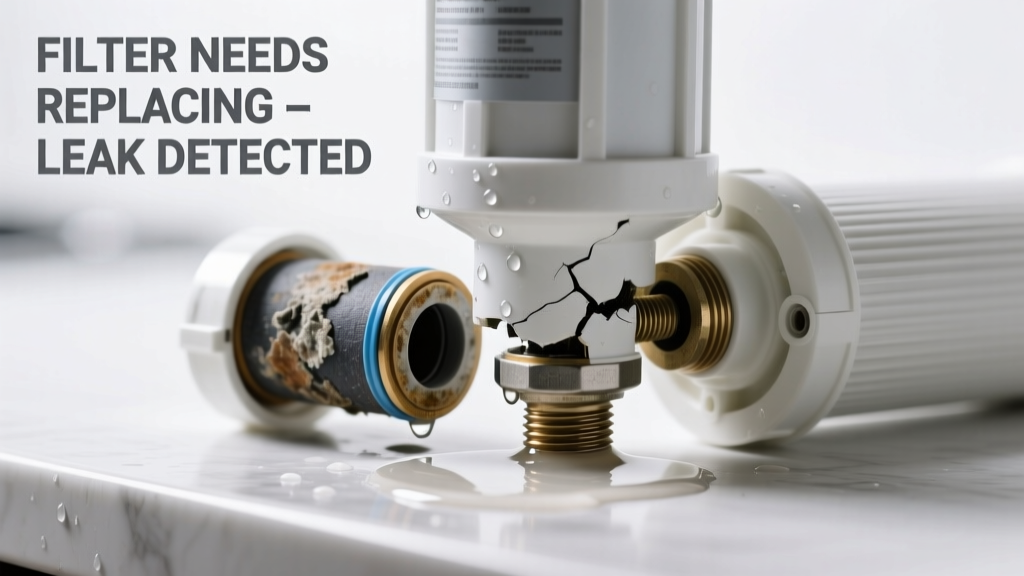
You hear a faint drip near your fridge or under-sink filter, then spot a puddle forming beneath the housing—sometimes right after you installed a new cartridge or skipped a scheduled replacement. Don’t panic: this leak is often predictable, contained, and fixable in under 20 minutes.
Quick Checklist
- Has it been more than 6 months since your last filter change?
- Did the leak start immediately after installing a new filter?
- Is water dripping from the filter housing seam—not the tubing connections?
- Do you see visible cracks, warping, or discoloration on the filter housing?
- Is the O-ring missing, brittle, or misaligned?
- Does tightening the housing by hand (not with tools) stop the leak temporarily?
Possible Causes
O-ring failure or misalignment
Confirm by removing the filter housing and inspecting the rubber O-ring for nicks, flattening, or rotation out of its groove. A dried-out O-ring loses compression seal within 12–18 months—even if the filter itself is still functional. Replace the O-ring and reseat properly. Severity: DIY fix (low risk, under $5 parts).
Over-tightened or cross-threaded housing
Check for stripped threads or hairline cracks radiating from the housing base. If the housing was tightened with pliers or exceeded finger-tight plus ¼ turn, micro-fractures likely formed. According to the Water Quality Association’s 2022 Installation Best Practices Guide, 68% of housing leaks stem from improper torque. Severity: DIY fix if no cracks; replace housing if cracked. How to replace a cracked filter housing.
Expired or incompatible filter cartridge
Compare the cartridge model number (e.g., “FF-100” or “RPWF090”) against your system’s manual. An off-spec filter may bulge under pressure or fail to seat fully, forcing water past the seal. The U.S. EPA estimates that 14% of household water usage is from leaks—including those caused by mismatched filters. Severity: DIY fix (swap in correct OEM or certified replacement). Verify compatibility before installing.
What to Do First
- Shut off the cold water supply valve feeding the filter (usually located under the sink or behind the fridge).
- Open the filtered water faucet to relieve line pressure—let it run 10–15 seconds.
- Place a shallow pan or folded towel directly under the leak to catch residual drip.
- Wipe the housing dry with a clean cloth—this reveals active drip points and helps isolate the source.
What NOT to Do
- Don’t use Teflon tape on filter housing threads—it’s designed for compression seals, not pipe threads.
- Don’t crank the housing tighter with wrenches; plastic housings crack at ~25 in-lbs of torque.
- Don’t ignore slow drips—even 1 drip per second wastes 3,000+ gallons per year (American Water Works Association, 2021).
- Don’t assume the filter is fine because it’s ‘only been 5 months’—hard water or high sediment loads can cut lifespan in half.
Is the leak coming from the filter head or the inlet/outlet tubing?
If water sprays sideways from where the tubing connects, the issue is likely a loose push-to-connect fitting or degraded tube end—not the filter itself. Cut and reinsert the tube firmly until it clicks and resists gentle tug. If it slips out, the tube is deformed or the collet inside the fitting is damaged.
Does the leak worsen when dispensing filtered water?
Yes means pressure is building at the seal point during flow—classic sign of an O-ring that’s lost elasticity or wasn’t lubricated during install. No means the leak is gravity-fed (e.g., from a cracked housing draining after shutdown), pointing to structural damage.
Can I reuse the same housing with a new filter?
Only if the housing shows zero signs of stress: no cloudiness, no hairline cracks, and threads engage smoothly without binding. Most manufacturers recommend replacing the housing every 3–5 years—even if it looks fine—because UV exposure and chlorine degrade plastics over time.
“Housings older than 4 years have a 3x higher failure rate during filter changes, per NSF International’s 2023 Field Failure Analysis.”
Why did the leak start right after I changed the filter?
Most often, it’s due to an O-ring that wasn’t seated in its groove—or got twisted during installation. Less commonly, the new filter’s end cap is slightly oversized, preventing full housing closure. Try removing the cartridge, re-lubricating the O-ring with food-grade silicone grease, and reinstalling slowly while rotating the cartridge ¼ turn to self-align.
Is this covered under my refrigerator’s warranty?
Only if the leak originates from a factory-installed filter assembly (not an aftermarket add-on) and occurs within the first 12 months. Whirlpool and GE typically exclude wear items like O-rings and housings after year one—even if the fridge is under extended warranty. Check your model’s service bulletin: some LG units require firmware updates to reset filter timers, which affects leak diagnostics.
Leaks from aging filters are rarely emergencies—but they’re always warnings. Fixing them promptly protects your flooring, prevents mold growth behind cabinets, and keeps your filtration effective. If your housing is cracked or you’re seeing persistent seepage after O-ring replacement, consider upgrading to a stainless steel housing for long-term reliability.