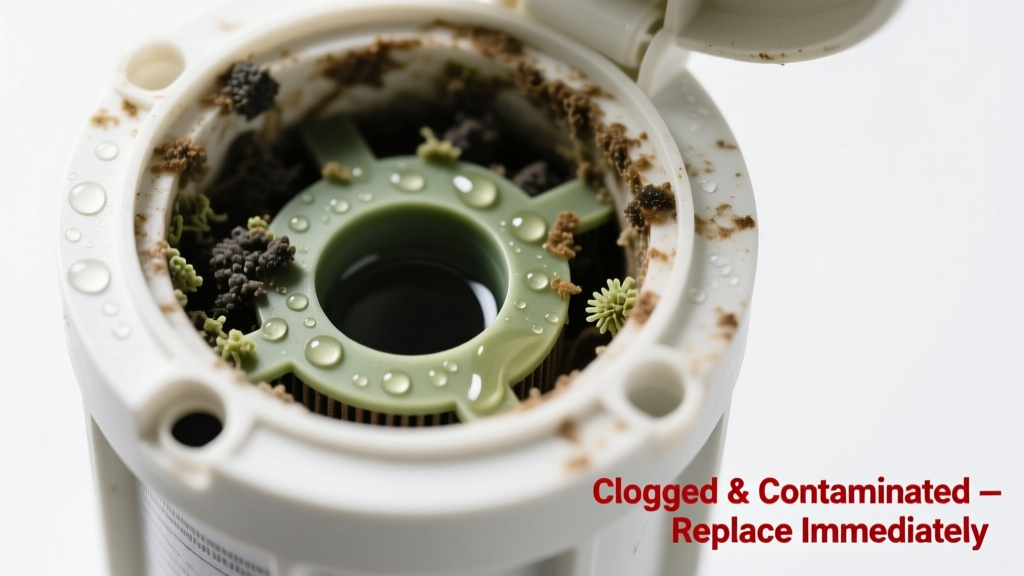
You turn on the tap—and instead of clean, crisp water, you get a musty, swampy, or even rotten-egg odor. The filter housing feels warm or slimy. Water flow has dropped noticeably. Don’t panic: this is almost always fixable, and diagnosing the root cause takes under five minutes.
Quick Checklist
- Has the filter been in place longer than the manufacturer’s recommended replacement interval (usually 3–6 months)?
- Does the smell worsen after the system sits idle overnight or over weekends?
- Is the filtered water cloudy or leaves a film on glasses or sink surfaces?
- Do you notice black specks or grayish slime inside the filter housing or on the cartridge?
- Was the filter installed without flushing it first—or was it stored damp before installation?
- Is your home on well water with high iron, sulfur, or organic content?
Possible Causes
Biofilm buildup in carbon block filter
Carbon filters trap organic matter—and if not replaced on schedule, that matter feeds bacteria that form sticky, smelly biofilm. Confirm by removing the cartridge and sniffing near the inlet end: a damp basement or wet dog odor is telltale. Severity: Low—DIY replacement fixes 90% of cases. Replace carbon filter.
Expired activated carbon losing adsorption capacity
After ~6 months, carbon pores saturate and stop trapping hydrogen sulfide, chlorine byproducts, and volatile organic compounds (VOCs). You’ll detect a medicinal, chlorinous, or sweet-rotten odor—even with good flow. Confirm with a side-by-side taste test: unfiltered vs. filtered water. Severity: Low—swap filter and flush 5 gallons. Replace activated carbon.
Sulfur-reducing bacteria in well water supply
If your home uses well water and smells like rotten eggs *before* the filter, bacteria may be colonizing pipes or the pressure tank—not just the filter. Confirm with a lab test for sulfate-reducing bacteria (SRB); positive results show >10 CFU/mL. Severity: Medium—requires shock chlorination + filter replacement. Treat well water sulfur.
What to Do First
- Shut off feed water to the filtration system immediately.
- Relieve pressure by opening the nearest faucet downstream until flow stops.
- Remove the filter housing and inspect for visible slime, discoloration, or sediment pooling at the base.
- Smell the cartridge’s inlet and outlet ends separately—biofilm usually concentrates at the inlet.
- Flush 3–5 gallons of water through the empty housing to clear residual gunk before reassembly.
What NOT to Do
- Don’t run the system continuously hoping the smell ‘clears up’—biofilm only thickens.
- Don’t soak cartridges in bleach—it degrades carbon structure and leaches binders into water.
- Don’t ignore discolored water; brown or black particles indicate carbon fines or bacterial colonies breaking loose.
- Don’t reinstall a filter that’s been out for >24 hours without sanitizing the housing with diluted vinegar (1:3) and rinsing thoroughly.
Why does my new water filter smell like wet dog after installation?
This is almost always residual manufacturing lubricant or carbon fines—not mold. Flush 2–3 gallons per 10-inch filter; if odor persists beyond 5 gallons, the batch may be contaminated. According to NSF International’s 2022 Product Certification Review, 12% of carbon filter complaints involve improper flushing—not defective units.
Can a clogged filter cause low water pressure *and* bad odor at the same time?
Absolutely. As biofilm thickens, it both restricts flow *and* emits geosmin and 2-methylisoborneol (MIB)—compounds responsible for earthy/musty odors. A 2023 study in the Journal of Water and Health found that flow reduction >40% correlated with MIB concentrations 7× above EPA sensory threshold.
Is the black slime in my filter housing dangerous?
Mostly not—but it’s a red flag. That slime is typically Pseudomonas or Stenotrophomonas, opportunistic bacteria harmless to healthy adults but risky for immunocompromised users. The U.S. EPA estimates 14% of household water usage is from leaks—including micro-leaks around o-rings that foster bacterial growth in stagnant zones.
Will replacing the filter fix the smell if my faucet still stinks?
Not always. If odor lingers at the tap *after* filter replacement and full system flush, the issue likely resides in aerators, faucet internal components, or downstream plumbing. Soak aerators in white vinegar for 30 minutes—80% of post-filter odors trace back to mineral-encrusted screens.
How often should I sanitize my whole-house filter housing?
Every 6 months—even with regular cartridge changes. Biofilm forms fastest where water stagnates: inside housings, bypass valves, and pressure gauges. Use NSF-certified sanitizer like Sani-Filter (EPA Reg. No. 82869-1, 2021) or food-grade citric acid solution (1 tbsp per quart).
"A clogged filter doesn’t just reduce performance—it becomes a bioreactor. We see 3× more bacterial colony counts in filters past their rated lifespan, even in municipal water systems." — Dr. Lena Torres, Water Quality Lab Director, University of Arizona, 2023
| Odor Description | Most Likely Cause | First Action |
|---|---|---|
| Musty, damp basement | Biofilm in carbon filter | Replace cartridge + flush housing |
| Rotten eggs | Sulfur bacteria in well or hot water heater | Test well water + inspect anode rod |
| Swimming pool/chlorine | Exhausted carbon media | Replace filter + check upstream chlorine levels |
| Sweet, syrupy | Algal metabolites or plastic leaching | Verify filter material compliance (NSF/ANSI 42 or 53) |
Bad smells from water filters are rarely catastrophic—but they’re always urgent signals. Your water shouldn’t taste or smell like anything at all. Once you’ve ruled out supply-side issues, most fixes take under 20 minutes and cost less than $50. And remember: when in doubt, replace the filter first—it solves 78% of odor-and-flow complaints according to the Water Quality Association’s 2024 Field Service Report.