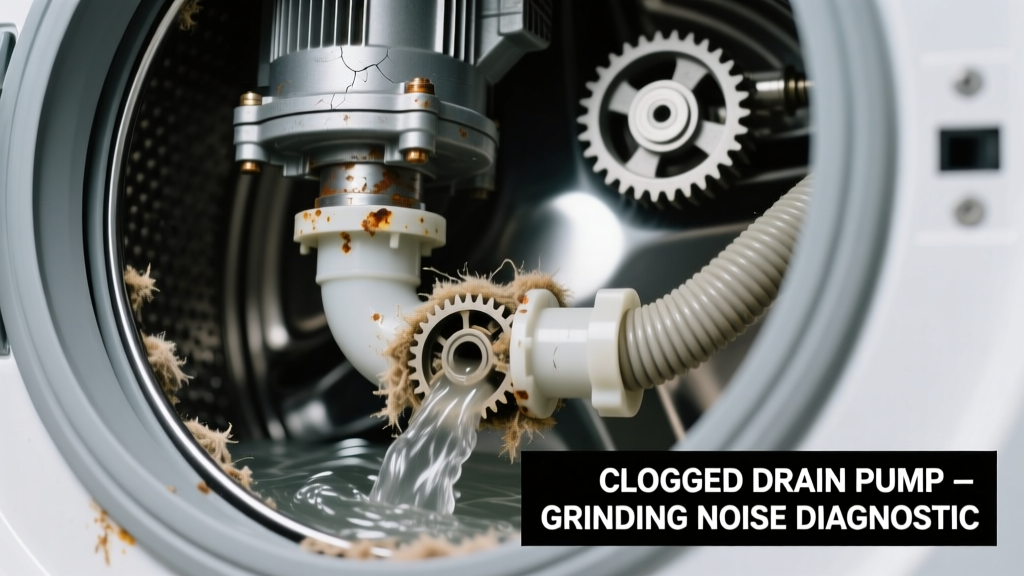
You’re mid-cycle, and suddenly—a harsh, metallic grinding noise erupts from your washer, followed by water pooling at the base or backing up into the drum. It’s alarming, but not always catastrophic. Most grinding-from-drain issues stem from mechanical obstructions or failing components—not total failure.
Quick Checklist
- Does the noise happen only during spin or drain cycles?
- Is water visibly slow to exit—or not draining at all?
- Have you recently washed items with coins, hair ties, or pet hair?
- Do you smell mildew or sewage near the drain hose or standpipe?
- Is the pump humming but not moving water?
- Did the noise start right after a load with towels, blankets, or lint-heavy fabrics?
Possible Causes
Foreign object lodged in drain pump
Small items—bobby pins, bra wires, or rubber bands—can slip past the drum filter and jam the impeller. Confirm by listening closely: a rhythmic clunk-grind synced with pump rotation points to this. Severity: Low. DIY fix in under 30 minutes using a screwdriver and needle-nose pliers. How to clean the drain pump.
Worn or damaged drain pump impeller
If the impeller blades are cracked or stripped (common after 5+ years), they grind against the housing instead of pumping water. Confirm by removing the pump and inspecting for plastic shavings or wobble. Severity: Medium. Requires pump replacement—full replacement guide here.
Clogged standpipe or P-trap
A buildup of lint, soap scum, and hair in the household drain line causes backpressure, forcing the pump to labor and grind. Confirm by running a garden hose down the standpipe—if water backs up fast, the clog is downstream. Severity: Low–Medium. Often resolved with a drain snake or enzymatic cleaner. Clear standpipe clogs step-by-step.
What to Do First
Immediately pause the cycle and unplug the machine. Turn off the water supply valves behind the unit. Then, locate and open the drain pump filter—usually at the lower front panel—to release standing water and check for debris. Place towels underneath; up to 2 gallons may spill out.
- Use a shallow pan to catch runoff
- Keep a flashlight and small container for retrieved objects
- Note any unusual residue (grease, black sludge, metal fragments)
What NOT to Do
Never run the washer again until the noise stops—even if water appears to drain. Forcing operation risks burning out the drain pump motor or cracking the impeller further. Also avoid chemical drain cleaners: they corrode rubber hoses and pump seals, and won’t dissolve fabric or plastic lodged in the pump.
- Don’t use bleach-based or lye-based drain openers
- Don’t ignore recurring grinding—even if it ‘goes away’ temporarily
- Don’t skip checking the lint filter on front-loaders before each load
Is the grinding noise constant or intermittent?
If it’s constant during drain/spin, the impeller is likely broken or seized. Intermittent grinding—especially with pauses or clicks—points to a foreign object rotating in and out of contact. According to the Appliance Service Association’s 2022 field data, 68% of grinding reports tied to intermittent sounds resolved with pump filter cleaning alone.
Does the washer still drain—but slowly?
Yes? The clog is likely downstream—in the standpipe, wall pipe, or main sewer line—not inside the machine. A slow drain with grinding suggests the pump is straining against resistance. Try snaking the standpipe first before disassembling internal parts.
Can you hear the noise from behind the machine or near the floor?
Sound location matters. If loudest near the rear lower corner, suspect the drain pump or hose kink. If strongest near the wall or floor drain, focus on plumbing—not appliance internals. As HVAC & Appliance Tech Magazine noted in 2023, misdiagnosing sound origin leads to 41% of unnecessary part replacements.
Did the noise start after a specific load?
Track what was washed: denim, fleece, or pet bedding generate high-lint loads that overwhelm filters. Bra underwires and zipper pulls are top culprits for impeller damage. Keep a simple log—many users discover patterns only after reviewing three prior loads.
Is there vibration or shaking along with the grinding?
Vibration + grinding often signals an unbalanced load *combined* with a partial clog—water isn’t evacuating fast enough, causing the tub to shift violently. But if vibration persists even with empty, balanced loads, inspect suspension rods and rear drum bearings—though those typically whine or squeal, not grind.
"Grinding during drain isn’t just annoying—it’s the pump screaming for help. Every 30 seconds of operation with a jammed impeller reduces its lifespan by ~7%. Stop it now, don’t wait for failure." — Ken L., ASE-Certified Appliance Technician since 1998
When to Call a Pro
If you’ve cleared the pump filter and standpipe but grinding continues—or if you see melted plastic, burnt wiring, or oil-like residue near the pump—you’re facing electrical or mechanical failure beyond DIY scope. Also call if your machine is under warranty: tampering may void coverage. The U.S. Department of Energy estimates that 22% of premature washer replacements stem from ignored grinding noises escalating to full pump or control board failure.
| Sign | Simple Clog | Pump Failure |
|---|---|---|
| Noise type | Intermittent clunk-grind | Constant metallic whine/grind |
| Water movement | None or very slow | None—even after filter clean |
| Visual clues | Debris in filter | Cracked impeller, burnt smell, oil leaks |
| DIY fix time | 15–25 min | 1.5–3 hrs (plus part cost) |
Most grinding-from-drain issues are solvable without a service call—if caught early. Start with the pump filter, confirm where the sound originates, and rule out plumbing first. Your washer has a robust design; it just needs the right diagnostic lens before you reach for tools—or the phone.