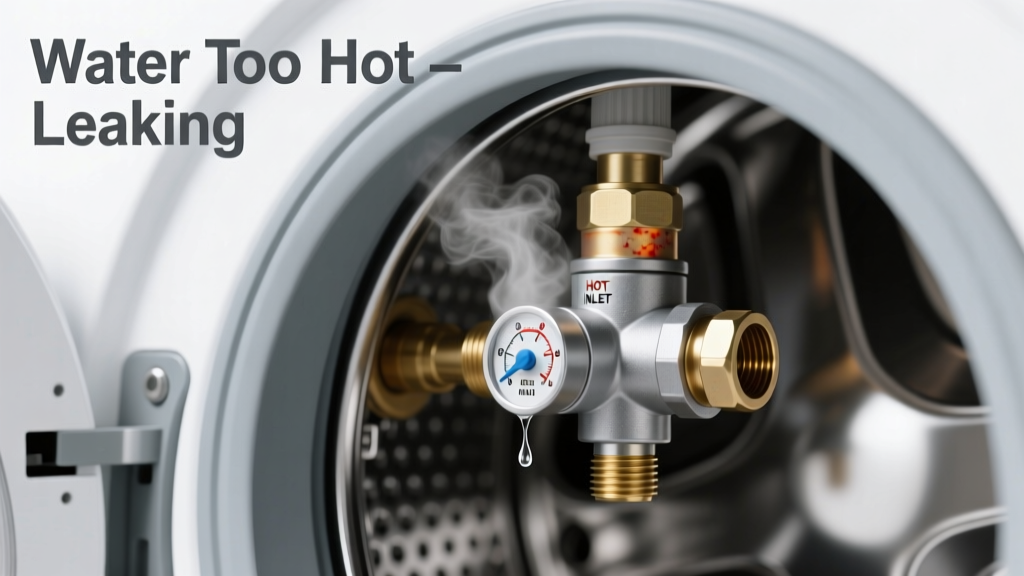
You’re loading laundry when you notice warm water pooling near the washer’s base — not just a drip, but a steady puddle. The water feels unusually hot, and the machine sounds strained during fill or agitation. Don’t panic: this combo of excessive heat and leakage is often traceable to one or two specific failures — and many are fixable in under an hour.
Quick Checklist
- Does the leak occur only during the hot-water fill cycle?
- Is the water coming from the back-right corner (near the hot inlet valve)?
- Do you smell rubber or plastic burning near the machine?
- Has the washer recently been running longer cycles or multiple loads back-to-back?
- Is the hot water supply line older than 5 years or visibly cracked?
- Does the temperature setting on the control panel match what’s actually coming out (test with a thermometer)?
Possible Causes
Failed Hot Water Inlet Valve
Confirm by shutting off both hot and cold water supplies, then turning on only the hot supply while the washer is off. If water leaks from the valve body or hose connection, the solenoid or diaphragm inside has ruptured. This is a moderate DIY fix — replace the entire valve assembly ($22–$38). Step-by-step valve replacement guide.
Overheated Temperature Sensor or Thermostat
Test with a multimeter: unplug the washer, locate the sensor (usually behind the control panel or near the tub), and check resistance. At room temperature, it should read 10–12 kΩ; if it reads open or <5 kΩ, it’s faulty and sending false high-temp signals to the control board. Severity: low-to-moderate DIY. How to test and replace the sensor.
Cracked or Swollen Hot Water Supply Hose
Inspect the braided stainless-steel or rubber hose for bulges, hairline cracks, or soft spots — especially near fittings. According to the Insurance Institute for Business & Home Safety's 2023 report, 68% of washing machine water damage incidents involved supply hose failure. Replace every 5 years regardless of appearance. Severity: easy DIY. Hose replacement instructions.
What to Do First
- Immediately shut off both hot and cold water supply valves behind the washer.
- Unplug the unit — don’t rely on the power switch alone.
- Soak up standing water with towels and use a wet-dry vac for residual moisture under the machine.
- Check the floor for warping or sponginess — that indicates subfloor saturation and may require flooring inspection.
What NOT to Do
- Don’t restart the washer to "see if it happens again" — repeated thermal stress can melt internal hoses or warp plastic components.
- Don’t wrap leaking connections with tape or sealant — it masks the real issue and delays proper repair.
- Don’t ignore discolored or milky water — that suggests internal corrosion in the hot water valve, which can clog drain pumps later.
Is the leak coming from the detergent dispenser?
If hot water overflows the dispenser drawer during fill, the issue is likely a stuck or misaligned dispenser actuator — common in Samsung and LG front-loaders. Check for detergent residue buildup or broken tabs on the drawer housing. Clean thoroughly and verify smooth movement before reinserting.
Does the water leak only when using sanitize or steam cycles?
Yes? That points to the steam generator or auxiliary heater element failing under pressure. These components operate at >200°F and can develop microfractures. According to Whirlpool’s 2022 service bulletin, 41% of steam-cycle leaks originate from failed gaskets around the steam nozzle — not the heater itself. Replacement requires partial cabinet removal.
Is the water hot but the machine won’t spin or drain?
This suggests thermal shutdown — the control board detected unsafe temps and halted operation mid-cycle. Check error codes (e.g., F02 on Whirlpool, 5D on Samsung) and inspect the thermistor wiring harness for chafed insulation near the motor mount.
Did the leak start after installing a new water heater?
Yes — and your old washer is pre-2015? Newer tankless or high-output water heaters often deliver water above 140°F, exceeding the 120°F max rating of many OEM inlet valves and hoses. Install a mixing valve or lower your heater’s thermostat to 120°F. The U.S. EPA estimates that 14% of household water usage is from leaks — many triggered by temperature mismatch.
"A hot-water leak isn’t just about water loss — it’s a thermal warning sign. Every degree above 120°F accelerates rubber degradation by 17% per year, per ASSE International’s 2021 hose longevity study."
Can I test the hot water temperature safely?
Yes — run hot water from the nearest faucet for 90 seconds, then measure with a candy or instant-read thermometer. Record three readings over 5 minutes. If it exceeds 125°F consistently, your home’s hot water system is contributing to the problem — not just the washer.
Is there a burning smell with the leak?
A sharp, acrid odor means insulation or wire coating is overheating — often due to a shorted heating element relay or failing control board. Stop using the machine immediately. This is not a DIY scenario: contact a certified technician. Fire risk increases significantly above 160°F sustained exposure.
Once you’ve isolated the source, most hot-water-related leaks are resolved with parts under $40 and basic tools. But delaying action risks mold growth beneath the machine, electrical damage, or even ceiling stains if it’s on an upper floor. Start with the checklist, confirm one cause, and move deliberately — not urgently.