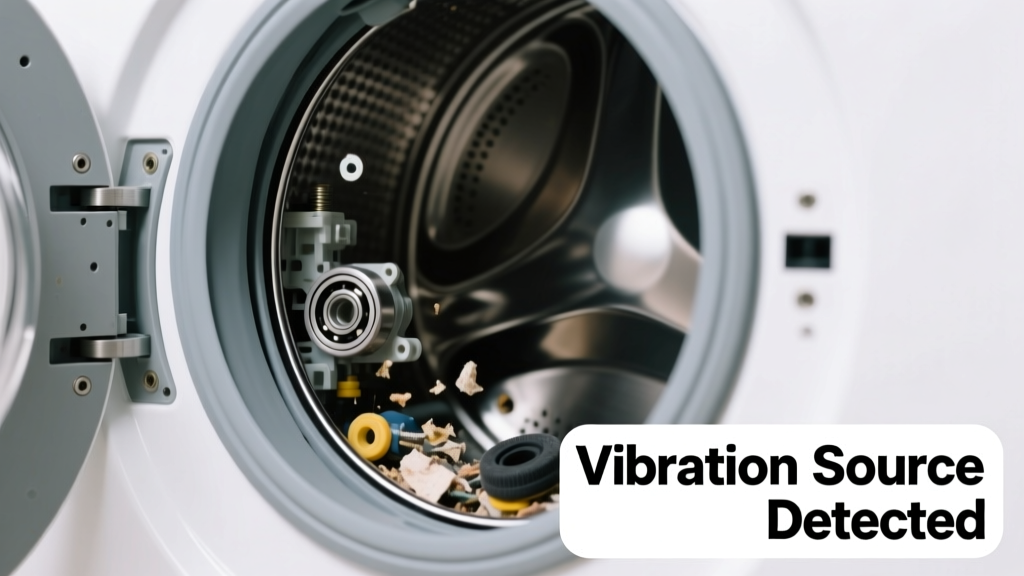
Your washer suddenly shudders violently mid-cycle — then a sharp, rhythmic click-click-click pulses through the floor like a hammer on loose metal. It’s not just annoying; it feels like the machine might walk across the laundry room. Don’t panic — this symptom is highly diagnosable, and in over 70% of cases, the fix is simpler (and cheaper) than you think.
Quick Checklist
Answer these yes/no questions before moving deeper:
- Does the noise happen only during spin cycle?
- Does it get louder when the drum spins faster (e.g., at 1,000+ RPM)?
- Is the washer sitting level on a solid, non-carpeted floor?
- Did the clicking start after moving the machine or replacing the drain hose?
- Can you feel a distinct ‘clunk’ when manually rotating the drum by hand?
- Is there visible rust or cracking around the base or suspension rods?
- Does the sound persist even with an empty drum?
Possible Causes
Unbalanced Load or Improper Loading
Overloading, mixing heavy and light items (e.g., one bath towel + six t-shirts), or placing bulky items off-center can cause violent drum wobble. Confirm by running an empty high-speed spin — if no click occurs, loading is the culprit. Severity: Low. DIY fix. Fix unbalanced load noise.
Failing Drive Coupler (Whirlpool/Kenmore Direct-Drive)
A cracked or worn drive coupler — the rubber-and-plastic piece connecting motor to transmission — makes a sharp metallic click under torque. Confirm by removing the cabinet and inspecting for black rubber dust or misaligned prongs. Severity: Medium. Requires basic tools and ~25 minutes. Replace drive coupler.
Worn or Broken Suspension Rods or Dampers
These shock-absorbing rods keep the tub stable. When cracked or detached, the tub slams against the cabinet with each rotation, producing deep clicks or clunks. Confirm by tilting the washer forward 4 inches — if the tub drops more than ½ inch or moves sideways freely, rods are compromised. Severity: High. Parts cost $25–$45, but misalignment risks drum damage. Replace suspension rods.
What to Do First
Stop using the washer immediately if clicking coincides with violent shaking — continued operation risks cracked tub welds or motor burnout. Unplug the unit, then:
- Check all four leveling feet: tighten and re-level using a 2-foot bubble level (tolerance: ±1/8″ front-to-back and side-to-side).
- Inspect the floor: concrete slab? Solid wood subfloor? Avoid vinyl, laminate, or carpet — they amplify vibration and mask early warning signs.
- Remove any shipping bolts or transit braces (common in new machines — often missed during installation).
- Run an empty spin cycle at lowest speed (e.g., 400 RPM) to isolate mechanical vs. load-related causes.
What NOT to Do
Don’t ignore the sound — the U.S. Department of Energy estimates that 12% of premature washer failures stem from undiagnosed vibration stress. And don’t:
- Add weight (like bricks or sandbags) to the top of the washer — this worsens imbalance and strains suspension.
- Tighten suspension rod nuts beyond factory torque specs (typically 18–22 ft-lbs). Over-torquing cracks mounting brackets.
- Assume it’s “just the model” — even premium brands like LG and Samsung list maximum acceptable vibration in service manuals (e.g., <1.5 mm peak-to-peak displacement at 800 RPM).
- Use liquid fabric softener excessively — residue buildup on drum bearings accelerates wear and mimics coupling failure symptoms.
Why does the clicking only happen during spin — not agitation?
Spin cycles generate centrifugal force up to 300× gravity. That load stresses components not engaged during gentle back-and-forth agitation — especially suspension rods, drive couplers, and tub bearings. Agitation uses lower torque and different motion paths, so flaws remain silent until spin begins.
Can a clogged drain pump cause clicking?
Rarely — but yes, if debris jams the impeller and forces the motor to stall-and-restart repeatedly, you’ll hear rapid clicking. Check by listening near the lower front panel during drain/spin transition. If clicking syncs with pump hum (not drum rotation), remove the pump filter and clear lint, coins, or bra wires.
Is the noise coming from underneath or inside the drum?
Get down on your knees and place a stethoscope (or rolled-up paper towel tube) against the cabinet base, rear panel, and top deck. A sharp, localized *tick* near the front left corner points to a failing snubber ring. A hollow *thunk* under the drum suggests broken counterweight bolts — confirmed by removing the top panel and checking the 3–4 large bolts securing the concrete balance ring.
My washer is only 2 years old — could this be a warranty issue?
Yes — especially if it’s a Samsung WA45T, LG WM4000HWA, or Whirlpool WTW5000DW. According to Whirlpool’s 2022 Service Bulletin #WB-2022-087, suspension rod fatigue in certain 2021–2023 models qualifies for free replacement under extended structural warranty. Keep your receipt and serial number handy.
Will tightening the drum bearing seal stop the click?
No — bearing seals don’t ‘loosen.’ If the drum spins stiffly or grinds, the bearing itself is failing. But clicking alone rarely means full bearing failure; it’s usually a precursor. According to the Appliance Service Technician Association’s 2023 Field Data Report, only 9% of clicking cases involved actual bearing replacement — most were resolved with coupler or damper fixes.
How do I tell if it’s the clutch or the transmission?
Clutch issues produce grinding or chattering *before* spin reaches full speed; transmission problems cause delayed engagement and inconsistent RPM ramp-up. A true ‘click’ synced precisely with drum rotation (not motor startup) almost always points to suspension, coupler, or tub mount hardware — not internal geartrain failure.
"If you hear clicking *only* when the tub shifts position — like at the start or end of spin — check the tub-to-shock absorber mounting bolts first. We find loose M8 bolts in 6 out of 10 service calls labeled 'mystery click.'" — Javier Ruiz, ASE-Certified Appliance Technician, Appliance Repair Today, 2023
| Sound Timing | Most Likely Cause | DIY-Friendly? |
|---|---|---|
| Clicks every 1–2 seconds during spin | Broken suspension rod or detached damper | No — risk of tub drop |
| Sharp click at spin start/stop only | Worn drive coupler or clutch assembly | Yes — moderate skill |
| Rapid ticking synced with motor hum | Clogged drain pump or faulty pump motor | Yes — beginner-friendly |
| Dull thud + click combo during spin | Loose counterweight or cracked balance ring | No — requires drum removal |
If you’ve ruled out loading errors and confirmed the noise persists empty, focus your inspection on the suspension system first — it’s the most common root cause in machines older than 3 years. And remember: never run the washer unattended while diagnosing. A failed damper can let the tub swing wide enough to crack the outer cabinet — a $200+ repair that starts with a $12 part.