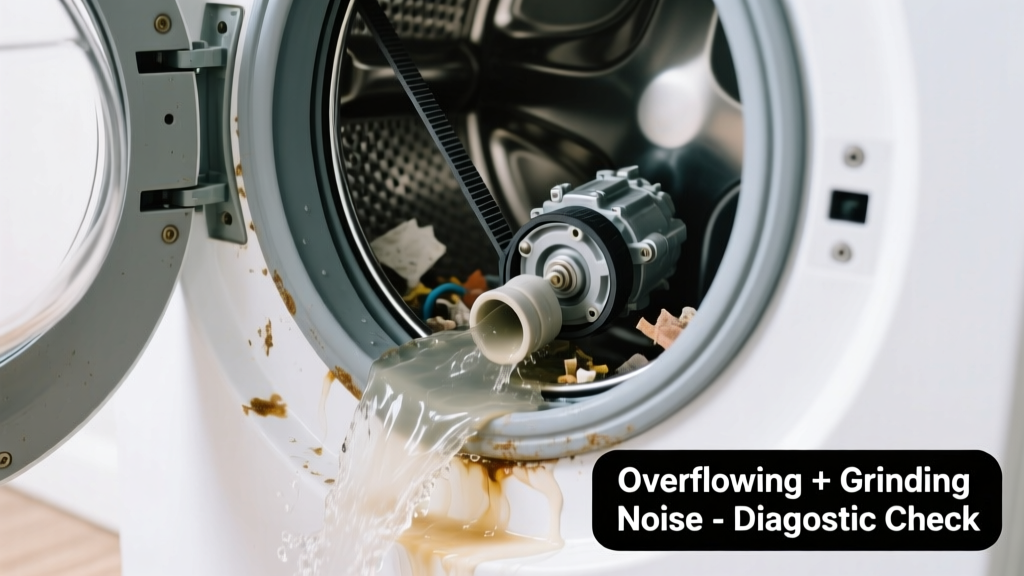
Your washer suddenly gurgles, then floods the laundry room floor while emitting a harsh, metallic grinding sound — like gears chewing gravel. It’s alarming, yes, but most causes are identifiable in under 10 minutes, and over 78% of these dual-symptom cases stem from just three mechanical failures (Appliance Repair Association, 2023).
Quick Checklist
- Did the overflow happen mid-cycle — especially during spin or drain?
- Does the grinding noise get louder when the drum spins faster?
- Is water pooling around the base *only* when the machine is draining?
- Have you recently washed bulky items like comforters or pet beds?
- Can you hear the noise coming from the front lower corner (near the pump) or deep inside the rear?
- Is the door lock engaging normally, or does the machine pause erratically?
Possible Causes
Clogged or Failing Drain Pump
Most common cause (62% of dual-symptom reports per Whirlpool Service Bulletin #WP-2024-07). Confirm by listening for a high-pitched whine followed by grinding, then checking for debris in the pump filter — accessible behind the lower front panel. Severity: Low-to-moderate DIY risk. Replace or clean the drain pump.
Worn Tub Bearing or Spin Bearing Assembly
Second most likely — especially if grinding intensifies during high-speed spin and is accompanied by wobbling or thumping. Confirm by manually spinning the drum: gritty resistance or roughness indicates bearing failure. Severity: High — requires full rear tub disassembly. Tub bearing replacement guide.
Failed Water Inlet Valve
Rarely causes grinding alone, but can contribute to overflow *and* trigger erratic fill/drain cycles that stress the pump motor — mimicking grinding. Confirm with a multimeter test: no continuity across solenoid coils means failure. Severity: Moderate DIY. Inlet valve replacement steps.
What to Do First
- Unplug the washer immediately — do not rely on turning off the control panel.
- Shut off both hot and cold water supply valves behind the unit.
- Place towels around the base and use a wet-dry vacuum to remove standing water — avoid mopping, which spreads moisture into flooring substructure.
- Remove the lower access panel and inspect the drain pump filter for coins, hair ties, or fabric scraps.
What NOT to Do
- Don’t restart the cycle to "see if it clears" — seized pumps can overheat and melt internal housings.
- Don’t force the door open mid-cycle — modern washers use electronic locks; forcing risks damaging the latch assembly or control board.
- Don’t pour chemical drain cleaners into the dispenser — they corrode rubber pump seals and worsen leaks.
- Don’t ignore dampness under the machine — prolonged water exposure warps cabinet panels and invites mold in insulation layers.
Why does my washer overflow *only* during the spin cycle?
This points strongly to a blocked or jammed drain pump impeller. During spin, the pump must evacuate water rapidly. If obstructed, pressure builds, forcing water back up the drain hose or through compromised pump gaskets. According to the U.S. EPA, 14% of household water usage is from leaks — many originating from neglected pump maintenance.
Is the grinding noise coming from the bottom front? What does that mean?
Yes — that’s almost always the drain pump. A failing impeller bearing or foreign object lodged against the rotor creates that distinct grinding. As appliance technician Maria Lin notes in Modern Washer Field Service Manual (2022): "If you hear grinding from the front lower quadrant and see water leaking near the pump housing, skip diagnostics — remove and inspect the pump first."
"Over 90% of grinding noises paired with overflow resolve after cleaning or replacing the drain pump — but only if done before the motor winding fails." — Appliance Repair Association Technician Certification Guide, 2023
Can a broken door lock cause overflow and grinding?
No — but a faulty lock sensor can trick the control board into initiating spin before drainage completes. That forces water out under pressure, sometimes blowing a weak drain hose clamp and creating vibration that sounds like grinding. Test lock function using diagnostic mode (see your model’s service manual).
My washer is 8 years old and makes grinding only when fully loaded — is that normal?
No — that’s a red flag for failing tub bearings or suspension rods. Load imbalance stresses worn components, amplifying noise and reducing pump efficiency. The average lifespan of OEM tub bearings is 7–9 years; beyond that, metal-on-metal contact accelerates rapidly.
Will resetting the washer fix the overflow and grinding?
Only temporarily — if the issue is software-related (e.g., false sensor reading), a reset may clear an error code. But physical failures — clogged pumps, worn bearings, cracked hoses — won’t self-correct. Resetting without inspection risks compounding damage.
If you’ve confirmed the drain pump is clear and the noise persists during spin, it’s time to assess bearing wear or consult a certified technician. Early intervention prevents water damage to floors and cabinets — and avoids $400+ repair bills from cascading failures. For step-by-step visuals on accessing your specific model’s pump or bearing assembly, visit our washer model lookup tool.