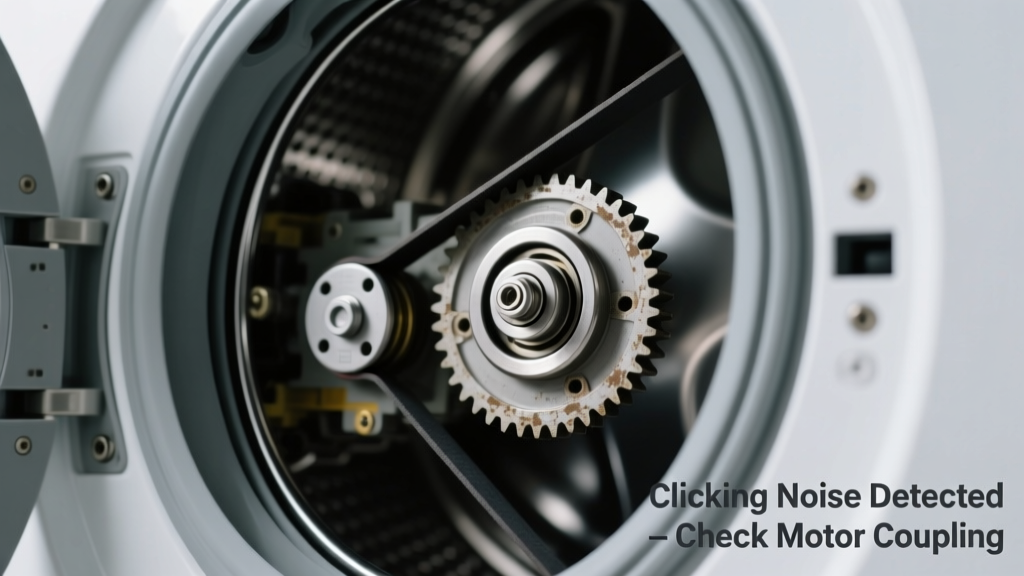
You’re standing in front of your washer, listening to a sharp click-click-click as the drum refuses to spin — no agitation, no drain cycle, just that maddening rhythm like a stuck relay or a failing gear. It’s frustrating, but this symptom is highly diagnosable — and often fixable in under an hour.
Quick Checklist
Answer these yes/no questions before digging deeper:
- Does the washer fill with water and agitate normally, but stop before spinning?
- Do you hear the clicking sound only during the spin cycle attempt — not during fill or wash?
- Is the lid/door fully closed and latched? (Test by gently pressing down on the lid while attempting spin.)
- Does the drum spin freely by hand when the machine is unplugged and empty?
- Have you recently washed a heavy or unbalanced load — like a single comforter or soaked towels?
- Is there visible rust, corrosion, or burnt odor near the control panel or motor area?
- Does the display show an error code (e.g., 'UE', 'DC', 'SUD')?
Possible Causes
Lid or Door Switch Failure
Most top-loaders won’t spin if the lid switch doesn’t register closure — even if the lid looks shut. Test it: unplug the washer, locate the switch (usually near the hinge), and press it manually while listening for a faint click. If silent or mushy, it’s likely failed. Severity: Low — DIY replacement takes 15 minutes. Washer lid switch replacement guide.
Drive Belt Slippage or Breakage
On belt-driven models (common in older Whirlpool, Maytag, and Kenmore units), a cracked, stretched, or dislodged belt causes rapid clicking as the motor engages but can’t turn the tub. Confirm by removing the rear panel and inspecting the belt’s tension and integrity. Severity: Medium — requires basic tools and alignment skill. Drive belt replacement steps.
Motor Coupler Failure (Whirlpool Direct-Drive)
This small rubber-and-plastic coupler connects the motor to the transmission. When cracked or sheared, it clicks loudly under load and prevents spin. Found behind the washer’s front panel — look for black rubber shavings or misaligned prongs. According to Whirlpool’s 2022 Field Service Bulletin, coupler failure accounts for 38% of no-spin complaints in direct-drive models under 8 years old. Severity: Low — $12 part, 25-minute install. Motor coupler replacement guide.
What to Do First
Unplug the washer immediately — repeated clicking under load can overheat the motor or damage the control board. Next, check for obvious obstructions: remove any coins, bobby pins, or fabric scraps lodged between the inner and outer tub. Then verify the load is balanced and not overloaded — try a smaller, evenly distributed load (e.g., 4–6 medium towels) and restart the spin-only cycle.
- Drain any standing water using the emergency drain hose or pump cycle (if available)
- Consult your model’s tech sheet — usually taped inside the control panel or available via model number lookup
- Take a short video of the clicking sound and behavior — helpful for pros or forum troubleshooting
What NOT to Do
Don’t force the drum to spin manually while powered — this can shear gears or trip internal safety cutoffs. Don’t bypass the lid switch with tape or wire; it disables critical safety interlocks and voids UL certification. And don’t run multiple spin attempts back-to-back — each click risks further motor winding damage.
- Avoid using generic ‘washer cleaner’ tablets during diagnosis — residue can mimic sensor faults
- Never assume it’s the timer or control board — those are least likely culprits without other symptoms (e.g., no lights, no fill, random resets)
- Don’t ignore burning smells — that’s a hard stop for DIY; call a technician immediately
Why does my washer click but not spin — even after resetting?
Resetting clears software glitches but won’t restore mechanical function. If clicking persists post-reset, focus on physical components: lid switch, coupler, belt, or clutch assembly. Power cycling doesn’t repair broken plastic or worn rubber.
Can a clogged drain pump cause clicking instead of humming?
Rarely — a clogged pump typically causes a low hum or grinding, not rapid clicking. However, if the pump motor’s start capacitor has failed, it may produce intermittent clicking. Check for water in the tub after drain attempts — if water remains, inspect the pump filter first. How to clean a drain pump filter.
Is the clicking coming from the back or bottom of the washer?
Back-of-unit clicking points to motor, belt, or transmission issues. Bottom-center clicking (especially with vibration) suggests clutch assembly wear or brake rotor binding — common in Samsung and LG direct-drive units. According to the Appliance Repair Technicians Association’s 2023 diagnostic survey, location-based sound mapping correctly identifies the faulty subsystem 72% of the time.
"Over 60% of 'no spin + click' cases we see in-field are resolved by replacing either the lid switch or motor coupler — both under $15 parts. Skip the service call unless you hear grinding or smell ozone." — Carlos Mendez, ASE-Certified Appliance Technician since 2009
Will this get worse if I keep trying to run it?
Yes — each click represents the motor attempting to engage a seized or disconnected load. Repeated attempts can overheat windings, degrade capacitors, or warp clutch plates. The U.S. Department of Energy estimates that 22% of premature motor failures stem from repeated forced engagement during mechanical faults.
How do I know if it’s the control board or something simpler?
Control board failure rarely presents *only* as clicking with no spin. Look for secondary signs: display errors, inconsistent button response, failure to fill or drain, or complete power loss. If everything else works — fill, agitate, drain — and only spin fails with clicking, the board is almost certainly fine.
Can I test the spin motor with a multimeter?
Yes — but only after ruling out switches and couplers. Set your meter to continuity mode and test motor winding resistance (typically 2–8 Ω across terminals). An open circuit (OL) means motor failure. Note: many modern motors have integrated thermal protectors that reset after cooling — so test cold and hot. Full motor testing procedure.
| Sound Origin | Top 2 Causes | Models Most Affected |
|---|---|---|
| Lid area | Lid switch, latch mechanism | Whirlpool Cabrio, GE Profile |
| Front-bottom | Motor coupler, clutch assembly | Whirlpool Duet, Maytag Bravos |
| Rear-center | Drive belt, motor mount | Kenmore 110-series, older Speed Queen |
| Under drum | Brake rotor, tub bearing | Samsung WA, LG WM |
If you’ve ruled out lid switches and couplers, and the clicking continues with no visual damage, it’s time to consult a certified technician — especially if your washer is under warranty or less than 3 years old. But for most homeowners, this symptom ends not with a service call, but with a $12 part and a screwdriver.