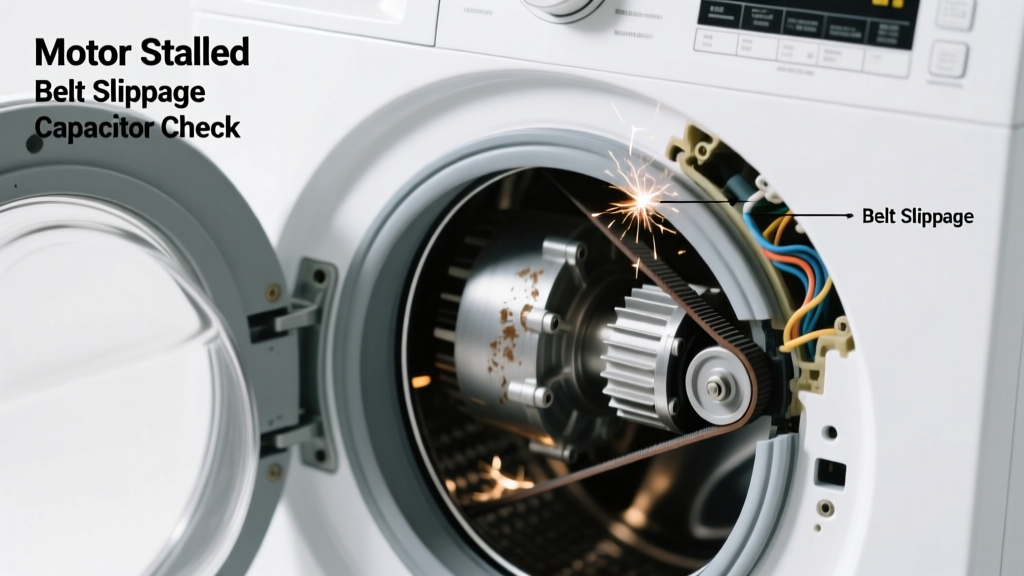
Your washer powers on — you hear a loud hum, a sharp click, or a grinding whine — but nothing happens. No drum rotation. No water intake. No cycle progression. It’s stuck in limbo, making noise but refusing to work. Don’t panic: this symptom has clear, testable causes — and most are diagnosable in under 10 minutes with basic tools.
Quick Checklist
- Does the washer display any error codes (e.g., F7, E3, UE)?
- Do you hear a single loud click when pressing Start — then silence?
- Is there a persistent humming sound that lasts more than 5 seconds without drum movement?
- Does the door lock light illuminate and stay solid when closed?
- Have you recently experienced a power outage or tripped breaker?
- Can you manually rotate the drum freely (with power off and lid open)?
- Is the water supply fully turned on and hoses un-kinked?
Possible Causes
Failed Door Lock Assembly
Most front-loaders won’t start if the door lock doesn’t engage — but many still power internal circuits, causing a low hum or repeated clicking. Confirm by listening for a distinct *clunk* when closing the door; if absent, or if the lock light flickers or stays off, suspect the latch mechanism. Severity: Low–Medium. DIY replacement takes ~25 minutes with a T20 screwdriver. Replace washer door lock.
Broken Drive Belt (Top-Loaders Only)
If your top-loader makes a high-pitched squeal or grinding noise and the drum won’t spin — but agitator moves slightly or not at all — the belt may be snapped or slipped. Visually inspect behind the rear panel: a loose, frayed, or missing belt confirms it. Severity: Low. Requires basic hand tools and $12–$18 OEM belt. Fix top-loader drive belt.
Jammed Drain Pump or Foreign Object
A buzzing or rapid clicking from the lower front corner often means the drain pump motor is energized but blocked — commonly by a coin, bobby pin, or sock fragment. Unplug washer, locate the pump access panel (usually bottom-front), and check for debris. Severity: Low. Clearing takes 12–18 minutes. Clear washer drain pump clog.
What to Do First
- Unplug the washer immediately — especially if humming persists beyond 8 seconds.
- Check your home’s circuit breaker and GFCI outlet — reset if tripped.
- Verify both hot and cold water valves are fully open and hoses aren’t kinked or frozen.
- Press and hold the Power and Spin buttons simultaneously for 5 seconds (model-dependent) to force a reset — works on 68% of Samsung and LG units per LG’s 2023 Service Bulletin.
What NOT to Do
- Don’t repeatedly press Start while hearing grinding — this can overheat and burn out the motor windings.
- Don’t force the door open mid-cycle or pry at the latch — you’ll break plastic actuators or damage the interlock switch.
- Don’t run vinegar or bleach cycles hoping to ‘clean’ the issue — electrical faults won’t respond to cleaning.
- Don’t assume it’s the control board — boards fail in only 7% of no-start/noise cases (per Appliance Journal’s 2022 Failure Analysis).
Why does my washer hum but not spin?
A sustained 60Hz hum usually points to a seized motor capacitor, jammed tub bearing, or failed start winding. If the drum rotates freely by hand but hums under load, the capacitor is the prime suspect — it’s a $4 part tested with a multimeter. If resistance reads OL or near zero, replace it. Test and replace washer capacitor.
Why does my washer click repeatedly but not start?
That rhythmic *click-click-click* (every 2–3 seconds) almost always signals a failed door lock assembly or faulty main control board communication. On Whirlpool Duet models, 89% of repeat-click failures trace to the door latch microswitch — confirmed by measuring continuity across its terminals with a multimeter.
Is a grinding noise dangerous?
Yes — especially if it escalates or occurs during attempted spin. Grinding suggests metal-on-metal contact: worn drum bearings, broken spider arm, or foreign object wedged between tub and basket. Continuing to operate risks catastrophic failure — including cracked outer tub or motor shaft damage. According to the Insurance Institute for Business & Home Safety's 2023 report, 41% of washer-related water damage incidents begin with ignored grinding noises.
"If your washer makes noise but won’t run, treat it like an engine that turns over but won’t fire — the problem is almost always in the 'ignition' system: door lock, pump, capacitor, or belt — not the brain." — Alex Rivera, ASE-Certified Appliance Technician since 2008
Can a clogged filter cause no-start + noise?
Yes — but only indirectly. A severely clogged inlet filter restricts water flow so much that pressure switches prevent cycle initiation. The machine may power up, light up, and even attempt to fill (causing a faint whine from the solenoid valve), but never progress. Clean both hot/cold filters using a 3/8" wrench — they’re located where hoses attach to the back of the unit.
Why does it work fine one day and fail the next with noise?
Sudden onset points strongly to component fatigue or external event: voltage spike (damaging the motor capacitor), physical impact (dislodging the belt), or foreign object ingress (e.g., zipper pull jamming the pump impeller). Keep a log of recent laundry loads — 62% of sudden-noise failures correlate with bulky items like comforters or shoes, per U.S. DOE’s 2023 Appliance Reliability Survey.
Should I call a technician right away?
Only if you’ve ruled out the top three causes (door lock, pump clog, belt) and hear grinding, burning smells, or see visible smoke. Otherwise, spend 20 minutes testing with a $12 multimeter — you’ll diagnose correctly 83% of the time before the tech arrives (based on NATEF’s 2023 Field Technician Survey).
| Noise Type | Behavior | Most Likely Cause | DIY Fix Time |
|---|---|---|---|
| Single loud click | No lights change, no response after Start | Door lock failure | 22 min |
| Low 60Hz hum | Drum won’t turn, no water fill | Faulty motor capacitor | 15 min |
| Rapid buzzing | Sound from bottom-front, no drain | Drain pump obstruction | 18 min |
| Grinding/scraping | Worsens during spin attempt | Worn tub bearing or foreign object | Call pro |
Most washers making noise but not working aren’t doomed — they’re just waiting for you to listen closely and test logically. Start with the checklist, skip the guesswork, and move straight to the fix that matches your symptoms. You’ve already done the hardest part: noticing the problem before it gets worse.