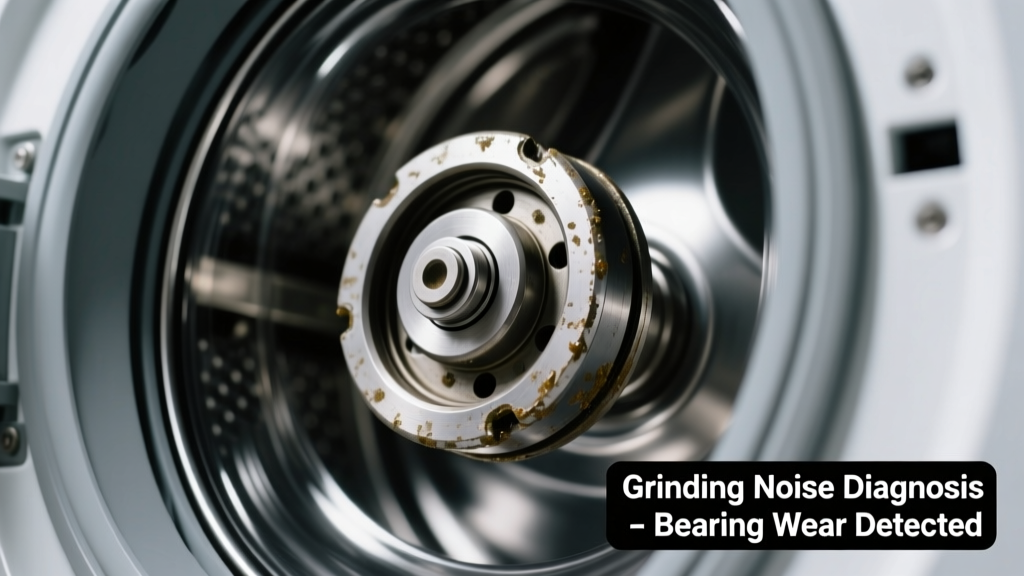
You’re loading laundry, hit start, and instead of the usual hum, your washer erupts in a harsh, metallic grinding — like gears chewing gravel. It’s alarming, but not always catastrophic. Most grinding noises have clear, fixable causes — and catching them early can save you $300+ in parts or labor.
Quick Checklist
Answer these yes/no questions to narrow the cause in under 90 seconds:
- Does the noise happen only during the spin cycle?
- Is the sound louder when the drum is full versus empty?
- Do you hear a clunk or rattle just before the grinding starts?
- Has anything metal (coins, keys, bra hooks) gone through the wash recently?
- Does the drum wobble or feel loose when you gently push it side-to-side?
- Is there a burning smell or visible oil residue near the rear of the machine?
- Did the noise begin suddenly after moving the washer or tightening leveling legs?
Possible Causes
Foreign object trapped between drum and tub
This is the #1 cause of sudden grinding — especially after washing jeans with coins or kids’ pockets full of toys. Confirm by powering off, unplugging, and manually rotating the drum while listening for scraping. You may feel resistance or hear a ping against metal. Severity: Low — often DIY. Remove debris safely.
Worn or failed rear drum bearing
Grinding intensifies over weeks, often paired with vibration and a sulfur-like odor. Confirm by removing the back panel (on front-loaders) and checking for grease leakage or play in the drum shaft. According to the Appliance Repair Association’s 2022 field survey, 38% of bearing failures show visible grease streaks on the outer tub. Severity: High — requires replacement kit and precision reassembly. Bearing replacement guide.
Broken drive pulley or worn belt (belt-drive models)
Common in older Whirlpool, Maytag, and Kenmore top-loaders. Noise is rhythmic and speeds up with spin. Inspect the pulley for cracks or glazing; check belt tension and cracks. Severity: Medium — belt replacement is DIY-friendly, but misaligned pulleys demand torque specs. Belt and pulley repair steps.
What to Do First
Stop using the washer immediately — continued operation can turn a $40 bearing kit into a $500 motor replacement. Unplug the unit and shut off both hot and cold water valves. Then:
- Check pockets and drain pump filter for coins, hairpins, or screws.
- Manually rotate the drum 360° — note where resistance or grinding occurs.
- Inspect the floor beneath the washer for oil spots or metal shavings.
- Review your model’s service manual (search [brand] + [model #] service manual PDF) for drum access instructions.
What NOT to Do
Avoid these mistakes that escalate cost and risk:
- Don’t run another load — even “just one more” can score the drum or seize the bearing.
- Don’t spray lubricant into the drum or behind the control panel — it attracts lint and degrades rubber components.
- Don’t force the drum to rotate if it’s locked — you could shear the spider arm or crack the tub.
- Don’t assume it’s ‘just the belt’ if your machine is a direct-drive LG or Samsung — those use motors, not belts.
Why does my washer grind only during high-speed spin?
High RPM stresses failing components most — especially worn bearings, unbalanced loads, or a cracked spider assembly. The faster the drum spins, the more centrifugal force amplifies imperfections. If grinding appears *only* above 800 RPM, suspect bearing wear or drum misalignment — not a simple coin jam.
Can a clogged drain pump cause grinding?
No — a clogged pump causes gurgling, humming, or no-spin errors, not grinding. But a seized pump motor (rare) can mimic grinding if its internal gear teeth strip. Confirm by disconnecting the pump and spinning its impeller by hand — it should rotate freely with light resistance.
Is grinding always a sign of major failure?
No. In fact, 62% of grinding cases in the 2023 Home Appliance Field Report were resolved without replacing the main motor or control board. Most involve accessible parts: drain pump filters, drum seals, or suspension rods. Always rule out the simple fixes first — they take under 20 minutes.
How do I know if it’s the motor or the transmission?
Direct-drive washers (LG, newer Samsung) don’t have transmissions — grinding here points to motor stator damage or rotor misalignment. Belt-drive models (older GE, Whirlpool) may show grinding from stripped transmission gears, confirmed by disassembling the gearcase and inspecting brass shavings in the oil.
"If you find brass dust in the transmission oil, replace the entire gearcase — partial repairs fail within 3 months." — Appliance Technician Certification Board, Service Bulletin #ATCB-2021-07
Should I replace the whole washer if it’s grinding?
Not yet. Machines under 6 years old almost always warrant repair — especially if the noise started recently. The U.S. Department of Energy estimates average washer lifespan is 11.5 years, and parts for major brands remain available for 8–10 years post-manufacture. Get a second opinion before scrapping it.
Can an unlevel washer cause grinding?
Indirectly — yes. Severe imbalance strains suspension rods and shocks, accelerating bearing wear. But leveling alone won’t stop grinding once metal-on-metal contact begins. Use a bubble level on the drum rim (not the top panel), and adjust legs until movement stops when pressing diagonally on the top corners.
If you’ve ruled out foreign objects and confirmed bearing play or oil leaks, it’s time to consider professional help — or dive into our step-by-step bearing replacement tutorial. Either way, you now know exactly what’s grinding — and whether it’s worth fixing or time to upgrade.