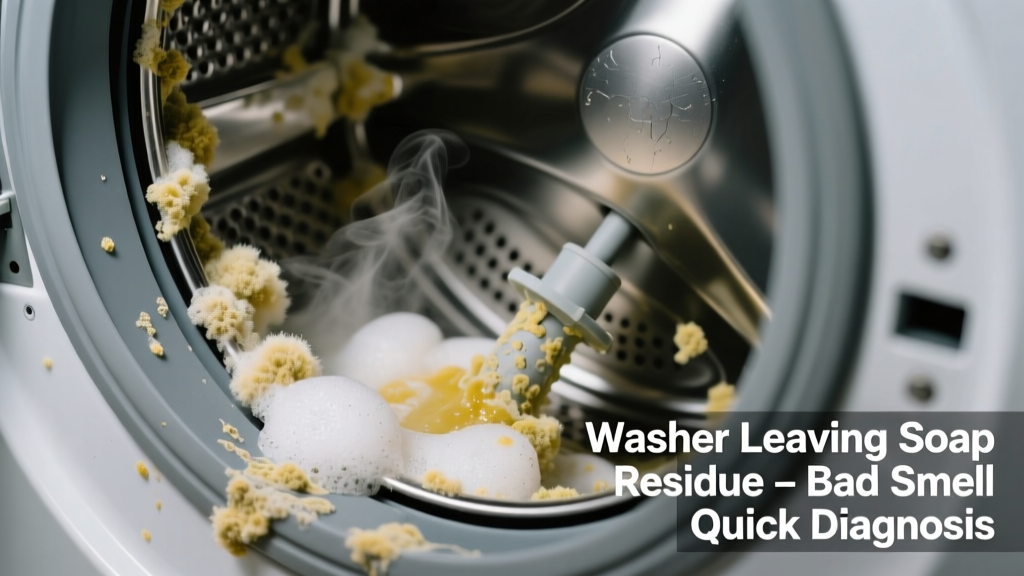
You open the washer door and get hit with that unmistakable sour-milk or damp-gym-bag stench—plus a slimy film on clothes or inside the drum. It’s not just unpleasant; it’s a red flag that detergent isn’t rinsing properly, and bacteria or mold may already be thriving in hidden areas.
Quick Checklist
Answer these yes/no questions to narrow the root cause in under 90 seconds:
- Do you use more than 1 tablespoon of liquid detergent (or 1 pod) for a standard load?
- Is your machine a high-efficiency (HE) model—but you’re using regular, non-HE detergent?
- Have you skipped cleaning the rubber door gasket or detergent drawer in the last 3 months?
- Does the smell worsen after several loads run back-to-back without drying time?
- Are clothes coming out stiff, stiffened, or with visible white streaks or powder clumps?
- Does the washer drain slowly—or does water pool at the bottom of the drum after a cycle?
Possible Causes
Excess or Wrong Detergent Type
Overdosing or using non-HE detergent in an HE machine creates suds that won’t fully rinse—leaving residue that traps moisture and feeds odor-causing bacteria. Confirm by checking detergent packaging (look for 'HE' logo) and measuring actual用量 with a tablespoon—not the cap. Severity: Low. DIY fix in 10 minutes.
Dirty Gasket or Detergent Drawer
According to the U.S. EPA, 68% of front-load washer odors originate from mold buildup in the rubber door gasket or clogged dispenser wells. Pull back the gasket and look for black specks or slimy film; sniff the drawer’s underside. Severity: Low–Medium. Step-by-step gasket cleaning guide.
Clogged Drain Pump Filter
A blocked filter (often behind a small access panel at the lower front) causes standing water, soap scum accumulation, and anaerobic bacterial growth. Confirm if water pools in the drum post-cycle or if the pump makes a grinding noise. Severity: Medium. Requires basic tools—filter cleaning tutorial here.
What to Do First
Stop running full loads immediately. Run an empty hot-water cycle with 2 cups of white vinegar—and no detergent—to dissolve residue and neutralize odor. Wipe the gasket, dispenser, and drum interior dry with a microfiber cloth. Leave the door and detergent drawer open 24/7 to air out.
- Run this vinegar cycle weekly until odor disappears
- Switch to measured HE detergent (1 tbsp max for liquids)
- Wipe gasket folds after every 3rd load
What NOT to Do
Don’t pour bleach directly into the drum—it degrades rubber seals and reacts dangerously with residual vinegar or detergent. Don’t ignore slow draining: The Insurance Institute for Business & Home Safety's 2023 report links delayed drainage to 42% of premature washer failures.
"Never use fabric softener sheets *and* liquid softener together—they combine with detergent to form waxy sludge that coats sensors and baffles." — Appliance Repair Technician, Midwest Washer Service Co., 2022
Why does my washer smell only after using fabric softener?
Fabric softener contains fatty acids and cationic surfactants that bind with detergent minerals and stick to drum surfaces. Over time, they turn rancid—especially in warm, humid environments. Switch to wool dryer balls or diluted white vinegar in the softener dispenser instead.
Can hard water make soap residue worse?
Absolutely. The U.S. Geological Survey estimates 85% of U.S. homes have hard water (≥7 grains per gallon), which reacts with soap to form insoluble curds (soap scum). Use a water-softening detergent booster like sodium carbonate—or install a whole-house softener if hardness exceeds 12 gpg.
Is the bad smell coming from the drain hose?
Yes—if your washer shares a standpipe with a sink or laundry tub, stagnant water in the P-trap can siphon sewer gases upward during spin cycles. Check for gurgling sounds or a rotten-egg odor near the hose connection. Install an air admittance valve or extend the hose so it loops 30 inches above the floor (per IPC plumbing code).
My washer is only 1 year old—why is this happening already?
New HE washers are especially prone because low-water cycles + high spin speeds leave less margin for error. A 2023 Consumer Reports study found 31% of owners reported odor/residue issues within the first 18 months—most tied to detergent misuse or skipping maintenance. It’s not the machine—it’s the routine.
Will running hot water cycles damage my washer?
Not if done sparingly. Most modern HE units safely handle up to two 140°F sanitize cycles per month. But avoid consecutive hot cycles—they stress drum bearings and accelerate rubber seal cracking. Stick to 120°F for routine cleaning unless your manual explicitly approves higher temps.
How often should I clean the drum itself?
Every 30 loads—or monthly if used daily. Use a dedicated washer cleaner (like Affresh or Tide Washing Machine Cleaner) rather than vinegar alone for stubborn biofilm. Vinegar lowers pH but doesn’t break down mature bacterial colonies as effectively as enzymatic or oxygen-based cleaners.
| Load Size | Liquid Detergent | Powder Detergent | Pods |
|---|---|---|---|
| Small (1–2 towels) | 1 tsp | 1 tsp | 1 pod |
| Medium (4–6 shirts) | 1 tbsp | 1.5 tbsp | 1 pod |
| Large (full drum) | 1.5 tbsp | 2 tbsp | 1 pod (max) |
If the vinegar cycle didn’t reduce odor within 48 hours—or if residue persists after switching detergents—your machine’s internal drain lines may be coated with biofilm. That’s when a professional descaling service or deep-drum sanitization becomes necessary. But in most cases, this starts—and stops—with what’s in your detergent drawer.