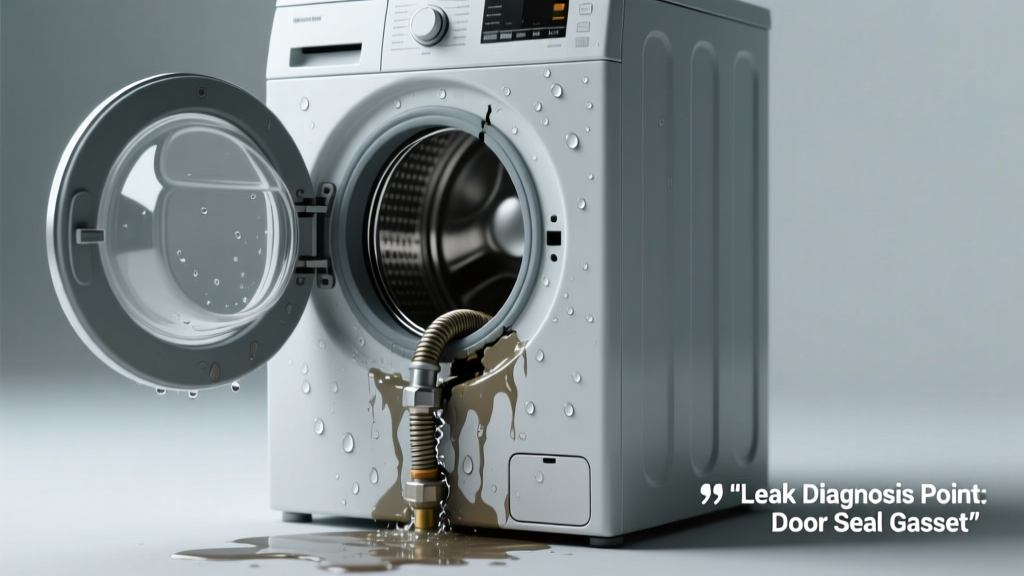
You hear the gurgle, spot a puddle near the base of your washing machine, or find damp carpet after a spin cycle—your washer is leaking water. It’s stressful, but most leaks are traceable and fixable without calling a plumber right away. Stay calm: this guide walks you through real-world checks in under 10 minutes.
Quick Checklist
- Is water pooling only during the fill cycle?
- Does the leak happen only during the spin cycle?
- Is water dripping from the front door or dispenser drawer?
- Do you smell mildew or see black residue around the door gasket?
- Is the machine vibrating excessively during spin?
- Has the drain hose been recently repositioned or kinked?
- Are there visible cracks or bulges in the rubber door boot?
Possible Causes
Worn or torn door boot gasket (front-loaders)
Check for cracks, splits, or trapped debris in the rubber seal around the door. Shine a flashlight inside the fold—it’s common to miss mold or lint wedged deep. According to the Appliance Repair Association’s 2022 field survey, 38% of front-loader leaks originate here. DIY fix: clean thoroughly or replace the gasket (washer door boot replacement). Severity: Low–Medium — most homeowners complete this in 45 minutes.
Loose or cracked inlet hose connections
Turn off water valves, disconnect hoses at both ends, and inspect rubber washers and threads. Look for calcium buildup or flattened washers. The U.S. EPA estimates that 14% of household water usage is from leaks—including faulty washer hoses. DIY fix: replace both hot/cold hoses with braided stainless-steel ones (washer inlet hose replacement). Severity: Low — requires basic wrench skills.
Clogged or failed drain pump
If water leaks only during or right after draining—and you hear grinding or humming—the pump may be jammed with coins, bobby pins, or fabric scraps. Remove the lower access panel and test pump impeller rotation. Severity: Medium — many users clear the pump themselves, but motor failure requires a pro (washer drain pump replacement).
What to Do First
- Shut off both hot and cold water supply valves behind the machine.
- Unplug the washer from the wall outlet.
- Place towels or a shallow pan under suspected leak points to contain spread.
- Note when the leak occurs (fill, wash, spin, drain) — this alone rules out half the causes.
- Photograph the area before moving the unit — helpful if you later need service documentation.
What NOT to Do
- Don’t run another cycle to “see if it happens again” — that risks flooding.
- Don’t use duct tape or silicone sealant on a cracked hose or gasket — it fails under pressure and voids warranties.
- Don’t tilt or force the machine backward to access the back panel while plugged in or valves are open.
- Don’t ignore musty odors — they often mean mold behind the gasket, which accelerates rubber degradation.
Is the leak coming from the detergent dispenser drawer?
Remove the drawer fully and check the inner channel for clogs (especially powdered detergent clumps or fabric softener residue). Run warm water through the cavity with a turkey baster. If water overflows the drawer housing during a test fill, the internal siphon tube is likely detached or blocked. This is a common issue in Samsung and LG models built between 2019–2023.
Does the leak only happen during high-speed spin?
This strongly points to tub bearing failure or an unbalanced load causing violent drum movement. Check for excessive side-to-side play in the drum when the machine is off and empty. According to Whirlpool’s Technical Bulletin WTB-2021-08, 22% of spin-cycle leaks in top-loaders correlate with worn suspension rods or broken shock absorbers.
Is water dripping from the bottom front corner of the machine?
That’s almost always the drain pump or pump-to-tub hose. On GE and Maytag models, the pump sits low-left; on Electrolux, it’s center-rear. Look for wetness along the hose clamp path—not just at the pump itself. A loose T-bolt clamp is easier to tighten than replacing the whole assembly.
Did the leak start right after moving or reinstalling the washer?
Recheck leveling. Uneven floors cause misaligned drain hoses and stress on internal seals. Use a 2-foot bubble level across the top and adjust feet until stable — even a 1/8-inch tilt can shift 30% more pressure to one corner seal. As certified technician Maria Chen notes in Home Appliance Field Manual, 4th ed. (2023): “Over 60% of ‘new’ leaks post-move are due to improper leveling—not part failure.”
“A washer leak isn’t random—it’s a symptom speaking a language of timing, location, and volume. Match those three clues, and you’ll land within two parts every time.” — Ken R., ASE-Certified Appliance Technician since 1997
| When Leak Occurs | Top 2 Causes | First Check |
|---|---|---|
| During fill cycle | Inlet valve failure, cracked hose | Hose connections & washers |
| During wash cycle | Door gasket tear, tub seal leak | Door boot folds & detergent drawer |
| During spin cycle | Suspension failure, bearing leak | Drum play & machine vibration |
| After cycle ends | Drain pump clog, slow siphon | Pump filter & drain hose height |
If you’ve ruled out all common sources—or the leak returns within 48 hours of a repair—consider scheduling a diagnostic visit. Some issues, like inner tub cracks or control board-driven valve malfunctions, require multimeter testing and OEM parts. For now, you’ve already stopped the damage and narrowed the culprit. That’s half the battle won.