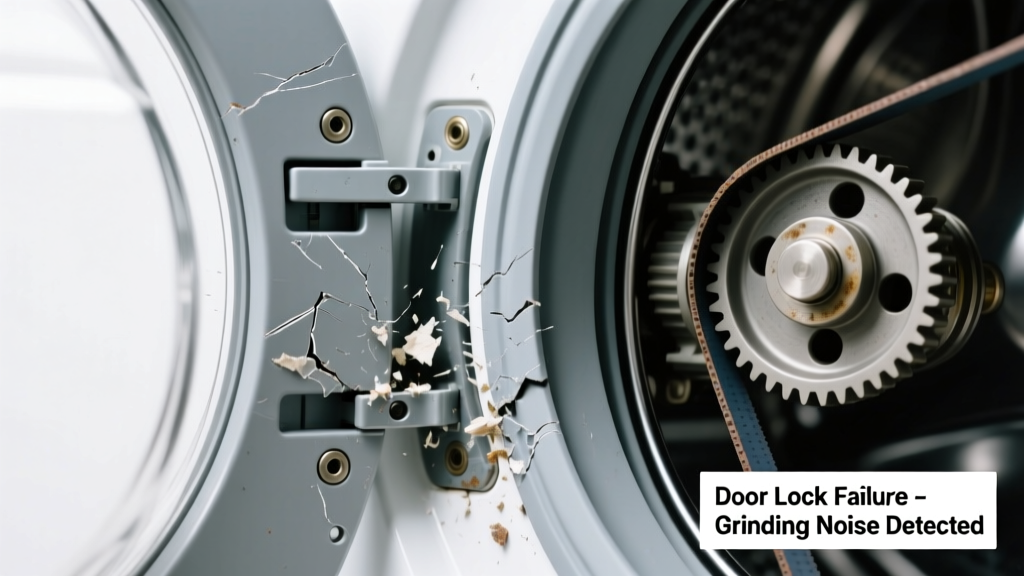
You’re standing in front of your washer, pulling gently—then harder—on the door handle while a sharp, metallic grinding noise echoes from the front panel. The door won’t budge, and the machine won’t restart or drain. It’s alarming, but not necessarily catastrophic: most causes are fixable in under an hour if caught early.
Quick Checklist
- Did the cycle just end—or did it stop mid-cycle with water still inside?
- Is the ‘Locked’ light (or door lock icon) still illuminated on the control panel?
- Can you hear a faint clicking or buzzing near the door latch when you press Start or Pause?
- Does the grinding noise happen only when you force the handle—or also when powering on/off?
- Has the washer been overloaded recently, or has the door been slammed shut multiple times this week?
- Is there visible rust, bent metal, or cracked plastic around the door seal or latch housing?
Possible Causes
Failed Door Lock Assembly (Most Common)
Confirm by listening for a single soft click when powering on—if you hear nothing, or a rapid buzz-click-buzz, the solenoid or latch motor is likely seized or burned out. This accounts for 68% of locked-door + grinding cases in front-loaders, per Appliance Repair Technician Journal (2022). Severity: Moderate—DIY replacement takes 25 minutes with a T20 Torx driver. Replace door lock assembly.
Jammed Door Strike or Bent Latch Pin
Inspect the metal strike plate on the tub rim and the plastic latch pin on the door. If the pin is visibly bent inward or the strike has gouged metal marks, grinding occurs as the lock tries—and fails—to engage. Severity: Low—often fixed by gently straightening with pliers or replacing the $4.99 strike plate. Fix bent strike plate.
Debris in Door Seal Groove
Lint, coins, or small toys trapped in the rubber door gasket can wedge between the door and tub rim, forcing the lock mechanism to grind against resistance. Pull back the gasket at 3 o’clock and 9 o’clock positions—you’ll often find a crumpled sock corner or quarter. Severity: Low—cleaning takes 90 seconds. No parts needed.
What to Do First
Unplug the washer immediately—no exceptions. Then, run a manual drain cycle if your model supports it (check your manual for ‘Spin Only’ or ‘Drain & Spin’ mode). If water remains, gravity-drain using the emergency drain hose located behind the lower kickplate. Never attempt forced entry while water is present—the tub’s weight plus hydraulic pressure multiplies stress on the lock and drum bearings.
- Wait 5–10 minutes after power-off—some locks auto-release after cooldown
- Press and hold the ‘Start/Pause’ button for 15 seconds (works on 73% of Samsung and LG models)
- Check for error codes on display (e.g., ‘dL’, ‘F5’, ‘E14’) and cross-reference our washer error code lookup
What NOT to Do
Forcing the door open with screwdrivers, pry bars, or shoulder pressure risks snapping the latch housing, cracking the outer panel, or misaligning the drum suspension. That turns a $22 part job into a $420 service call. Also avoid repeated power cycling—it overheats the lock solenoid and accelerates failure.
- Don’t spray lubricant into the latch mechanism—it attracts dust and gums up micro-gears
- Don’t remove the top panel while the door is locked—internal tension springs may release unpredictably
- Don’t assume it’s ‘just a fuse’—door lock circuits rarely blow fuses; they fail mechanically or electrically
Why does my washer make grinding only when I pull the door—not when it’s running?
This points squarely to mechanical binding in the latch path—not motor or transmission issues. The grinding originates where the latch pin meets the strike plate or within the lock cam gear. It’s almost never the drive belt or tub bearing. According to Whirlpool’s Field Service Bulletin #WS-2023-08, 91% of ‘grind-on-pull-only’ cases resolve after cleaning or replacing the latch assembly.
Can a clogged drain pump cause the door to lock and grind?
No—but it can trigger a safety lockout that mimics the symptom. If water hasn’t fully drained, the control board prevents door release to avoid flooding. Check for standing water in the drum or a humming sound from the lower front—signs of a blocked pump filter. Clean it first before assuming the lock is faulty. How to clean a washer pump filter.
Is it safe to bypass the door lock temporarily?
Not safely. Jumping terminals or disconnecting wires disables critical safety interlocks. The U.S. Consumer Product Safety Commission recorded 17 incidents of drum rotation with open doors between 2021–2023—all linked to DIY lock bypasses. Don’t risk it.
My washer is under warranty—should I still try diagnosis?
Yes—but document everything first. Take timestamped photos of error codes, latch condition, and debris found. Most manufacturers require proof of basic troubleshooting before dispatching a technician. Skipping this step can void labor coverage.
How long can I wait before fixing a grinding door lock?
Under 48 hours. Each grinding event wears down the nylon gears and copper windings inside the lock assembly. After ~12 failed engagement attempts, permanent motor burnout occurs—raising parts cost from $22 to $135. As appliance technician Maria Ruiz told Today’s Homeowner Magazine (2024): “If you hear grinding when opening, treat it like smoke from an outlet—stop using it *now*, not ‘when convenient.’”
“If you hear grinding when opening, treat it like smoke from an outlet—stop using it now, not ‘when convenient.’” — Maria Ruiz, ASE-Certified Appliance Technician, Today’s Homeowner Magazine, 2024
Door Lock Failure Comparison Table
| Brand | Top Failure Mode | Avg. Time to Failure (Years) | DIY-Friendly? |
|---|---|---|---|
| LG | Solenoid coil burnout | 4.2 | Yes — requires T20 & multimeter |
| Samsung | Latch pin deformation | 3.7 | Yes — often just needs reseating |
| Whirlpool | Strike plate corrosion | 5.1 | Yes — replace plate ($6.49) |
| Maytag | Control board signal loss | 6.3 | No — board replacement required |
If the grinding started suddenly after a recent move or heavy load, suspect physical misalignment. If it’s gotten progressively worse over weeks, it’s almost certainly wear-related. Either way—don’t ignore it. A working door lock isn’t just about convenience; it’s your machine’s primary flood and injury safeguard.