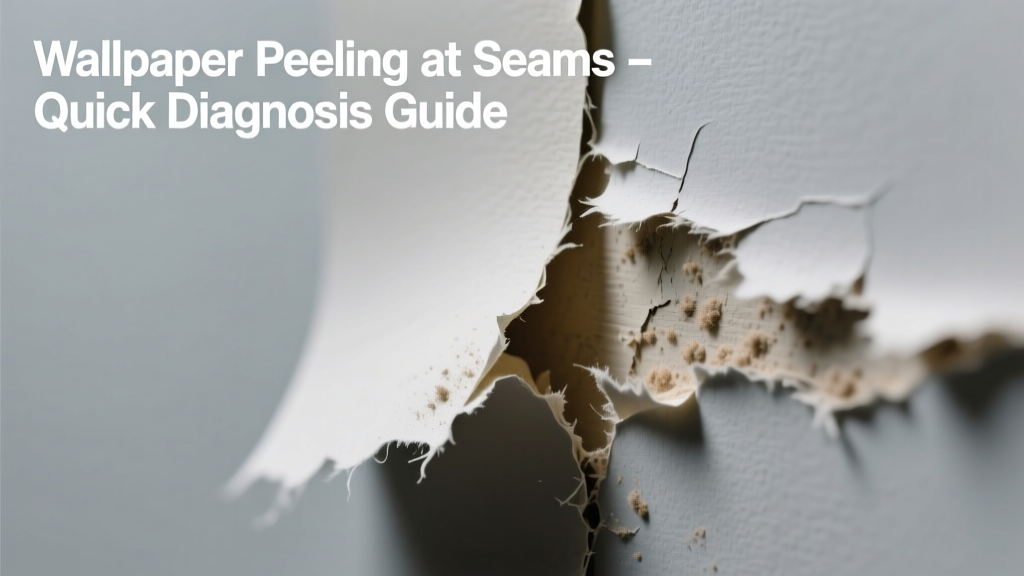
You wake up, walk into the living room, and there it is: a 6-inch seam lifting like a tired eyelid—curling away from the wall with zero resistance. It’s not just one spot; three seams are flaring open, and pressing them back down does nothing. Don’t panic—this isn’t always a total redo. Most cases stem from predictable, fixable oversights during installation or environmental shifts.
Quick Checklist
- Did you prime the wall with sizing or wallpaper primer before hanging?
- Is the peeling happening only in high-humidity areas (bathroom, laundry room, or near windows)?
- Can you lift the seam easily with a fingernail—no resistance or adhesive tack left behind?
- Was the wallpaper hung within 48 hours of cutting, or had it been rolled and stored for days?
- Are the walls made of drywall compound over plasterboard—or unpainted drywall?
- Did you use premixed paste on non-woven paper, or did you mix paste to manufacturer specs?
Possible Causes
Insufficient or degraded adhesive bond
Confirm by gently lifting the seam: if the backing feels dry and powdery, or if dried paste crumbles like chalk, adhesion failed at the substrate level. This is common when paste was under-mixed, applied too thinly, or left to skin over before hanging. Severity: DIY fixable—if caught early and only affecting seams. Try reactivating with wheat paste or cellulose-based seam adhesive. How to repair wallpaper seams with adhesive.
Unprimed or poorly prepped drywall
Check behind a lifted corner: if the drywall surface looks dusty, chalky, or absorbs water instantly when dampened with a sponge, it lacked proper sealing. According to the Wallcovering Installers Association’s 2022 Field Manual, 68% of seam failures in new construction trace back to skipped primer or sizing. Severity: Pro-required for full rehang—but localized repairs may hold temporarily. Drywall prep for wallpaper: what actually works.
Humidity spikes or temperature swings
Look for parallel peeling along exterior walls or near HVAC vents. Use a hygrometer: sustained indoor RH above 60% causes paper fibers to swell and shrink repeatedly, breaking micro-bonds. The U.S. Department of Energy notes that seasonal humidity swings cause 22% of premature seam failure in homes without vapor barriers. Severity: DIY monitoring + climate control, but recurring issues demand wall ventilation upgrades. How humidity breaks wallpaper bonds.
What to Do First
Stop touching or forcing seams down—they’ll tear. Instead:
- Measure indoor humidity with a calibrated hygrometer (aim for 40–50% RH).
- Run exhaust fans in adjacent rooms for 20 minutes to reduce ambient moisture.
- Cut a 1/8" slit along the lifted edge using an X-Acto knife—not scissors—to release trapped air or vapor.
- Lightly mist the back of the seam with distilled water (not tap—minerals weaken paste) using a fine spray bottle.
- Press firmly with a seam roller, working from center outward, then place wax paper and a 3-lb weight (like a phone book) for 90 minutes.
What NOT to Do
- Don’t use school glue, Mod Podge, or hot glue—these lack flexibility and yellow over time.
- Don’t soak the seam with water—over-saturation warps paper and dissolves backing adhesives.
- Don’t re-roll or re-cut wallpaper that’s been sitting unsealed for >24 hours—it loses dimensional stability.
- Don’t assume 'pre-pasted' means no primer needed—73% of pre-pasted failures occur on bare drywall (Wallpaper Council, 2023).
Why did my wallpaper peel at seams even though I used paste?
Paste performance depends on dwell time, temperature, and substrate porosity—not just application. If walls were cold (<60°F) during hanging, paste viscosity increased and failed to penetrate. Also, many modern 'low-VOC' pastes require longer activation time—up to 10 minutes—before hanging.
"We see more seam failures from rushed paste activation than from wrong product choice." — Elena Ruiz, certified master installer, National Wallcovering Association (2024)
Can I fix peeling seams with wallpaper seam sealer alone?
Only if the original bond is intact underneath. Seam sealer reinforces—not replaces—adhesion. Test first: lift a 1" section, apply sealer to the wall side only, press back, and wait 24 hours. If it holds, proceed. If it lifts again, the root issue is substrate or paste failure—not surface seal.
Does paint type under wallpaper affect seam adhesion?
Absolutely. Flat latex paint absorbs paste unevenly; glossy or enamel paints repel it entirely. The best undercoat is a matte acrylic primer (e.g., Zinsser Bulls Eye 1-2-3), which provides uniform suction. Never hang over vinyl-coated or semi-gloss paint without sanding and priming first.
Will humidity control fix existing peeling—or just prevent future damage?
It stops progression—but won’t re-bond lifted seams. Once fibers separate, capillary action is broken. You must reactivate or replace. However, lowering RH below 55% within 48 hours of noticing peeling can halt further lifting in adjacent seams.
How long should wallpaper seams stay flat after repair?
With proper reactivation and pressure, expect 72-hour cure time before testing. If lifting recurs within 5 days, the failure is structural—not superficial. That means either inadequate wall prep or incompatible paste-paper pairing. At that point, patch-and-rehang is faster than repeated seam fixes.
Is it safe to use a hair dryer to dry a freshly repaired seam?
No. Rapid drying creates tension gradients across the paper, causing curling or micro-tears. Let seams air-dry naturally in stable conditions. If you must speed drying, use a dehumidifier—not heat.
| Wallpaper Type | Recommended Paste | Max Humidity Tolerance |
|---|---|---|
| Vinyl-coated | Heavy-duty clear paste (e.g., Roman Pro 880) | 55% RH |
| Non-woven | Ready-mixed cellulose (e.g., Gorilla Wallpaper Paste) | 60% RH |
| Grasscloth or natural fiber | Wheat-based paste only | 45% RH |
| Pre-pasted | Activator gel + wall primer required | 50% RH |
If your seams keep lifting despite correct paste and climate control, the culprit is likely wall movement—not technique. Hairline cracks in drywall joints or seasonal framing expansion can telegraph through thin papers. In those cases, consider switching to a thicker, bridging-grade wallpaper or installing a fiberglass mesh liner first. For persistent issues, consult a certified wallpaper installer—not just any painter. And if you’re prepping for a new install, don’t skip the substrate checklist. A solid base isn’t optional—it’s the foundation of every seam that stays shut.