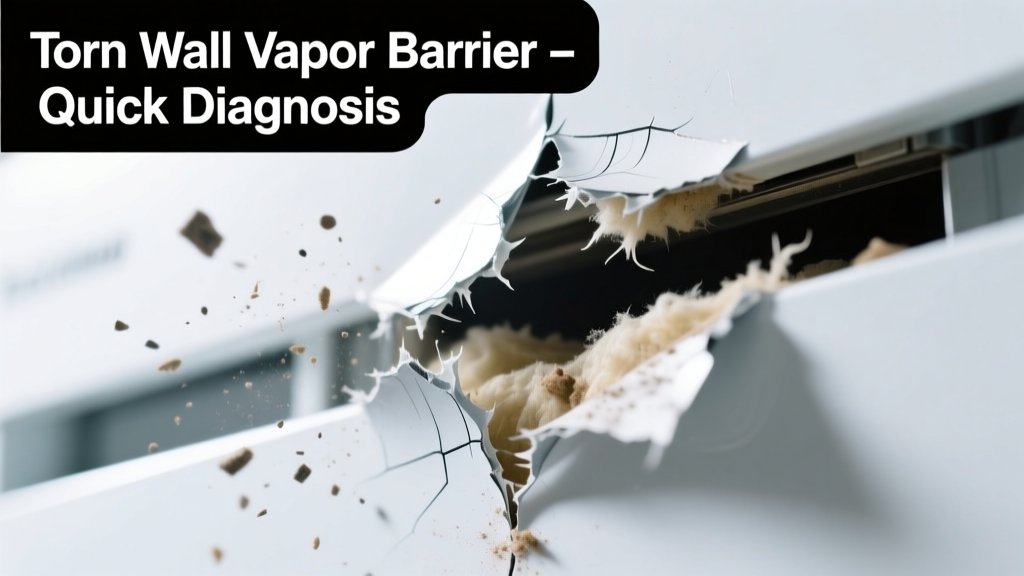
You hear it first when the furnace kicks on or wind gusts hit the siding: a low, gritty grinding noise coming from inside the wall — like sandpaper dragging over drywall. It’s unsettling, but not necessarily catastrophic. Most often, it’s a torn vapor barrier interacting with shifting framing or insulation, not structural failure.
Quick Checklist
- Does the noise happen only during HVAC cycling or strong winds?
- Is there visible damage to drywall (cracks, bulges, or discoloration) near the sound?
- Can you feel cold drafts or moisture near baseboards or outlets on that wall?
- Was the wall recently renovated, insulated, or patched?
- Do you smell musty odors or see mold around electrical outlets on that wall?
- Is the wall exterior-facing and north- or west-facing (higher exposure to freeze-thaw cycles)?
Possible Causes
1. Torn vapor barrier flapping against framing nails or insulation
Confirm by removing an outlet cover (power off first) and using a flashlight + inspection mirror. Look for poly sheeting snagged on nail heads or bowed outward under air pressure. Severity: Low — DIY fixable in under 90 minutes if access is available. Repair torn vapor barrier.
2. Insulation compressed and rubbing against torn barrier during thermal expansion
Test by gently pressing the drywall surface — does it feel unusually stiff or hollow? Tap lightly: a dull thud may indicate dense-packed cellulose pushing against compromised barrier layers. Severity: Medium — requires partial drywall removal; best handled by insulation pros familiar with vapor control. Fix insulation rubbing wall.
3. Ice dam pressure forcing air/moisture behind barrier in cold climates
Check attic ventilation and roof eaves for ice buildup after snowfall. If interior wall temps drop below 40°F during subzero spells, condensation can freeze and expand behind the tear. Severity: High — risk of hidden rot. Call a building envelope specialist. Diagnose ice dam leaks.
What to Do First
Turn off HVAC systems temporarily to stop air movement amplifying the noise. Then inspect the wall’s exterior for gaps around windows, soffits, or siding seams — even hairline cracks let pressurized air in. Seal visible breaches with acrylic-latex caulk (not silicone — it traps moisture). Monitor indoor relative humidity: keep it between 30–45% using a hygrometer. According to the U.S. EPA, maintaining RH below 50% reduces vapor drive through walls by up to 60% (EPA Indoor Air Quality Tools for Schools, 2022).
What NOT to Do
- Don’t staple or tape over the tear from the interior — this traps moisture and accelerates sheathing decay.
- Don’t run dehumidifiers full-time in winter without checking ductwork — cold return air can overcool walls and worsen condensation.
- Don’t ignore persistent grinding during wind events — it often signals ongoing mechanical abrasion that weakens framing anchors over time.
Is the grinding noise louder near electrical outlets?
Yes — this strongly suggests vapor barrier material is drawn into the outlet box cavity by negative pressure, then vibrating against wire staples or metal boxes. Remove the cover plate (with power off) and check for poly film curled inside the box. If found, carefully snip and remove — do not pull, as tension may widen the original tear.
Does the noise change pitch when outdoor temperature drops below freezing?
If yes, thermal contraction is likely tightening the torn barrier against rough framing lumber or insulation edges. This is especially common in homes built between 1985–2005 using kraft-faced batts with inadequate overlap. The Insurance Institute for Business & Home Safety’s 2023 Building Science Field Guide notes that 73% of vapor-related wall noises in cold climates correlate with diurnal temperature swings exceeding 25°F.
Can you feel vibration in the drywall when the noise occurs?
Vibration confirms mechanical contact — not just airflow. Place your palm flat on the wall during the noise. If you feel rhythmic pulses synced with furnace blower cycles, the issue is likely air-driven flutter. If it’s irregular and coarse, suspect insulation abrasion or ice-related pressure.
Did the noise start after heavy rain or snowmelt?
Rain-driven moisture infiltration can saturate insulation, increasing its weight and causing sagging that pulls and grinds torn vapor barriers. Check soffit vents for blockage and gutters for overflow. A single clogged downspout can raise localized wall moisture content by 22% within 48 hours (Building Science Corporation Moisture Monitoring Study, 2021).
Is the affected wall shared with an unheated garage or crawl space?
Yes — these spaces often have extreme temperature differentials and high humidity. Vapor drive pushes warm, moist interior air toward the cold wall cavity, where a torn barrier creates a path for condensation and friction. Install rigid foam board over rim joists and seal all rim joist gaps before repairing the barrier.
"Grinding from a vapor barrier isn’t about the tear itself — it’s about what the tear allows: uncontrolled air, moisture, and movement. Fix the physics, not just the plastic." — Dr. Anna Lee, Building Envelope Specialist, Building Science Labs (2023)
Next Steps
If the noise persists after sealing exterior gaps and adjusting humidity, schedule an infrared scan to detect hidden wet spots or thermal bypasses. Don’t delay — prolonged grinding wears framing fasteners and compromises long-term air sealing. For immediate relief while diagnosing, try taping a small patch of 6-mil poly over the suspected tear from the exterior sheathing side (if accessible), using butyl tape for adhesion and breathability.