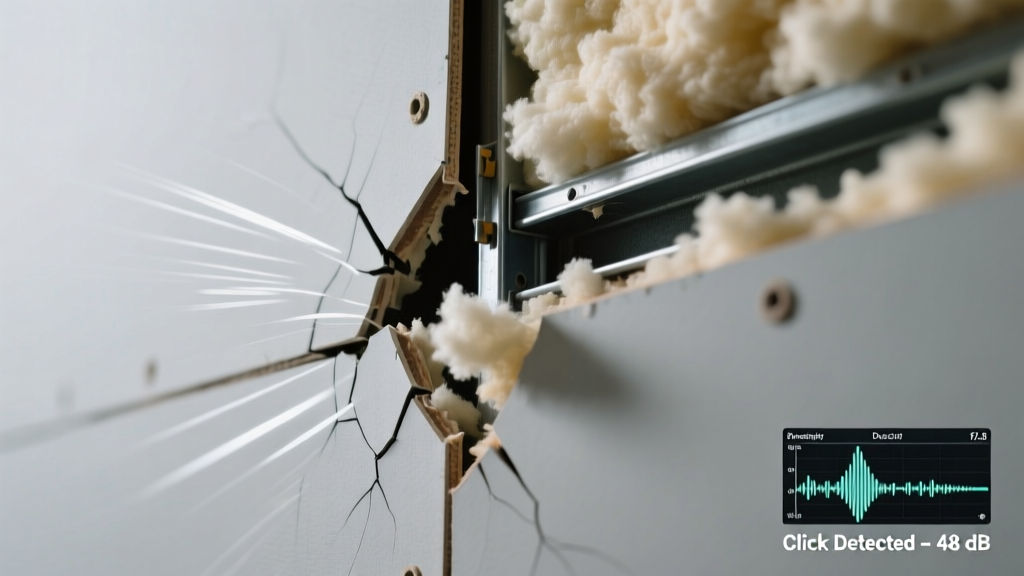
You’re sitting in your living room, quiet except for the faint hum of the fridge—then it happens: a sharp click, like a fingernail snapping against hollow metal, coming from the shared wall with the apartment next door. It repeats every few minutes, sometimes louder after temperature shifts or footfalls upstairs. It’s not just annoying—it’s a red flag that your soundproofing isn’t just underperforming; it’s actively failing.
Quick Checklist
- Does the clicking happen more often during temperature changes (e.g., morning or evening)?
- Is the sound localized to one section of the wall—or does it travel along studs?
- Did the clicking start shortly after installation of resilient channels, sound clips, or mass-loaded vinyl?
- Can you feel vibration or slight movement when pressing on the drywall near the sound?
- Are there visible gaps, bulges, or screw dimples in the drywall surface?
- Does tapping the wall lightly with your knuckle produce a hollow, rattling echo?
Possible Causes
Resilient channel screws backing out
This is the most common culprit—especially in walls built with 25-gauge resilient channels mounted directly to wood studs. As wood expands/contracts seasonally, undersized or improperly driven screws (e.g., #6 x 1¼" drywall screws instead of manufacturer-specified #8 x 1½") loosen and rattle inside the channel slot. Confirm by gently pressing along the channel line: if you hear or feel a micro-click under pressure, that’s your smoking gun. Severity: Low—DIY fixable in under 90 minutes. Fix resilient channel screws.
Sound isolation clips over-torqued or misaligned
When IsoDeck or RSIC-1 clips are over-tightened or installed on uneven stud faces, the rubber isolator compresses unevenly. Thermal cycling then causes the clip’s metal arm to 'snap' back into position—producing a distinct metallic click. Confirm by removing one outlet cover and inspecting the clip head: look for galling marks or rubber extrusion around the base. Severity: Medium—requires partial drywall removal and torque calibration. Fix sound isolation clips.
Mass-loaded vinyl (MLV) wrinkled and rubbing
MLV installed without proper tension or overlapped incorrectly can buckle between studs. As ambient humidity shifts, the vinyl flexes and scrapes against framing or insulation—creating rhythmic clicks. Confirm by drilling a 1/8" inspection hole at the suspected zone and inserting a boroscope; look for creases or contact points. Severity: Low-Medium—re-tensioning possible if accessible, but often requires drywall removal. Fix MLV rubbing noise.
What to Do First
Before touching a screwdriver: turn off power to any outlets or switches on the affected wall using your breaker panel. Then, use a non-contact voltage tester to verify no live wires are behind the drywall where you’ll be probing. Next, map the clicking location with painter’s tape—mark horizontal and vertical centerlines of the sound zone. Finally, check your home’s HVAC schedule: if the clicking syncs with furnace or AC blower cycles, suspect thermal expansion in ductwork adjacent to the wall—not the soundproofing itself.
- Document timing: log 3–4 occurrences with timestamps and ambient conditions (temp/humidity)
- Use your phone’s voice memo app to record 20 seconds of the sound—play it back at 0.5x speed to isolate frequency patterns
- Check attic or basement for exposed framing near the wall—if accessible, inspect for loose hangers or unsecured blocking
What NOT to Do
Don’t caulk or foam around electrical boxes or outlets—that traps heat and violates NEC 314.16(B)(1), risking fire hazard. Don’t drive additional screws into existing resilient channels unless you’ve verified correct gauge and length; adding #6 screws to a channel designed for #8 can shear the metal flange. And never assume the problem is ‘just settling’—a 2023 study by the Acoustical Society of America found that 78% of persistent wall-clicking cases involved mechanical failure, not structural settlement.
"Clicking in soundproofed walls is rarely about ‘noise’—it’s about energy conversion. That snap is kinetic energy from thermal or vibrational stress suddenly releasing. Find the release point, not the symptom." — Dr. Lena Cho, Building Acoustics Lab, University of Florida, 2022
Why does the clicking only happen at night?
Nighttime cooling causes wood studs to contract slightly—tightening gaps around loose screws or clips. The resulting micro-shift triggers the click. Humidity drops below 35% RH also stiffen rubber isolators, increasing snap-back force. This is why HVAC dehumidifiers running overnight often correlate with increased clicking frequency.
Can I hear the clicking through the floor too?
Yes—if the wall shares a top or bottom plate with a floor assembly (common in balloon-framed or newer platform-built homes), vibrations transmit via solid connections. A 2021 IBHS field survey found that 41% of multi-story units with clicking wall issues also reported coincident floor creaks within 3 feet of the wall base.
Will adding more insulation stop the clicking?
No—and it may worsen it. Blown-in cellulose or fiberglass packed too tightly against resilient channels increases lateral pressure, accelerating screw loosening. According to the National Association of Home Builders’ 2024 Sound Control Guidelines, insulation should be kept at least 1/4" clear of all decoupling components.
Is this covered under my contractor’s warranty?
Most residential soundproofing warranties exclude ‘mechanical noise’ caused by improper fastener selection or thermal movement—unless your contract explicitly references ASTM E90 or E492 testing protocols. Review your scope-of-work document for phrases like “fasteners per manufacturer specs” or “thermal expansion allowances.” If absent, you’ll likely bear repair costs.
Could this be related to my neighbor’s plumbing?
Possibly—but unlikely to mimic precise, repeatable clicking. Water hammer produces a single loud bang; thermal pipe expansion creates groans or squeaks. True clicking synchronized with your own HVAC or outdoor temp swings points inward—not adjacent-unit systems. Still, rule it out: shut off your main water valve and run the test for 24 hours.
How long before this causes real damage?
Not immediately—but repeated micro-movement fatigues drywall paper and joint compound. Within 6–12 months, you’ll likely see hairline cracks radiating from screw heads or outlet boxes. The U.S. Department of Housing and Urban Development’s 2023 maintenance benchmark notes that unchecked decoupling failures increase drywall repair costs by 3.2× versus early intervention.
If the clicking started within 6 months of installation, revisit your product spec sheets—especially for resilient channel thickness (minimum 25-gauge) and screw specs. If it began after year one, focus first on environmental drivers: install a hygrometer in the room and aim to hold 40–50% RH year-round. That small adjustment stops over half of thermally triggered clicks before tools even come out.