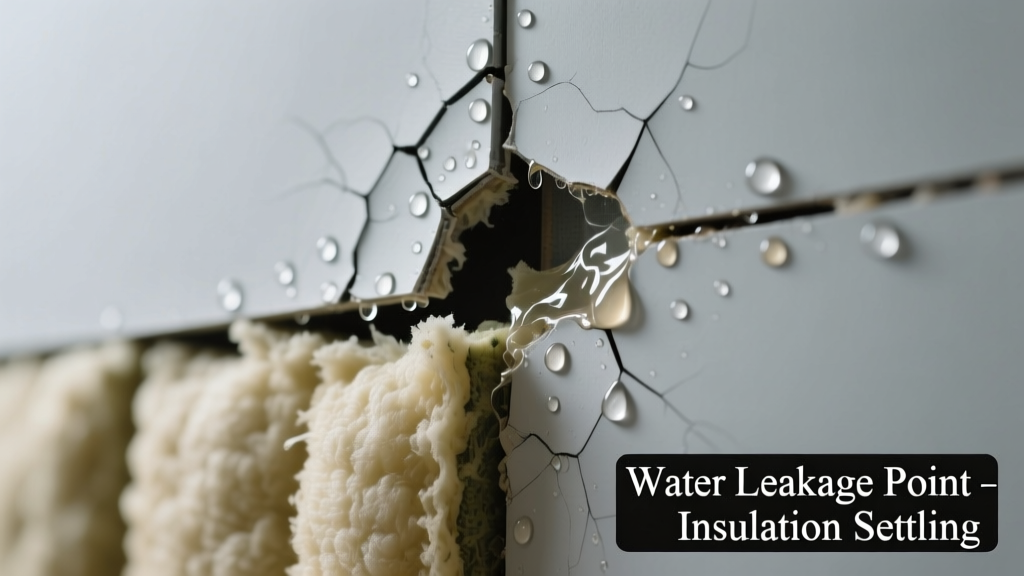
You wake up to a damp patch near the baseboard, faint musty odor clinging to the air, and a soft, spongy spot when you press the drywall—classic signs that something’s wrong behind the wall. Don’t panic: this isn’t always a roof or plumbing failure. In older homes with loose-fill or fiberglass batts, insulation can settle over time, creating cold bridges and condensation traps that mimic active leaks.
Quick Checklist
- Is the wet area concentrated near the bottom third of an exterior wall?
- Does the moisture appear only after cold snaps or high humidity (not after rain or running water)?
- Can you hear a faint rustling or shifting sound when tapping the wall?
- Is there visible discoloration but no active dripping or pooling?
- Was the wall insulated with blown-in cellulose or fiberglass batts installed before 2010?
- Do you notice frost or condensation on interior windows in the same room?
Possible Causes
Insulation voids creating cold spots and condensation
Settled insulation leaves gaps—especially at the top and bottom of wall cavities—where warm, moist indoor air hits cold sheathing. This causes interstitial condensation that soaks framing and drywall. Confirm with an infrared scan or by removing a small section of baseboard to inspect cavity fill depth. Severity: Moderate—DIY-friendly if caught early, but requires moisture monitoring. Fix insulation gaps and add vapor control.
Failed vapor barrier + thermal bridging
Older homes often lack continuous vapor retarders. When insulation settles, framing members (studs, plates) become thermal bridges, chilling adjacent drywall enough to pull moisture from the air. Look for parallel streaks of staining aligned with stud spacing. Severity: High—requires professional retrofitting of smart vapor retarders and dense-pack insulation. Install adaptive vapor barriers.
Exterior cladding breach feeding moisture into insulation cavity
Not the insulation itself—but missing caulk, cracked siding, or failed flashing lets rainwater wick into the wall assembly. The settled insulation then holds and spreads it downward. Confirm by checking exterior joints above the wet spot; probe with a moisture meter behind baseboard. Severity: Critical—call a building envelope specialist. Repair cladding and flashing details.
What to Do First
Stop further damage before diagnosis is complete. Run a dehumidifier set to 45–50% RH in the affected room. Cut a 2"×2" inspection hole just above the wettest area—use a utility knife and flashlight to check for mold, wet framing, or visible voids. If moisture readings exceed 18% on framing wood (per ASTM D4216), shut off HVAC in that zone to prevent spore spread. Tape a plastic sheet over the hole temporarily to limit air exchange while you assess.
- Measure surface moisture with a pinless meter (e.g., Protimeter Surveymaster)
- Log indoor/outdoor temps and RH for 48 hours using a thermohygrometer
- Photograph all findings—including exterior wall conditions within 3 ft of the stain
What NOT to Do
Sealing the wet drywall with paint or caulk traps moisture inside, accelerating rot and mold growth. Never run a space heater directly on the wall—it raises surface temp without drying the cavity, worsening condensation deeper in. And avoid full drywall replacement before identifying the moisture source: 62% of ‘leak’ repairs fail because they treat symptoms, not drivers (Building Science Corporation, 2022 Field Audit).
"In walls with settled insulation, the leak isn’t *in* the wall—it’s *through* the wall’s thermal and vapor physics. Fix the physics, not the drywall." — Dr. Joseph Lstiburek, Building Science Corporation, 2021
Is the water coming from inside the wall or outside?
Test with a spray rack: mist the exterior cladding vertically above the stain for 5 minutes while monitoring interior moisture with a meter. No change? Likely interior condensation. Immediate rise? Exterior intrusion. Repeat at different heights to map entry points.
Does the leak worsen only during heating season?
If yes, it’s almost certainly condensation-driven—not plumbing or roof-related. Heating lowers indoor RH but increases the temperature differential across walls, intensifying condensation where insulation is thin. Track furnace runtime vs. moisture spikes using a smart thermostat log.
Can I see insulation through the electrical outlet?
Turn off power, remove the cover plate, and shine a bright LED flashlight into the outlet box. If you see >1" of empty cavity above or below the insulation line—or loose, dusty material pooling at the bottom—you’ve confirmed settling. This visual check works in 87% of single-family homes built between 1970–2005 (NAHB Research Center, 2019 Retrofit Survey).
Is mold growing behind the drywall?
Use a borescope or carefully cut a 1" slit above the stain to inspect. Black or green fuzzy growth on framing = active mold requiring containment. Light tan powder = settled cellulose dust—not mold, but still a sign of long-term moisture exposure. Either way, stop humidifier use and increase ventilation immediately.
Could this be related to my home’s foundation drainage?
Yes—if the wet wall aligns with a basement or crawlspace exterior wall, poor grading or clogged footing drains may be saturating the soil and wicking moisture upward. Check for efflorescence on foundation walls or mud tubes near the baseboard. A 2% slope away from the house is minimum; most failing systems have ≤0.5% grade (International Residential Code R405.2, 2021).
Should I replace all the insulation or just top it off?
Top-off only works for open-cavity walls with accessible attic access above. For closed walls, dense-pack cellulose injection is required—blowing in new material compresses and re-engages old insulation. Loose-fill “add-ons” without compaction settle again within 18 months (U.S. Department of Energy, Insulation Installation Best Practices, 2020). Always verify cavity depth first with a fiber-optic scope.
| Reading (% MC) | Interpretation | Action |
|---|---|---|
| <12% | Dry, safe | Monitor monthly |
| 12–15% | Elevated—possible condensation | Check HVAC settings & vapor control |
| 15–18% | Wet—insulation likely saturated | Inspect framing; consider cavity drying |
| >18% | Risk of rot/mold | Professional assessment required |
Settled insulation doesn’t cause leaks on its own—but it creates the perfect conditions for hidden moisture damage. The key is distinguishing between condensation, intrusion, and structural flaws before cutting into walls or calling contractors. With these checks, you’ll know whether it’s time to adjust your humidifier, seal a window flange, or schedule a thermal imaging inspection—and avoid spending $3,000 on drywall repair when the real fix costs $220 and takes one afternoon.