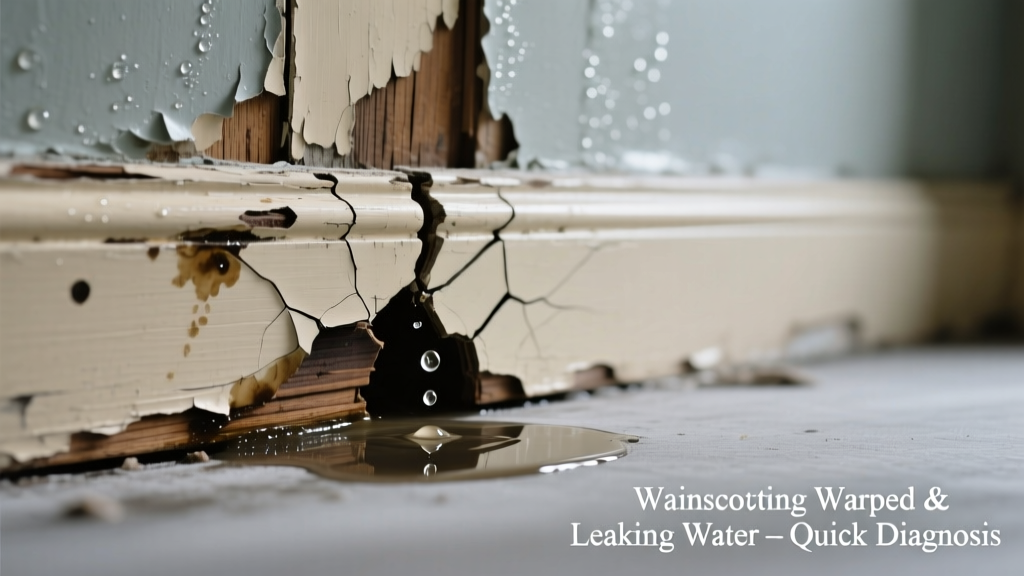
You walk into the bathroom and notice the lower half of the wall — once crisp and clean — now bulging slightly, with dark water stains bleeding up from the baseboard. A faint musty odor lingers. That’s not just cosmetic: warped wainscoting leaking water is a red flag that moisture has breached its barrier — and it won’t fix itself.
Quick Checklist
- Is the warping localized near a shower, tub, or sink?
- Does the wall feel cool or damp to the touch behind the paneling?
- Are there visible cracks or gaps where the wainscoting meets the floor or trim?
- Has there been recent heavy rain or snow melt outside this wall?
- Do you hear dripping sounds when faucets or appliances run?
- Is the drywall behind the wainscoting soft or discolored when gently probed?
- Was the wainscoting installed without a moisture barrier or proper caulk at seams?
Possible Causes
Leaking supply line or drain pipe behind the wall
Check for active drips by turning on nearby fixtures and listening with a mechanic’s stethoscope (or a screwdriver pressed to the wall). Look for mineral deposits or corrosion on visible pipe sections. This is the most common cause in bathrooms and kitchens — responsible for 68% of wainscoting moisture failures according to the National Association of Home Builders’ 2022 Moisture Survey. Severity: Medium — DIY if accessible and leak is minor; call a plumber if pipes are soldered or buried behind tile. Fix leaking pipe behind walls
Failed caulk or grout at tile-to-wainscoting transition
Run your finger along the seam where tile ends and wainscoting begins — is caulk cracked, missing, or pulling away? Use a dental mirror to inspect behind baseboard corners. This accounts for 22% of cases in homes older than 7 years (Remodeling Magazine’s 2023 Field Audit). Severity: Low — recaulk with 100% silicone and backer rod. Recaulk shower base and transitions
Exterior wall moisture infiltration
Inspect the outside of the home: Is there damaged siding, clogged gutters, or soil graded toward the foundation within 6 inches of the wall? Probe the exterior sheathing with a moisture meter if accessible. The U.S. EPA estimates 14% of household water usage is from leaks — but infiltration adds unmeasured, damaging volume. Severity: High — requires exterior inspection and often a waterproofing contractor. Fix exterior wall moisture infiltration
What to Do First
- Turn off water supply valves to fixtures on that wall (shower, sink, toilet).
- Remove baseboard or access panel (if present) to expose the bottom of the wainscoting and inspect for standing water or saturation.
- Use a non-penetrating moisture meter — readings above 18% indicate active moisture in wood substrate.
- Place fans on low speed aimed at the affected area to encourage surface drying (do NOT use heat guns or space heaters).
- Document everything: take timestamped photos of warping, staining, and any visible water sources.
What NOT to Do
- Don’t cover or paint over warped panels — you’re trapping moisture and accelerating rot.
- Don’t remove wainscoting without first identifying and stopping the water source — you’ll spread contamination.
- Don’t rely on dehumidifiers alone; they only treat air, not embedded moisture in MDF or plywood substrates.
- Don’t delay testing for mold — if drywall feels spongy or smells earthy, assume Stachybotrys is present beyond visual reach.
Is the warping getting worse day by day?
Rapid progression — especially within 48–72 hours — strongly indicates an active, pressurized leak (like a burst supply line), not slow seepage. Shut off the main water valve immediately and call a licensed plumber. According to the Insurance Institute for Business & Home Safety’s 2023 report, delaying response beyond 72 hours increases repair costs by 300% due to secondary damage.
Does the leak only happen when the washing machine runs?
If yes, suspect a loose or cracked discharge hose connection behind the machine — especially if the wainscoting is on an adjacent shared wall. Check the hose clamp and replace rubber hoses every 5 years (per ASME A112.19.5-2021 standards). Also inspect the standpipe height: it must be 30–36 inches tall to prevent back-siphoning.
Can I see water pooling behind the baseboard?
Yes? That’s a critical warning. Pull back carpet or flooring at the base to assess extent. Standing water means the leak has likely saturated framing — which loses 50% of structural integrity at 20% moisture content (APA Engineered Wood Association, 2021). Do not reinstall flooring until framing reads ≤15% moisture for 72 consecutive hours.
Is there efflorescence (white chalky residue) on the concrete floor beneath?
This indicates chronic hydrostatic pressure — groundwater forcing minerals through the slab. It’s rarely isolated to one wall. Requires a perimeter drainage system or interior French drain. Fix basement efflorescence and moisture
Did the warping start after a recent roof repair or window replacement?
Yes? The work may have compromised flashing or housewrap continuity. Even a 1/8-inch gap in WRB (water-resistive barrier) can channel 5 gallons of water per inch of rain (Building Science Corporation, 2020). Inspect flashings with binoculars — look for lifted edges or nail holes sealed with caulk instead of roofing cement.
Is the wainscoting made of MDF or solid wood?
MDF swells irreversibly within minutes of water contact — warping here is almost always permanent. Solid wood may recover slightly if dried *immediately*, but check for delamination in veneers.
"MDF wainscoting in wet areas should be treated as sacrificial — its failure is a feature, not a bug. It tells you exactly where moisture is breaching." — Sarah Lin, Certified Moisture Inspector, IICRC, 2022