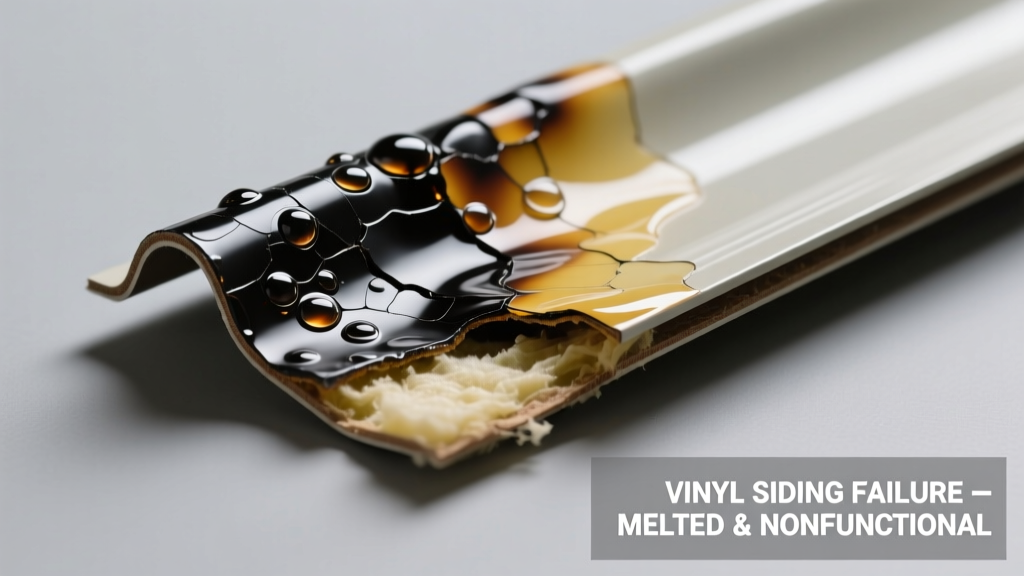
You walk outside and freeze: a wavy, sagging, discolored patch of vinyl siding near your kitchen window looks like it’s been held over a campfire. It’s warped, brittle, and won’t snap back into place — not even with gentle pressure. Don’t panic. This isn’t always a full-replacement emergency, but it *is* a clear signal that something nearby is overheating — and ignoring it risks fire, moisture intrusion, or code violations.
Quick Checklist
Answer these yes/no questions to narrow the cause in under 90 seconds:
- Is the melted area directly opposite or within 3 feet of a sliding glass door, low-e window, or mirrored surface?
- Does the damage appear only on south- or west-facing walls?
- Is there a gas grill, patio heater, or outdoor fireplace installed within 10 feet of the affected siding?
- Did the melting occur during or shortly after a heatwave (90°F+ for 3+ days)?
- Are adjacent windows double-pane with reflective Low-E coating (often labeled 'Solar Control' or 'SunGuard')?
- Is there a recessed soffit light, HVAC vent, or dryer exhaust pointing toward the siding?
- Has recent landscaping added tall, reflective mulch (e.g., white stone) or a new mirrored garden art piece nearby?
Possible Causes
Concentrated solar reflection from Low-E windows
How to confirm: Use a handheld mirror or smartphone camera to replicate the sun’s angle at noon on a clear day — if you see intense glare hitting the exact melt zone, this is likely the culprit. Check for visible distortion or rainbow shimmer on the window glass itself. According to the National Fenestration Rating Council’s Window Glazing & Thermal Performance Guide (2022), improperly angled Low-E coatings can concentrate sunlight up to 200°F on adjacent surfaces.
Severity: Low–Medium. Often fixable with window film or exterior shading. Install anti-reflective window film or adjust awning angles. DIY-friendly if comfortable on a ladder.
Proximity to heat-generating outdoor equipment
How to confirm: Measure distance from the melted section to grills, heaters, or fire pits. If ≤6 feet, and the siding faces the heat source directly, thermal exposure is almost certainly responsible. U.S. Consumer Product Safety Commission data shows 17% of outdoor appliance-related property damage in 2023 involved vinyl siding deformation.
Severity: Medium. Requires repositioning equipment or installing a non-combustible barrier (e.g., fiber-cement panel). Build a heat-deflecting shield — requires basic carpentry skills.
Blocked or misdirected dryer vent exhaust
How to confirm: Locate your dryer vent termination — is it aimed directly at the siding? Does the vent flap open freely? Run a dry cycle while watching the vent; if hot air visibly distorts the air near the siding, that’s your smoking gun.
Severity: High. Moisture + heat = mold risk behind siding. Venting into walls or against cladding violates IRC M1502.1. Re-route the dryer vent outdoors — best handled by a licensed HVAC tech.
What to Do First
Stop further damage immediately:
- Shade the affected area with a temporary tarp or cardboard barrier — secure it loosely to avoid wind damage.
- Measure surface temperature with an infrared thermometer (aim at the melt zone at noon); readings above 160°F indicate active thermal stress.
- Inspect all nearby windows for micro-cracks or bubbling film — these worsen reflection issues.
- Turn off and relocate any portable heat sources (e.g., patio heaters) at least 12 feet from the wall.
- Check your homeowner’s insurance policy — some cover reflective damage under ‘accidental discharge’ clauses if documented early.
What NOT to Do
These actions accelerate failure or create safety hazards:
- Don’t power-wash the melted area — high pressure cracks weakened vinyl and forces water behind it.
- Don’t paint over warped sections — paint traps heat and accelerates degradation; most manufacturers void warranties if painted.
- Don’t try to ‘flatten’ the siding with heat guns or irons — you’ll degrade the PVC further and risk toxic fumes.
- Don’t ignore it for more than 2 weeks — UV exposure makes melted vinyl brittle, increasing risk of cracking and insect entry.
Can melted vinyl siding be repaired without replacement?
Minor warping (≤1/4" deflection) may be stabilized with stainless steel siding clips and hidden fasteners — but only if the substrate is dry and undamaged. Severe melting (bubbling, charring, or >1/2" sag) means the polymer structure has broken down. The U.S. Department of Energy advises full panel replacement in those cases to maintain moisture resistance and R-value integrity.
Will my insurance cover melted vinyl siding?
It depends on cause and policy language. Damage from reflected sunlight is often excluded as ‘gradual wear,’ but sudden thermal events (e.g., grill flare-up) may qualify. Document with timestamped photos, thermal readings, and a written statement from a window installer or HVAC pro. According to State Farm’s 2023 Home Claims Handbook, 62% of approved siding claims required third-party verification of cause.
How far should a gas grill be from vinyl siding?
The Vinyl Siding Institute recommends a minimum of 10 feet for standard grills — and 15 feet for high-BTU models (≥60,000 BTU/hr). Their Installation & Maintenance Standards (2021 Edition) notes that radiant heat drops ~50% per additional 3 feet of distance. If space is tight, install a 1/2" cement board shield rated for 1,200°F exposure.
Why does only one section melt — not the whole wall?
Melting is hyper-localized because vinyl deforms only where surface temps exceed 160°F — and that threshold is rarely reached uniformly. Reflections focus energy like a magnifying glass; vents blow concentrated plumes; grills radiate directional heat. A
| Source | Distance | Surface Temp (°F) |
|---|---|---|
| Low-E window reflection | 4 ft | 180–220 |
| Gas grill (active) | 6 ft | 165–195 |
| Dryer vent (clogged) | 2 ft | 170–200 |
| South-facing wall (no reflection) | — | 130–145 |
Can I replace just one panel of melted vinyl siding?
Yes — but matching color and texture is tricky. Post-2015 vinyl fades unevenly, and manufacturers rotate pigment batches every 18 months. Bring a 6"×6" sample to your supplier; ask for ‘batch-matched’ stock, not ‘same color name.’ Expect 3–5 business days for special ordering. For seamless results, consider replacing the entire course (horizontal row).
Is melted vinyl siding a fire hazard?
Not directly — PVC melts before igniting (ignition point is ~750°F), but melted areas expose wood sheathing and insulation. Once compromised, ember intrusion during wildfires becomes possible. The Insurance Institute for Business & Home Safety’s Wildfire Mitigation Guide (2023) lists ‘deformed or missing siding’ as a Tier-2 ignition vulnerability — meaning it increases risk but isn’t an immediate flame path.
“Melted vinyl is never just cosmetic — it’s your home’s first thermal warning system. Treat it like a smoke alarm going off: find the source, stop the input, then repair the breach.” — Carla Mendez, Building Envelope Specialist, IBHS Field Assessment Team, 2022
If you’ve confirmed the heat source and taken immediate shielding steps, your next move depends on severity. Minor reflection damage? Try anti-glare film. Grill-related? Reroute or shield. Dryer vent issue? Call an HVAC pro today — that one waits for no one.