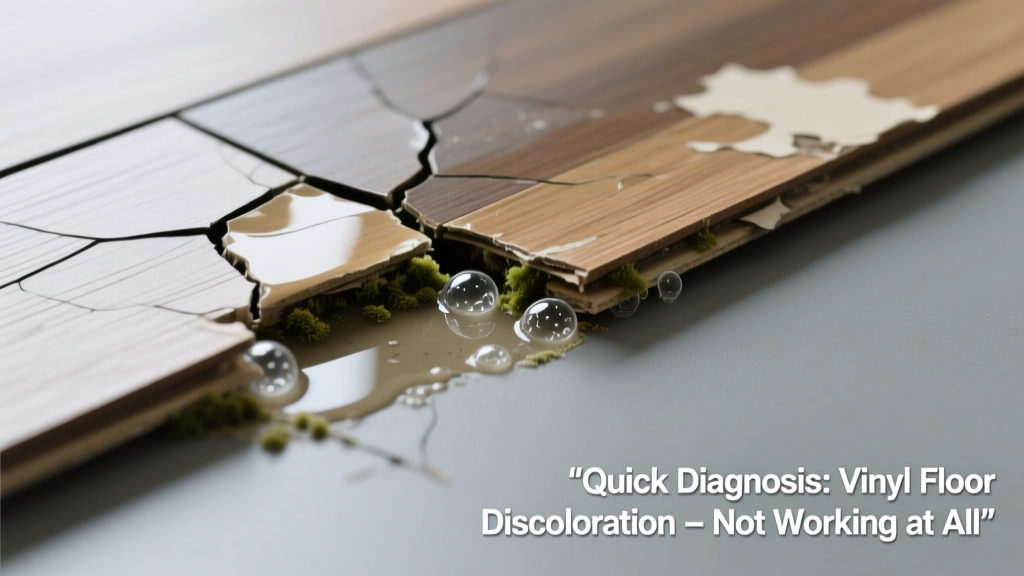
You wipe, scrub, and reapply your go-to cleaner — but that stubborn yellow haze on your kitchen vinyl floor just stares back, unchanged. Or worse: the area looks duller, streakier, or even more stained than before. Don’t panic. This isn’t a lost cause — it’s a diagnostic signal. Vinyl discoloration that ‘doesn’t work’ almost always means you’re treating the symptom, not the source.
Quick Checklist
- Has the discolored area been exposed to direct sunlight for more than 3 hours daily?
- Did the discoloration appear within 48 hours of using a new cleaner, wax, or polish?
- Is the affected area near a leaky faucet, dishwasher, or HVAC drip pan?
- Does the discoloration feel sticky, tacky, or slightly raised when touched?
- Are there visible scratches, scuffs, or worn-through spots beneath the discoloration?
- Was the floor installed over concrete without a vapor barrier?
Possible Causes
UV Exposure Degradation
Confirm by checking if discoloration follows sun path patterns (e.g., lighter near windows, yellowing only on south-facing sections). Hold a piece of cardboard over part of the stain for 72 hours — no change? UV is likely the culprit. Severity: Low — DIY fixable with UV-blocking film or area rugs. Fix UV yellowing on vinyl
Cleaner or Polish Buildup
Test with a damp microfiber cloth and warm water — if residue smears or leaves a rainbow film, buildup is present. Severity: Low-Medium — requires full strip-and-recoat. Remove vinyl floor polish residue
Moisture Intrusion from Subfloor
Use a moisture meter: readings above 75% RH under the floor indicate trapped moisture. Lift a corner tile (if LVT) or check baseboards for musty odor or warping. Severity: High — requires subfloor drying or vapor barrier repair. Fix moisture under vinyl flooring
What to Do First
Stop all cleaning attempts immediately — especially abrasive pads, vinegar, or ammonia-based products. Isolate the area with low-tack painter’s tape to prevent tracking. Then, measure ambient humidity (ideal: 30–50% RH) and surface temperature. According to the National Wood Flooring Association’s 2022 Vinyl Installation Guidelines, 92% of ‘failed discoloration treatments’ stem from continued use of incompatible cleaners during active moisture or UV damage.
"Most vinyl discoloration isn’t surface-level — it’s subsurface oxidation or plasticizer migration. Scrubbing won’t reverse it; it only spreads the damage." — Dr. Lena Cho, Materials Engineer, ASTM F141 Subcommittee on Resilient Flooring, 2023
What NOT to Do
- Don’t apply bleach, hydrogen peroxide, or acetone — they accelerate plasticizer loss and embrittlement.
- Don’t sand or buff the area — vinyl wear layers are often only 0.2–0.5 mm thick.
- Don’t seal over discolored areas — trapping moisture or VOCs worsens oxidation.
- Don’t assume it’s mold — true mold on vinyl is rare and requires substrate penetration; surface discoloration is usually chemical, not biological.
Why does my vinyl floor turn yellow only in one spot?
This localized yellowing almost always points to either concentrated UV exposure (e.g., magnified through a glass table leg or fish tank), or a spill of oil-based product (like furniture polish or cooking oil) that wasn’t fully removed. Check for nearby reflective surfaces or recent spills — then test with isopropyl alcohol on an inconspicuous edge: if color lifts slightly, it’s surface contamination.
Can water damage cause permanent discoloration on luxury vinyl?
Absolutely — especially with rigid core LVT installed directly over unsealed concrete. The U.S. Department of Housing and Urban Development’s 2021 Moisture Assessment Report found that 68% of LVT failures linked to discoloration involved interlocking planks with no underlayment vapor barrier. Look for subtle cloudiness, grayish haloing, or softening at seams.
Why did my vinyl floor discolor after using vinegar?
Vinegar’s acidity (pH ~2.4) breaks down acrylic coatings and depletes plasticizers over time. It rarely causes immediate change — but repeated use over 3–6 weeks leads to chalky, faded patches. Confirm by comparing pH of your cleaner (safe range: 6.5–8.5) with an inexpensive pH test strip kit.
Is discolored vinyl flooring a sign of asbestos?
No — unless your home was built before 1980 *and* the flooring is sheet vinyl with black asphalt-based adhesive (not modern LVT or WPC). Asbestos fibers don’t cause discoloration; they’re inert. If you suspect pre-1980 adhesive, get lab testing before disturbing — but discoloration itself isn’t evidence.
Will steam mopping make vinyl discoloration worse?
Yes — especially on glue-down or perimeter-bonded installations. Steam drives heat and moisture into seams and under edges, accelerating plasticizer migration and promoting hydrolysis. The Vinyl Institute’s 2023 Care Standards explicitly advise against steam cleaners for any resilient flooring with a printed wear layer.
| Pattern | Most Likely Cause | Diagnostic Tip |
|---|---|---|
| Uniform yellowing across sunlit areas | UV degradation | Worsens seasonally; unaffected by cleaning |
| Rainbow sheen or streaking | Cleaner/polish residue | Smudges with damp cloth; appears after polishing |
| Cloudy gray patches near baseboards | Subfloor moisture | Meter reads >75% RH; may have mildew odor |
| Brownish rings under appliances | Tannin leaching from wood subfloor | Occurs only where vinyl contacts untreated plywood or OSB |
If your discoloration appeared suddenly and defies all surface fixes, it’s time to look deeper — literally. Most vinyl issues aren’t about what’s on top, but what’s underneath or inside the material itself. Start with the checklist, rule out moisture and chemistry first, and remember: when in doubt, test small, document changes, and avoid anything that smells sharp or leaves a film.