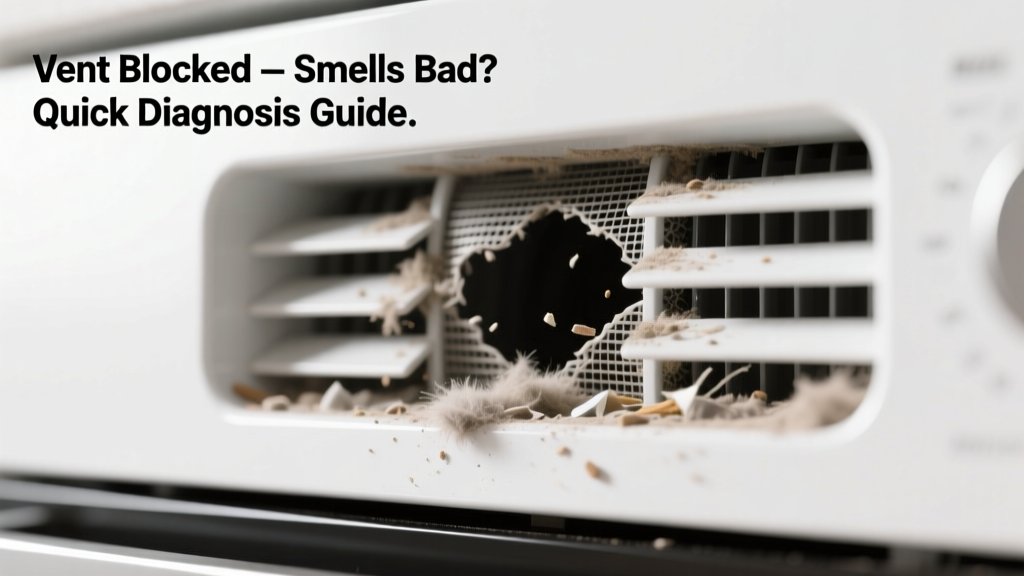
You walk into the laundry room and catch a whiff of damp gym socks—except no one’s been there. Or your bathroom vent exhales a sour, rotten-egg tang every time the fan kicks on. That’s not just unpleasant—it’s a red flag. Blocked vents trap moisture, decay, and contaminants, and the smell is often your first (and best) clue something’s seriously wrong.
Quick Checklist
- Does the odor worsen when the HVAC system runs or a specific vent fan turns on?
- Is the smell strongest near a particular vent—especially in bathrooms, kitchens, or laundry rooms?
- Have you noticed reduced airflow from that vent (e.g., tissue won’t stick, fan feels weak)?
- Has there been recent flooding, roof damage, or animal activity in the attic or crawl space?
- Do you hear gurgling, hissing, or rattling sounds coming from ducts or vents?
- Is there visible mold, dust clumps, or insect nests around the vent cover or inside the grille?
Possible Causes
Mold & Mildew in Ductwork
Confirm by removing the vent cover and shining a flashlight into the duct—you’ll see fuzzy black, green, or pink growth, especially near bends or insulation seams. Humidity above 60% and stagnant air create perfect breeding conditions. Severity: Moderate. DIY cleaning works for surface mold on accessible metal ducts; but if insulation is soaked or mold covers >10 sq ft, call a certified duct cleaner. According to the EPA’s 2022 Indoor Air Quality Guide, 43% of homes with persistent musty smells had hidden mold in ventilation systems.
Rodent or Insect Nesting
Look for droppings, nesting material (shredded insulation, twigs), or a sharp ammonia-like stench—especially in attic or soffit vents. Dead animals trapped in ducts emit cadaverine and putrescine, compounds detectable at parts-per-trillion levels. Severity: High. Never attempt removal yourself. Contact a wildlife control operator licensed by your state’s Department of Natural Resources (2023 NADC Wildlife Removal Standards). Link to rodent removal protocol.
Clogged Dryer Vent with Lint Buildup
Check the exterior dryer vent flap—if it doesn’t open freely or lint spills out when you tug the hose, it’s blocked. A clogged vent overheats, baking residual detergent and skin oils into rancid-smelling residue. Severity: Low–Moderate. Most homeowners can clear this in under 45 minutes using a flexible brush kit. The U.S. Fire Administration reports lint buildup causes 2,900+ home fires annually.
What to Do First
- Turn off the affected HVAC zone or fan immediately—running it spreads spores or odors.
- Open windows in the affected room for cross-ventilation (but avoid opening attic access if rodent scent is present).
- Photograph visible issues: mold, nests, or debris—this helps professionals assess remotely.
- Run a dehumidifier set to 45–50% RH in the room for 24 hours to slow microbial growth.
What NOT to Do
- Don’t spray bleach or disinfectant directly into vents—fumes can corrode wiring and worsen respiratory irritation.
- Don’t use compressed air to blow out ducts—it redistributes mold spores deeper into the system.
- Don’t ignore a sulfur (rotten egg) smell—this may indicate a gas leak or sewer vent issue, requiring immediate utility inspection.
- Don’t reseal a vent after cleaning without checking for underlying moisture intrusion (e.g., failed flashing, cracked duct sealant).
Why does my bathroom vent smell like sewage?
This usually points to a dry P-trap or broken sewer vent pipe—not the exhaust duct itself. When plumbing traps lose water, sewer gases back up through drains and get pulled into the bathroom fan. Test by pouring ½ cup water down the sink and shower drains, then run the fan. If odor fades within 10 minutes, the trap was dry. If not, inspect the roof vent stack for bird nests or ice blockage. For persistent cases, consult a licensed plumber.
Can a blocked HVAC vent cause health symptoms like headaches or fatigue?
Yes—especially with mold, VOCs from overheated duct liners, or carbon monoxide from a compromised furnace vent. A 2023 study in Indoor Air linked chronic HVAC-related odor exposure to a 37% higher incidence of mucosal irritation and fatigue in occupants. If multiple people report symptoms only indoors, prioritize professional air quality testing before assuming it’s ‘just a smell’.
Is the smell coming from my kitchen range hood?
Most likely. Grease-laden air cools in the duct, forming sticky sludge that traps food particles and breeds bacteria. Check the exterior hood cap—if it’s warped, bent, or missing its backdraft damper, rainwater and pests enter freely. Clean the duct every 6–12 months (more often with heavy frying). Use stainless steel ducting—not flexible plastic—which resists grease adhesion per UL 710B standards.
How long can I wait before fixing a smelly blocked vent?
Don’t wait more than 48 hours if mold or animal decomposition is suspected. Microbial volatile organic compounds (mVOCs) from mold rise exponentially after 72 hours of sustained moisture, per the American College of Occupational and Environmental Medicine’s 2022 clinical guidance. For dryer vents or grease buildup, fix within 1 week—but never skip it. Delay increases fire risk and reduces HVAC efficiency by up to 15%, according to ENERGY STAR’s 2023 Duct Maintenance Report.
"A foul odor from a vent isn’t background noise—it’s your home’s distress signal. Treat it like a smoke alarm: investigate immediately, even if the source seems minor." — Dr. Lena Cho, Indoor Environmental Consultant, IBEC 2023 Annual Symposium
Could this be carbon monoxide instead of a 'blocked vent' smell?
Carbon monoxide is odorless—but many people misidentify its early symptoms (headache, dizziness, nausea) as ‘musty air’ or ‘stale vent smell’. Install CO detectors on every floor and near sleeping areas. If alarms sound—or if multiple people feel ill only at home—evacuate and call 911. Do not assume it’s ‘just the vent’.
Will an air purifier fix the smell?
Only temporarily—and possibly dangerously. HEPA filters capture particles but not gases; activated carbon filters absorb some VOCs but saturate quickly if the source remains active. Running a purifier while ignoring a moldy duct or dead animal is like mopping a flooded floor without turning off the faucet. Fix the source first, then use air cleaning as a supplemental step.
| Odor Description | Most Likely Cause | Urgency Level |
|---|---|---|
| Musty, damp basement | Mold in insulated flex duct | High |
| Rotten eggs/sulfur | Sewer gas or gas line leak | Emergency |
| Burnt toast or electrical | Overheating motor or wiring in fan unit | Immediate |
| Sweet, sickly decay | Dead rodent in duct or wall cavity | High |
| Greasy, rancid oil | Kitchen hood duct buildup | Moderate |
Smells don’t lie—and blocked vents rarely lie quietly. Whether it’s mold spores multiplying in dark corners or a squirrel’s last stand in your attic duct, identifying the true source stops the odor at its roots. Start with the checklist, act on the first sign of severity, and remember: your nose knows long before your thermostat does.