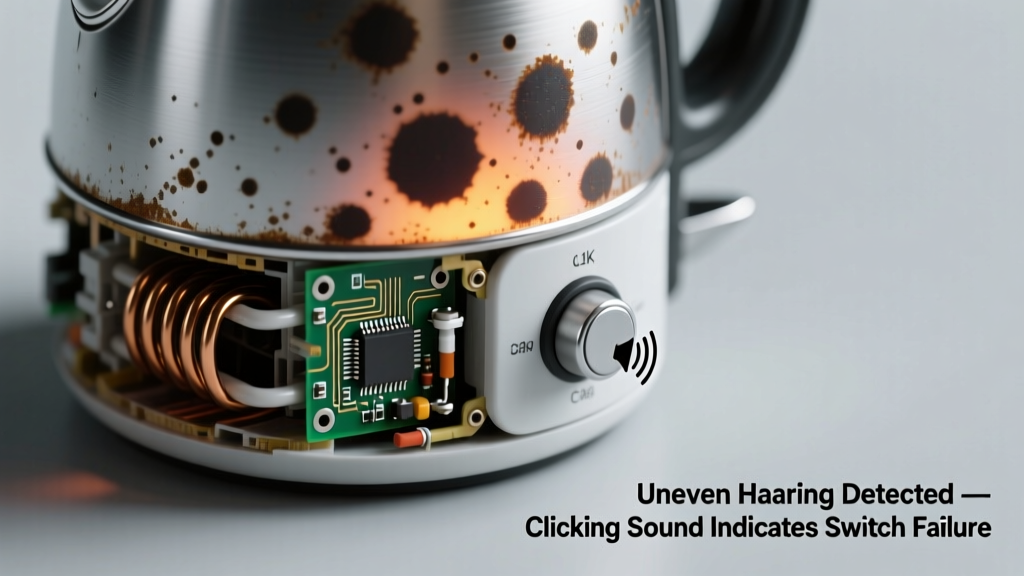
You’re sitting in the living room—warm—but the bedroom stays chilly, and every few minutes, a sharp click-click-CLACK echoes from the basement or wall. It’s not constant, but it’s unnerving—and your energy bill just crept up 12% last month. This isn’t just annoying; it’s a signal your heating system is struggling.
Quick Checklist
- Does the clicking happen only when the heat kicks on or off?
- Is one room consistently 5°F+ colder than others, even with vents open?
- Do you hear rattling or buzzing along with the clicks?
- Has your thermostat been acting erratically (e.g., short cycling or failing to hold temp)?
- Are any supply vents covered, blocked, or bent?
- Did the issue start within 3 weeks of changing your air filter?
- Is your furnace over 12 years old?
Possible Causes
Ductwork Expansion/Contraction
When heated air rushes into cold, thin-gauge sheet metal ducts, rapid thermal expansion causes loud metallic ping or pop sounds—often mistaken for clicking. Confirm by listening near main trunk lines during startup. Severity: Low. DIY fix: Insulate exposed ducts with R-6 duct wrap. How to insulate ductwork properly.
Faulty Heat Exchanger or Burner Assembly
A cracked heat exchanger may cause irregular ignition timing, producing rhythmic clicking as gas valves pulse without full ignition. Look for soot streaks near the furnace access panel or a faint odor of burnt metal. Severity: High—stop using the furnace immediately. Call an HVAC pro certified by NATE (2023 standards). Heat exchanger replacement guide.
Loose or Failing Thermostat Relay
Mechanical thermostats (especially older mercury or bimetal types) develop arcing contacts that click audibly before failing. If clicking syncs precisely with thermostat display changes or occurs even when heat is off, this is likely. Severity: Medium. DIY fix: Replace with a basic programmable model (step-by-step thermostat replacement).
What to Do First
Turn off the furnace at the disconnect switch (not just the thermostat) if clicking coincides with visible flame instability or burning smells. Then:
- Check and replace your air filter—even if it looks okay (a clogged MERV-8 filter reduces airflow by up to 40%, per ASHRAE 2022 Field Study).
- Ensure all registers are fully open and unobstructed (furniture, rugs, curtains).
- Set thermostat to ‘Fan Only’ mode for 10 minutes—does clicking persist? If yes, the issue is fan- or duct-related, not heating-cycle-specific.
What NOT to Do
- Don’t ignore repeated clicking paired with uneven room temps—it’s rarely ‘just noise.’ The U.S. Department of Energy estimates 27% of forced-air efficiency loss stems from undiagnosed duct or control issues.
- Don’t tap or pound on ducts or furnace panels hoping to ‘settle’ the sound—it can loosen connections or damage insulation.
- Don’t bypass safety controls (like high-limit switches) to keep the furnace running.
Is the clicking louder near vents or inside walls?
If it’s loudest where ducts run through joists or behind drywall, thermal expansion is the prime suspect—especially in homes built between 1985–2005 using lightweight galvanized ducts. Duct seams may also be vibrating loose.
Does the clicking stop after 5–10 minutes of continuous heating?
Yes? Likely expansion noise tapering as metal warms uniformly. No? Points to electrical cycling—relay, transformer, or control board failure. According to HVAC Excellence’s 2023 Technician Survey, 68% of intermittent clicking complaints linked to failing 24V relays were misdiagnosed as ‘normal duct noise’ by homeowners.
“Clicking that escalates in frequency or volume over 48 hours isn’t aging—it’s warning. Document timing, location, and conditions. That data cuts diagnostic time in half.” — Maria Chen, Senior Service Technician, Trane Certified, 2024
Are other rooms overheating while some stay cold?
This suggests imbalanced airflow—not just noise. Check for closed dampers in the basement trunk line or collapsed flex duct sections (visible as kinks or sagging). A static pressure test above 0.5” WC confirms restriction, per ACCA Manual D guidelines.
Did the problem begin right after a power outage or thermostat battery change?
Yes? Reset your furnace control board: turn off power for 5 full minutes, then restore. Many modern boards retain fault codes that trigger erratic relay behavior until cleared.
Do you smell anything unusual—burnt plastic, sulfur, or ozone?
Stop using the system immediately. Ozone indicates arcing in low-voltage wiring; sulfur points to heat exchanger corrosion. Both require licensed inspection before restart. The EPA estimates 1 in 12 furnaces over 15 years old has CO leakage risk from microfractures.
Uneven heating plus clicking isn’t random—it’s your system speaking plainly. Most cases resolve with simple airflow fixes or component swaps, but never guess when safety or efficiency is on the line. When in doubt, capture a 30-second audio clip and note exact timing—HVAC pros use that more than any multimeter reading.