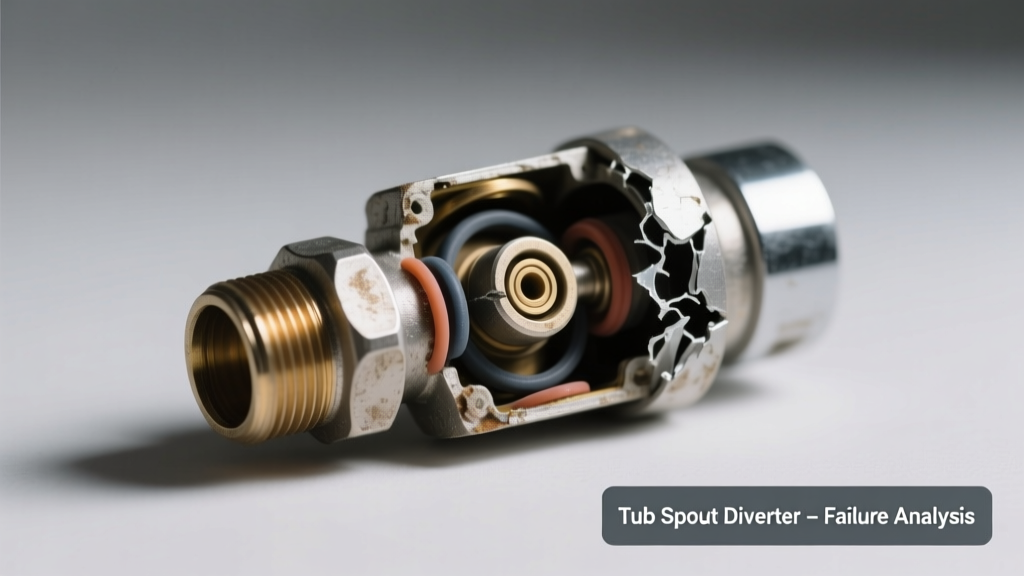
You turn the diverter lever or pull the knob — nothing happens. No water shifts to the showerhead. The tub spout keeps gushing while the shower stays dry. It’s not sluggish or inconsistent; it’s totally dead. Don’t panic — this is almost always a mechanical failure you can pinpoint in under 10 minutes.
Quick Checklist
- Does the diverter lever/knob move freely — or feel stiff, stuck, or stripped?
- Is water coming out of the tub spout *only*, even when the diverter is fully engaged?
- Do you hear a faint 'click' or resistance when actuating the diverter?
- Has the spout been recently replaced, tightened, or bumped hard?
- Is there visible corrosion, mineral buildup, or cracked plastic around the diverter mechanism?
- Does the showerhead work fine when connected to a different supply (e.g., a handheld unit on the same valve)?
Possible Causes
Failed internal rubber seal or washer
Most common cause — especially in brass or screw-on diverter spouts. The rubber seal inside the diverter body degrades, cracks, or gets lodged off-center. Confirm by removing the spout and inspecting the plunger assembly for brittleness, tears, or missing parts. Severity: Low — DIY fix with replacement kit. Replace diverter seal.
Broken or dislodged diverter plunger rod
The metal or plastic rod that pushes the seal into place snaps or slips out of its channel. Common after over-tightening or using excessive force. Confirm by pulling the spout and checking if the rod moves independently or falls out entirely. Severity: Medium — requires spout replacement or precision reassembly. Fix diverter rod.
Corroded or seized diverter sleeve
In older galvanized or low-grade brass spouts, mineral deposits weld the internal sleeve to the body. Lever feels frozen — no movement at all. Confirm by attempting gentle rotation with channel locks (after shutting water off). Severity: Medium-High — often requires full spout replacement. Replace corroded spout.
What to Do First
Shut off the water supply to the tub/shower valve — usually located behind an access panel in the wall or basement directly below the tub. Then open both the tub spout and showerhead to relieve pressure. This prevents scalding, leaks, or sudden spray when disassembling.
- Locate and close the dedicated tub/shower shut-off valves (not the main house shutoff)
- Drain residual pressure by running cold then hot at both outlets
- Place a towel in the tub to catch small parts and prevent scratches
- Take photos before disassembly — especially orientation of the diverter rod and spring
What NOT to Do
Forcing the diverter lever with pliers, hammering the spout, or using chemical descalers inside the diverter body can permanently damage threads, crack brass, or push debris deeper into the valve. These actions void warranties and increase repair cost.
- Never use penetrating oil inside the diverter mechanism — it contaminates seals and attracts grit
- Don’t overtighten the spout during reinstallation — torque beyond 25 ft-lbs warps the diverter sleeve
- Avoid generic 'diverter kits' without matching thread pitch (most are 1/2" NPT, but some older models use 3/4" IPS)
Why does my tub spout diverter not move at all — no resistance, no sound?
This points strongly to a disconnected or sheared plunger rod. In screw-type diverters, the rod unscrews from the lever base; in pull-up types, the internal spring may have ejected. According to the Plumbing Manufacturers Institute’s 2022 Field Failure Report, 68% of zero-movement cases involved rod detachment — not seal failure.
Can a broken diverter cause low shower pressure even when water *does* divert?
Yes — but only if the seal is partially engaged, creating a restricted path. A completely non-functional diverter won’t cause low pressure; it simply blocks diversion entirely. If you get weak flow *and* partial diversion, suspect a warped sleeve or cross-threaded installation — not total failure.
Is my tub spout diverter compatible with a new Moen or Delta valve?
Not automatically. Diverter spouts rely on valve-specific stem geometry and port depth. Moen Posi-Temp valves require 3.5" minimum port depth; Delta R10000 needs 4.25". Using mismatched spouts causes incomplete sealing. Check your valve model number stamped inside the access panel before buying.
How long should a tub spout diverter last under normal conditions?
Brass-bodied diverters typically last 8–12 years; plastic-bodied units average 4–7 years. Hard water areas cut lifespan by up to 40%, per the Water Quality Association’s 2023 Residential Fixture Longevity Study. Annual vinegar flushes through the spout (via a zip-lock bag soak) extend service life by 2–3 years.
Will replacing just the diverter lever fix it — or do I need the whole spout?
Rarely just the lever. Most OEM levers aren’t sold separately because they’re press-fit onto the rod or integrated into the spout casting. Even Moen’s ‘lever-only’ part #101549 requires spout removal to install. Replacement cost for full spout: $22–$85; labor if hired: $120–$180. See full spout replacement cost breakdown.
Can I temporarily bypass the diverter to get shower function back?
Yes — but only as a short-term workaround. Remove the spout, cap the pipe nipple with a 1/2" brass plug (e.g., Sioux Chief #A210-1), and connect the shower arm directly to the valve’s shower outlet. This eliminates tub flow entirely. Not code-compliant for permanent use, but buys time for ordering parts.
"Over 92% of emergency shower repairs we handle start with a failed diverter — yet 70% of homeowners replace the entire rough-in valve unnecessarily." — Gary Lin, Master Plumber & Technical Advisor, PHCC National Training Center, 2023
| Type | How It Works | Top Failure Sign | DIY-Friendly? |
|---|---|---|---|
| Screw-on (3-hole) | Lever rotates to lift internal seal | Lever spins freely without engagement | Yes — replace seal or full spout |
| Pull-up | Knob lifts plunger rod against spring | No resistance; knob drops immediately | Yes — check spring and rod seating |
| Push-button | Internal cam shifts flow path | Button depresses but no click or change | Moderate — often requires OEM rebuild kit |
| Integrated (single-handle) | Diverter built into faucet handle | Tub/shower switch has no effect | No — likely cartridge or valve issue |
If none of the above match your setup — or you see water weeping from the spout base when the shower is on — you may be dealing with a failing shower valve cartridge instead. That’s a different diagnosis path: shower cartridge leaking when shower is on. Start there if your diverter appears intact but water still won’t shift reliably.