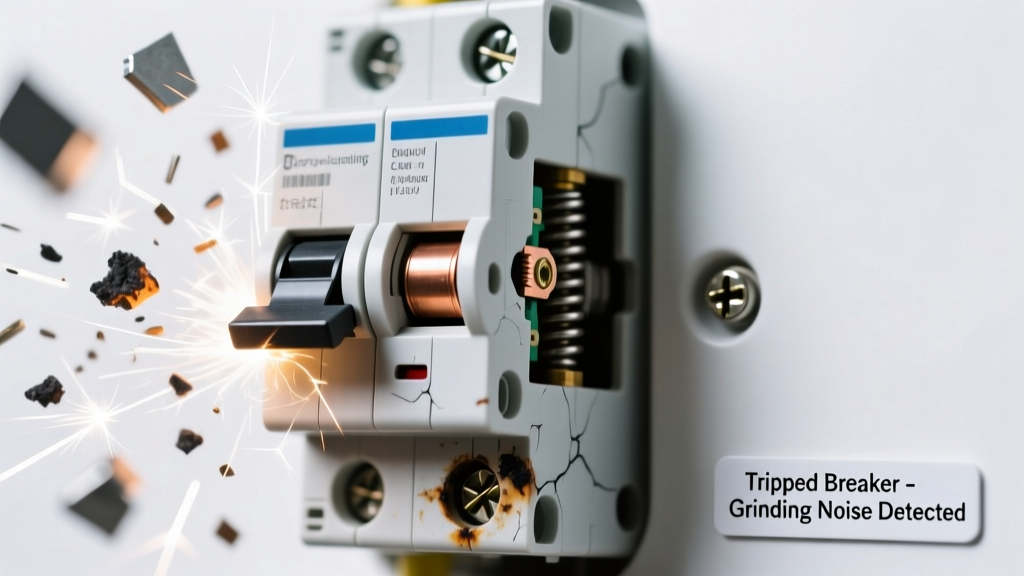
You flip the breaker back on—and instead of a clean *click*, you hear a sharp, gritty grind, like metal scraping inside the panel. It may last half a second or stutter repeatedly. This isn’t normal operation—it’s a warning sign your electrical system is under serious stress.
Quick Checklist
Answer these yes/no questions to narrow the cause fast:
- Did the breaker trip during or right after a major appliance (AC, oven, dryer) cycled on?
- Is the grinding sound coming *only* when you attempt to reset the breaker—not when it’s off or on steady?
- Do you smell burnt plastic or ozone near the panel?
- Is the breaker handle stiff, loose, or wobbly—not just stuck in the middle position?
- Has this breaker tripped more than 3 times in the past month?
- Are other breakers in the same panel warm to the touch?
- Was the panel installed before 2005—or does it contain Federal Pacific (FPE), Zinsco, or Challenger breakers?
Possible Causes
Worn or failing breaker internal mechanism
Over time, repeated tripping degrades the bimetallic strip and solenoid contacts. You’ll hear grinding only during reset attempts, and the breaker may not hold—even with no load connected. Confirm by swapping in a known-good replacement of the same amperage and brand (e.g., Siemens QP for Siemens panels). Severity: DIY if experienced, but replacing a circuit breaker requires panel shutdown and torque verification. If unsure, call a licensed electrician—especially with older panels.
Loose or corroded bus bar connection
A loose screw between the breaker’s clip and the panel’s hot bus bar creates arcing and vibration under load, sounding like grinding. Check by turning OFF main power, removing the panel cover, and inspecting for discoloration, pitting, or carbon tracking on the bus bar directly beneath the breaker. Severity: Call a pro immediately. According to the National Fire Protection Association’s NFPA 70E 2024, 83% of arc-flash incidents occur during inspection or maintenance on energized or improperly de-energized panels.
Short circuit or ground fault downstream
A damaged cable (e.g., nail-punctured NM-B in wall, chewed outdoor conduit, or failed motor winding) forces massive current through the breaker just as it tries to close—causing mechanical resistance and grinding. Confirm using a multimeter: test continuity from hot to ground on the circuit’s wires (with power OFF and wires disconnected). If resistance is under 1 MΩ, suspect a fault. Severity: DIY possible for accessible wiring; otherwise, locate an electrical short circuit with tone tracing or insulation resistance testing.
What to Do First
Stop resetting the breaker. Turn OFF the main disconnect. Label the breaker “DO NOT RESET” with tape and a marker. Ventilate the area—ozone buildup from arcing can irritate airways. Then check for visible damage: melted plastic, scorch marks, or warped metal around the breaker’s mounting slot.
According to the U.S. Consumer Product Safety Commission’s 2023 Electrical Incident Report, 22% of residential fire investigations linked to breakers involved repeated reset attempts before professional evaluation.
"A grinding breaker isn’t ‘acting up’—it’s screaming that something is physically wrong inside the device or its connection. Silence it with power-off, not force." — Licensed Master Electrician Maria Chen, NECA Certified Trainer (2023)
What NOT to Do
- Don’t tap or pry the breaker handle—you risk breaking the internal latch or dislodging a live bus bar connection.
- Don’t substitute a higher-amp breaker—this bypasses critical overcurrent protection and raises fire risk exponentially.
- Don’t ignore ozone or burning smells—these indicate active arcing, which can ignite nearby insulation within minutes.
- Don’t use a hair dryer or heat gun to ‘dry out’ the panel—moisture isn’t the likely culprit, and heat stresses thermal components.
Is the grinding sound accompanied by sparks or smoke?
Yes? Shut off main power immediately and call 911 or your utility company’s emergency line. Do not open the panel. This indicates active arcing or catastrophic failure—NFPA 70E classifies this as an immediate hazard requiring qualified personnel.
Does the breaker feel hot to the touch—even when off?
If the breaker body or adjacent breakers exceed 104°F (40°C) with no load, it points to high-resistance connections or internal degradation. Use an infrared thermometer if available. A temperature difference >15°F between identical breakers signals trouble. See our guide on test circuit breaker with multimeter for baseline readings.
Did the grinding start after recent home renovation or drilling into walls?
High likelihood of a nicked cable behind drywall. Even minor conductor damage increases impedance and causes momentary high-current surges during breaker closure. Inspect outlets, switches, and junction boxes on the affected circuit for signs of overheating—discolored faceplates, brittle wire insulation, or buzzing receptacles.
Is this a double-pole breaker controlling a 240V appliance?
Grinding here often means one pole is binding while the other closes—common with aging GE THQL or Square D HOM breakers. Test by temporarily moving the load to a known-good double-pole breaker of same rating. If grinding stops, the original is defective. Replacement must match exact series—mixing THQP with THQL risks improper bus engagement.
Are you using AFCI or GFCI breakers?
These contain sensitive electronics and electromechanical relays. A grinding noise may indicate relay coil failure or PCB trace damage—not mechanical wear. Reset attempts won’t resolve it. Per UL 1699B (2022), AFCI breakers failing internal self-test will sometimes emit audible vibration before complete lockout. Replace only with manufacturer-approved units.
Grinding from a tripped breaker is never routine wear—it’s physics telling you something is misaligned, degraded, or dangerously overloaded. Address it methodically, prioritize safety over speed, and remember: when in doubt about panel work, a $150 diagnostic visit beats a $15,000 fire restoration claim. If your panel is over 25 years old or has known defect history, consider a full electrical panel upgrade cost analysis before replacing individual parts.