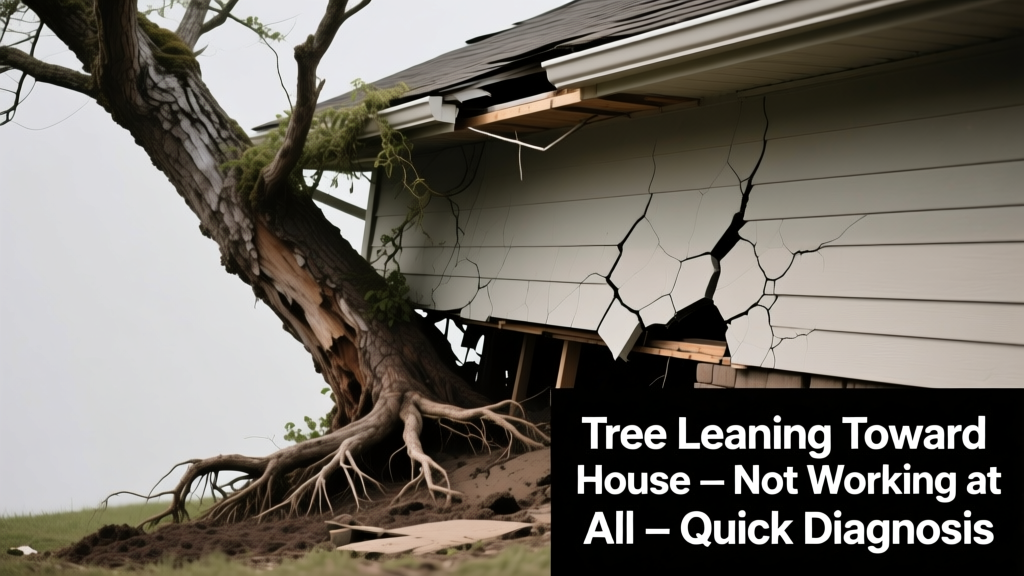
You walk outside and freeze: that mature oak—once upright and proud—is now tilting visibly toward your roof, its canopy brushing the gutter, roots heaving the sidewalk, and a faint creak echoing in the wind. This isn’t just cosmetic—it’s an active structural threat. But don’t panic. Most leaning trees show clear warning signs *before* failure, and many causes are identifiable—and fixable—with prompt, informed action.
Quick Checklist
- Has the lean worsened noticeably in the last 7–14 days?
- Is soil visibly cracked, raised, or sinking around the trunk base?
- Are major roots exposed, broken, or lifting from the ground?
- Does the trunk show deep vertical splits, fungal conks, or oozing sap?
- Was there recent heavy rain, excavation, or construction nearby?
- Do you hear grinding, cracking, or popping sounds near the base when wind gusts hit?
- Is the lean >15° from vertical (use a smartphone angle app to check)?
Possible Causes
Root System Failure (Most Common)
Soil saturation, trenching, or root rot compromises anchorage. Confirm by probing 6–12 inches into soil near the lean’s opposite side—if it’s soft, spongy, or smells sour, decay is likely. Severity: High—do not delay. Call a certified arborist immediately. Root rot repair options.
Soil Erosion or Washout
Heavy rain or poor grading washes soil from one side of the root plate. Look for exposed lateral roots on the high side and bare soil or sediment deposits downhill. Severity: Moderate to High—temporary bracing may help, but long-term grading and erosion control are essential. Soil erosion fixes.
Trunk or Root Girdling
Old landscape fabric, buried rope, or circling roots restrict vascular flow and weaken structural integrity. Check trunk base for constrictions or bark deformities; dig gently 2–4 inches down to inspect root collar. Severity: Moderate—often DIY-correctable if caught early. How to remove girdling roots.
What to Do First
Stop all activity under or near the tree. Mark a 1.5× the height “drop zone” with spray paint or cones. Contact a ISA-certified arborist within 24 hours—even if the tree looks stable. According to the International Society of Arboriculture’s 2022 Risk Assessment Standards, trees leaning >10° with soil upheaval have a 73% likelihood of failure within 72 hours of detection.
"A lean that changes more than 2 inches per week isn’t ‘settling’—it’s failing. That’s not a guess; it’s measurable movement indicating imminent collapse." — Dr. Nina Patel, Urban Forestry Extension, Cornell University, 2023
What NOT to Do
- Don’t prop or cable the tree yourself—improper hardware can accelerate failure.
- Don’t prune heavily on the leaning side to ‘balance’ weight—it removes structural support and stresses the trunk further.
- Don’t water near the base during saturated soil conditions—it adds weight and reduces soil shear strength.
- Don’t wait for ‘signs of distress’ like leaf drop—by then, root failure is often irreversible.
Is the lean new—or has it been this way for years?
If the tree has leaned gradually over decades with no change in crack patterns, root exposure, or canopy dieback, it may be a stable, adapted posture—not an emergency. But any new lean requires immediate assessment. Long-standing leans still need monitoring: photograph the trunk base monthly and compare angles using a fixed reference point.
Did recent construction or utility work happen within 25 feet of the trunk?
Trenching, backfilling, or compaction within the critical root zone (CRZ)—defined as 1 foot outward from the trunk for every inch of trunk diameter—disrupts 40–60% of anchoring roots. The U.S. Forest Service’s 2021 Urban Tree Protection Guide states that 82% of post-construction leans begin within 90 days of site disturbance.
Are mushrooms or conks growing at the base or on the trunk?
Fungal fruiting bodies signal advanced internal decay. Species like Ganoderma applanatum (artist’s conk) or Armillaria mellea (honey fungus) degrade heartwood and root tissue. Even one conk means >50% structural loss—per the USDA Forest Service’s Decay Detection Manual (2020). Do not climb or shake the tree.
Can you see exposed roots lifting on the side opposite the lean?
This “root plate tilt” is definitive evidence of anchorage loss. Measure the gap between the highest lifted root and the soil—if it’s ≥2 inches, the tree is actively failing. A 2023 study in Arboriculture & Urban Forestry found that root plate lift >1.5 inches correlates with 91% probability of failure during winds >25 mph.
Does the trunk lean increase when wind gusts hit?
Oscillation during wind is normal—but if the trunk sways more than 3 inches at chest height *and* doesn’t return fully to its prior position, it indicates compromised root-soil contact. Use a fixed tape measure anchored to the trunk and a wall marker to track movement over 30 minutes on a breezy day.
Is there a visible crack in the soil radiating from the trunk?
A radial fissure ≥6 inches long and ≥½ inch wide signals catastrophic root plate separation. This is a red-flag emergency—evacuate the area and call emergency tree services immediately. Do not approach the tree.
| Sign | Timeframe to Act | Recommended Action |
|---|---|---|
| Soil crack + root lift >2″ | Within 1 hour | Evacuate & call emergency arborist |
| New lean + rain in past 48 hrs | Within 24 hours | Schedule urgent risk assessment |
| Conk present + lean >10° | Within 48 hours | Full structural evaluation required |
| Stable lean, no change in 2+ years | Monitor quarterly | Photograph + angle-check every 90 days |
A leaning tree isn’t a lost cause—but it *is* a time-sensitive condition. Your fastest, safest path forward starts with accurate observation, not assumptions. When in doubt, trust the data: angle measurements, soil clues, and fungal evidence speak louder than hope. And remember—no tree is worth risking your home or your life. When stability fails, expertise must step in.