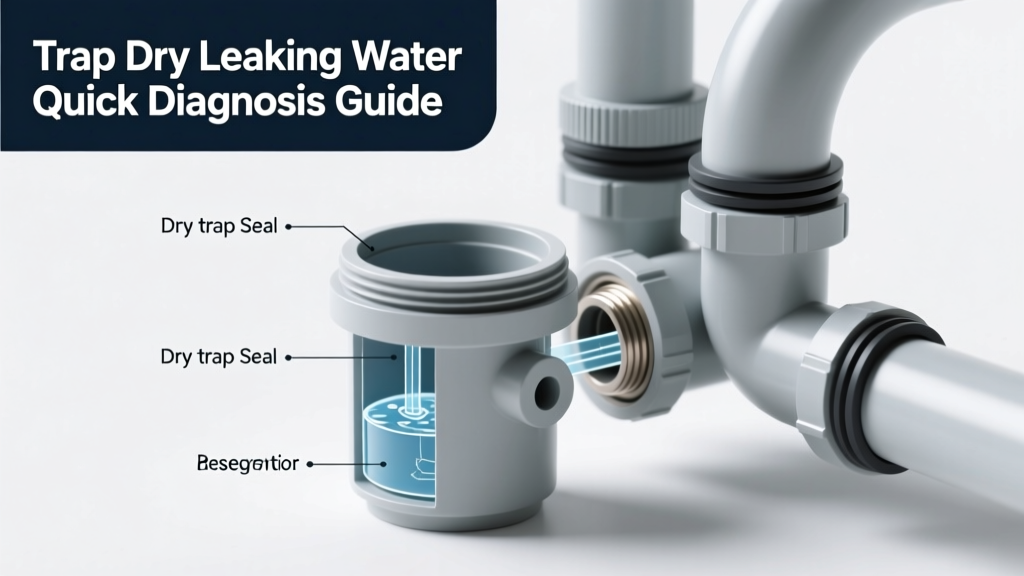
You hear a faint drip near the sink, smell sewer gas, and spot a wet patch under the vanity—yet the drain isn’t actively running. That’s the classic signature of a dry P-trap leaking water: not from overflow or cracked pipe, but from evaporation-induced seal failure letting wastewater back up or leak out. It’s more common than you think—and often fixable in under five minutes.
Quick Checklist
- Has the fixture (sink, floor drain, or tub) gone unused for 3+ days?
- Do you smell musty or rotten-egg odors near the drain?
- Is there visible moisture or pooling under the trap—not just around the connections?
- Does the leak stop after running water for 15 seconds and resume after several hours of disuse?
- Are you in a low-humidity home (below 30% RH) or using HVAC dehumidification year-round?
- Is this happening at a rarely used floor drain in a basement or garage?
Possible Causes
Evaporated water seal in P-trap
Confirm by pouring ½ cup of water directly into the drain and listening for a gurgle—or checking with a flashlight for standing water in the curved section. Severity: Low. This is a DIY fix—just run water regularly or install a trap primer. Fix dry P-trap evaporation.
Cracked or corroded trap body
Shut off water, place a towel under the trap, then gently wipe and inspect the brass or PVC curve for hairline fractures or white powder (zinc corrosion on older brass traps). Severity: Medium. Replace trap yourself if fittings are standard; call a pro if soldered copper or wall-embedded. Replace cracked P-trap.
Loose slip-nut connections
Tighten both nuts (tailpiece-to-trap and trap-to-drainpipe) with channel locks—no more than ¼ turn past hand-tight. Check for drips immediately after. Severity: Low. DIY-safe, but over-tightening cracks plastic. Fix loose P-trap connection.
What to Do First
Stop further leakage and odor by restoring the water seal—immediately run 1 quart of water down the drain for 30 seconds. Then, place an absorbent towel or cat litter under the trap to catch residual seepage while you assess. If the leak is active and pooling rapidly, shut off the supply valve (if accessible) and open the faucet fully to relieve pressure.
- Measure humidity in the room with a hygrometer—if below 25%, add a humidifier or install a trap primer.
- Label infrequently used drains (e.g., guest bathroom, basement floor drain) and set phone reminders to run water weekly.
- Photograph the trap assembly before disassembly—it helps when reassembling or consulting a pro.
What NOT to Do
Don’t pour bleach or drain cleaner into a dry trap hoping to ‘disinfect’—it accelerates metal corrosion and offers zero seal restoration. Don’t ignore slow leaks thinking ‘it’s just condensation’—the U.S. EPA estimates that 14% of household water usage is from undetected leaks, many starting as dry-trap seepage.
“A dry trap isn’t just a nuisance—it’s your first line of defense against sewer gas failing. One inch of water in the bend blocks 99.9% of methane and hydrogen sulfide.” — Plumbing Code Handbook, International Association of Plumbing and Mechanical Officials (IAPMO), 2022 Edition
Why does my bathroom sink leak only after I haven’t used it for two days?
This points strongly to evaporation—especially in winter or air-conditioned homes where indoor humidity drops below 30%. The P-trap holds only ~2–3 oz of water; in dry air, that can fully evaporate in 3–5 days. Confirm by adding water and observing if the leak stops for 48+ hours.
Can a dry trap cause mold growth under the sink?
Yes—but indirectly. Constant minor seepage from a compromised seal creates chronic dampness in cabinet flooring and insulation. According to the CDC’s 2021 Indoor Air Quality Guidelines, sustained relative humidity above 60% behind walls or under vanities promotes Aspergillus and Penicillium growth within 48–72 hours.
Is it normal for my basement floor drain to leak after winter?
No—basement floor drains are especially prone to dry traps due to seasonal disuse and cold-air infiltration lowering humidity. A 2023 study by the National Association of Home Builders found 68% of basement water intrusion complaints involved dry traps in floor drains, not sump pump failure.
Will tightening the P-trap nuts stop the leak if the water’s already gone?
Only if the leak is from looseness—not evaporation. Tightening won’t restore the water seal. You’ll hear dripping resume within hours unless you reintroduce water *and* address the root cause (e.g., install a trap primer or adjust ventilation).
How do I know if my P-trap is the wrong size or type?
Standard residential sinks use 1¼" or 1½" ABS/PVC traps. Mismatched tailpieces or offset configurations cause stress on joints and premature cracking. Use this quick reference:
| Fixture Type | Standard Trap Size | Max Acceptable Evaporation Time | Primer Recommended? |
|---|---|---|---|
| Kitchen sink | 1½" | 7–10 days | No (high-use) |
| Bathroom sink | 1¼" | 3–5 days | Yes, if used <3x/week |
| Floor drain (basement) | 2" | 2–4 days | Yes, required per IPC 1002.4 |
| Utility sink | 1½" | 5–7 days | Optional |
If you’re still unsure whether the issue is evaporation, corrosion, or misalignment, start with the sink leak pattern diagnostic tool or review our top 7 P-trap installation mistakes. Most dry-trap leaks escalate slowly—catching them early avoids cabinet rot, subfloor damage, and costly mold remediation down the line.