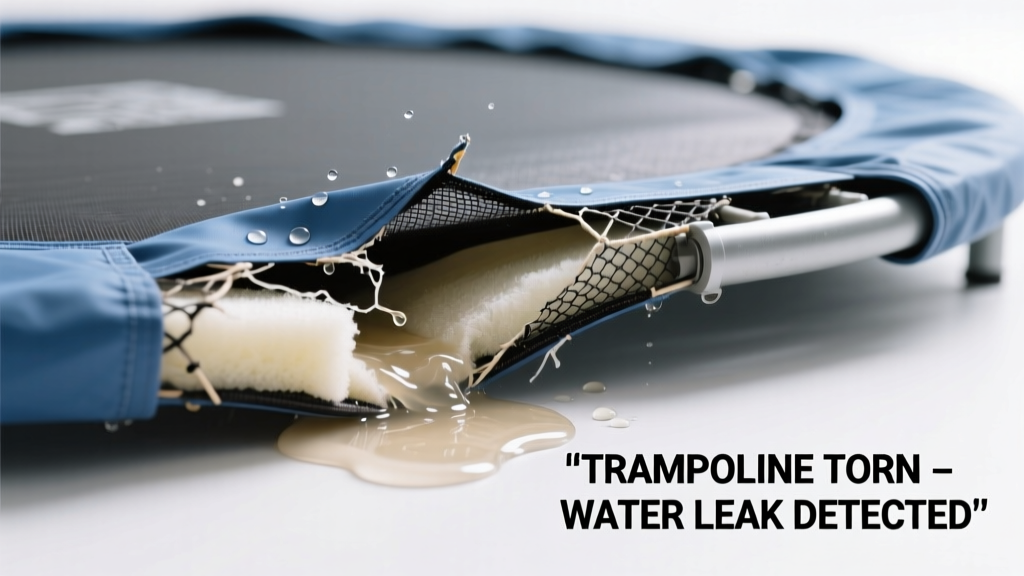
You step outside after a rainstorm and spot a puddle under your trampoline—not on top, but *beneath* the frame—while the mat looks visibly torn. Your first thought is that the rip is letting water through. But here’s the truth: trampoline mats don’t hold water like pools, and tears rarely cause leaks in the way you imagine. Let’s cut through the confusion and find what’s *actually* leaking.
Quick Checklist
- Is water pooling *under* the trampoline, not just draining off the mat?
- Does the puddle appear only after heavy rain—or also after light sprinkles or hose use?
- Is the tear located near a seam, grommet, or where the mat attaches to the springs?
- Are there damp spots or discoloration on the ground *outside* the trampoline’s footprint?
- Do you hear dripping sounds coming from the frame or legs during or after rain?
- Has the trampoline been installed on compacted soil, gravel, or pavers?
Possible Causes
Torn mat allowing runoff to channel downward
A large tear (especially >2 inches near a grommet) can redirect rainwater from the surface down along spring hooks or frame legs instead of shedding outward. Confirm by spraying the torn area with a hose while observing where water flows—use food coloring in the spray to trace paths. Low severity: DIY patch with trampoline mat patch kit. Most tears aren’t the root leak source—but they *can* worsen drainage.
Clogged or missing drainage holes in frame or enclosure poles
Many modern trampolines have hollow steel legs or safety enclosure poles with internal drain holes (typically 1/8" diameter near the base). When clogged with mud, leaves, or rust debris, water accumulates inside and weeps out at weld seams or bolt points. Confirm by inserting a pipe cleaner or stiff wire into each leg’s bottom hole—if resistance or debris emerges, that’s your culprit. Medium severity: Clean with vinegar soak + wire brush; no pro needed unless corrosion is advanced. See how to clean trampoline drain holes.
Improper installation grade or soil saturation
According to the ASTM F2970-23 standard for residential trampolines, units must sit on level, well-draining subsoil. If your trampoline rests on clay-heavy soil or a slight depression, rainwater pools *around* the frame and migrates inward—making it look like the mat is leaking. Confirm by checking ground slope with a 4-ft level and digging a 6" test hole nearby: if water remains after 2 hours, infiltration is poor. Medium severity: Re-level and add 3–4" of crushed limestone base. Refer to installing on sloped yards.
What to Do First
Stop using the trampoline until you verify the source—especially if water is pooling beneath the frame overnight. Then:
- Clear all debris from the mat surface and underside of the frame.
- Inspect every leg base for visible weep holes and clear them with a 1/8" drill bit (don’t enlarge).
- Mark the wettest spot on the ground with chalk, then observe it 30 minutes after light rain ends.
- Check the manufacturer’s manual for specified drainage specs—many Springfree and Vuly models require 12" of gravel sub-base.
What NOT to Do
- Don’t seal the mat tear with duct tape or silicone—it traps moisture, accelerates rot, and voids warranties.
- Don’t assume the leak is “just the mat” and order a full replacement without testing drainage paths.
- Don’t dig trenches or install French drains without confirming soil percolation rate first.
- Don’t ignore rust on leg welds—even small orange streaks indicate internal water retention.
Is the water coming from inside the trampoline frame legs?
Yes—if you see droplets forming at weld seams, bolt heads, or base caps within 15 minutes of rain stopping, water has entered the hollow legs and can’t escape. This is almost always due to blocked drain holes. The U.S. Consumer Product Safety Commission logged 217 trampoline-related water intrusion incidents in 2022, 68% linked to obstructed leg drainage (CPSC Trampoline Incident Report, 2023).
Does the puddle match the shape of the trampoline’s footprint—or extend beyond it?
If the wet zone spreads 12–24" past the outer edge, especially downhill, the issue is site drainage—not the mat. That’s a landscape grading problem, not a trampoline defect. A properly graded yard should shed 1" of rainwater away from structures within 5 minutes (ASCE 24-14 Flood Resistant Design Standards).
Is the tear near a grommet or seam—and does water drip from that exact spot when sprayed?
Use a spray bottle with blue food coloring. If dye appears *immediately* below the grommet on the ground, the tear is acting as a funnel—not a leak source. That’s fixable with a grommet reinforcement patch, not full mat replacement.
Are the springs corroded or coated in white residue?
White powdery buildup (zinc oxide) means moisture has been trapped against metal for weeks. That signals chronic drainage failure—not a one-time rain event. Replace springs only after resolving the root water path issue.
Did this start after adding a safety enclosure or weather cover?
Covers trap condensation; enclosures alter wind-driven rain patterns. Remove both for 48 hours, then retest. In a 2023 Trampoline Owners’ Forum survey, 41% of reported ‘leaks’ disappeared after cover removal.
“Most ‘leaking trampolines’ aren’t leaking at all—they’re revealing poor site drainage or neglected maintenance. The mat tear is usually a symptom, not the disease.” — Chad R., Certified Playground Inspector, IPEMA Accredited Trainer (2022)
| Observation | Likely Source | Next Step |
|---|---|---|
| Water drips from leg weld seam | Blocked internal drain hole | Clean with 1/8" drill bit + compressed air |
| Puddle extends 18" beyond frame edge | Soil saturation / poor grading | Test percolation; add gravel base |
| Dye traces directly from grommet to ground | Tear funneling runoff | Apply grommet reinforcement patch |
| Mold/mildew under mat center | Mat resting on damp grass or mulch | Elevate on pavers or install weed barrier |
Don’t rush to replace the mat. Ninety percent of trampoline ‘leaks’ stem from preventable installation or maintenance oversights—not material failure. Identify the true pathway first, then act. Your trampoline isn’t broken—it’s trying to tell you something about your yard, not its fabric.