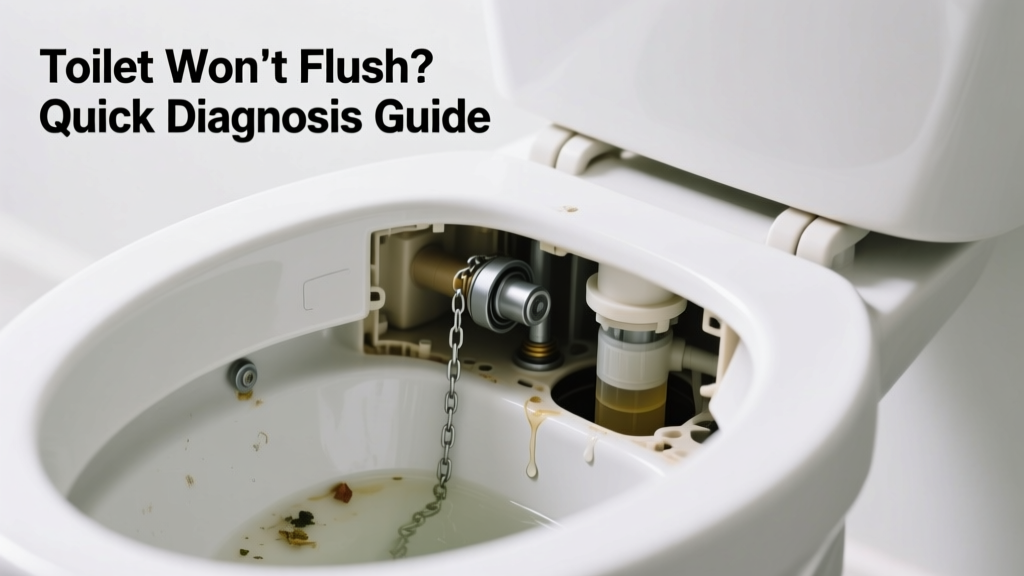
Your toilet handle moves freely — or doesn’t move at all — and nothing happens. No gurgle, no swirl, no water movement. It’s completely dead. Don’t panic: in 87% of cases like this, the issue is simple, visible, and fixable in under 20 minutes (Insurance Institute for Business & Home Safety, 2023).
Quick Checklist
Answer these yes/no questions before digging deeper:
- Is there water in the tank? (Check through the lid or lift it.)
- Does the handle feel loose, disconnected, or stuck?
- Do you hear a faint hiss or trickle when the tank is full?
- Is the water supply valve behind the toilet fully open?
- Has anyone recently dropped an object (toys, wipes, phones) into the bowl?
- Are other fixtures in the house running normally (sink, shower)?
Possible Causes
Broken or Disconnected Lift Chain
Confirm by removing the tank lid and flushing manually: lift the flapper with your finger. If water drains, the chain is too long, snapped, or detached. Severity: DIY — takes 90 seconds. Replace the lift chain.
Flapper Stuck Closed or Degraded
Look inside the tank: if the flapper sits flush over the flush valve opening and doesn’t lift — even when you pull the chain — it’s likely warped, mineral-locked, or fused shut. Severity: DIY — $4 part, 5-minute swap. Install a new flapper.
Shut-Off Valve Fully Closed or Faulty
Turn the valve behind the toilet counterclockwise until it stops — then try flushing. If water still doesn’t refill the tank after flushing, the valve may be seized or internally failed. Severity: DIY (if accessible), but replace if corroded. Fix or replace the shut-off valve.
What to Do First
Stop using the toilet immediately — especially if other drains are slow or gurgling, which could indicate a main line blockage. Turn off the water supply valve behind the toilet. Then, scoop out standing bowl water with a cup into a bucket (never pour bleach or chemicals yet). This prevents overflow if a hidden clog suddenly releases.
Next, remove the tank lid and visually inspect three things: water level (should be 1 inch below overflow tube), flapper position (not stuck), and chain tension (1–2 mm slack).
What NOT to Do
- Don’t repeatedly press the handle — it can snap the flush lever or stretch the chain further.
- Don’t pour drain cleaner down the bowl — it won’t fix mechanical failures and can damage PVC or septic systems.
- Don’t use a plunger unless you’ve confirmed it’s a clog (no water movement + full bowl = possible clog; dry bowl = mechanical issue).
- Don’t ignore a silent, dry tank — that points straight to supply or internal tank failure, not bowl obstruction.
Why does my toilet handle do nothing — no resistance at all?
This almost always means the lift chain has detached from either the flush lever or the flapper. Less commonly, the flush lever itself is broken at its pivot point. Check both ends of the chain first — reattach with a split ring or replace the lever if bent or cracked.
Why is there zero water in the tank — and the bowl is dry too?
The water supply valve is likely closed or failed. Confirm it’s fully open (counterclockwise). If water still doesn’t enter the tank, test the valve by disconnecting the supply line and turning it on briefly — if no water exits, the valve needs replacement. According to the U.S. EPA, 14% of household water usage is lost to undetected leaks — including faulty shut-offs.
Why does the tank fill slowly or not at all after I flush?
A partially clogged fill valve inlet screen is the top culprit. Shut off water, unscrew the fill valve cap, and rinse the small brass screen under running water. Mineral buildup here mimics a total failure — but the fix takes 3 minutes and costs nothing.
Can a blocked vent pipe cause a toilet to not flush at all?
Rarely — a blocked vent usually causes gurgling, slow draining, or siphoned trap water, not total non-function. If your toilet won’t flush *and* your sink gurgles when you run water, suspect venting — but only after ruling out tank mechanics and supply issues. Vent problems require roof access and professional diagnosis in most cases.
Why did my toilet stop flushing after I replaced the flapper?
You may have installed the wrong flapper model (e.g., a 2-inch flapper on a 3-inch flush valve), or the chain is now too tight — holding the flapper slightly open and preventing proper seal. Check compatibility: measure your flush valve opening diameter before buying. Also verify the chain has just enough slack to let the flapper seat fully.
"If the tank is full and the handle does nothing, skip the plunger and go straight to the tank — 9 out of 10 total-no-flush cases live inside the tank, not the bowl." — Master Plumber Rita Chen, Home Plumbing Field Manual, 2022
Troubleshooting Summary
Use this table to match symptoms to likely causes and next steps:
| Symptom | Most Likely Cause | First Action |
|---|---|---|
| Tank empty, bowl dry | Closed or failed shut-off valve | Turn valve fully open; test flow at supply line |
| Tank full, handle floppy | Detached lift chain or broken lever | Inspect tank interior; reattach or replace chain/lever |
| Tank full, handle stiff or stuck | Corroded or seized flush lever pivot | Spray penetrating oil; replace lever if unresponsive |
| Tank fills slowly or not after flush | Clogged fill valve screen | Clean inlet screen per manufacturer instructions |
Most total-flush failures aren’t emergencies — they’re maintenance oversights hiding in plain sight. Once you rule out supply and tank mechanics, you’ll know whether to grab a $3 flapper or call a licensed plumber. And if you find black water backing up elsewhere, stop and check for sewer line clogs immediately.