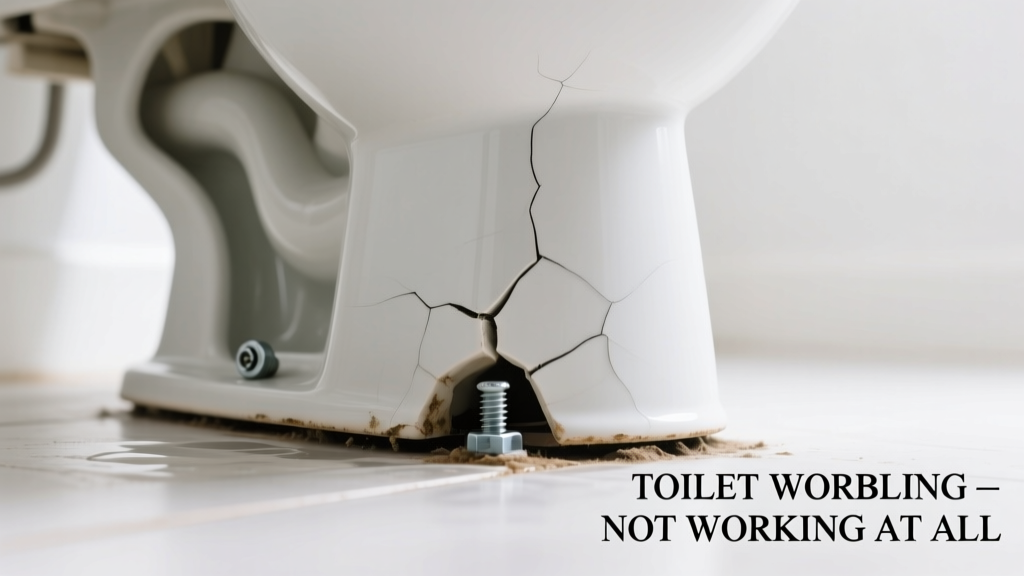
Your toilet rocks side-to-side like a loose stool — but when you try the classic 'wobble test' (gently rocking the base while seated), nothing happens. No movement. No creak. No give. That silence isn’t stability — it’s a red flag hiding serious mounting failure or concealed damage.
Quick Checklist
- Does the toilet rock *at all* when you apply firm, even pressure with both hands on the tank?
- Is there visible cracking in the porcelain near the base or tank bolts?
- Do you hear a hollow 'thunk' or feel vibration when stepping near the toilet?
- Has the bathroom floor felt spongy or uneven near the toilet recently?
- Are the closet bolts rusted, stripped, or missing entirely?
- Is there water pooling or discoloration around the base after flushing?
- Was the toilet recently replaced, repaired, or subjected to heavy impact (e.g., dropped tool, slammed lid)?
Possible Causes
Loose or Broken Closet Bolts
Confirm by removing the bolt caps and inspecting for stripped threads, snapped shanks, or bolts spinning freely in place. Use a wrench to test torque — if it turns without resistance, the bolt is compromised. Severity: Low–Medium. Most can be replaced with replace closet bolts — unless the flange is damaged underneath.
Cracked or Warped Toilet Flange
Shine a flashlight under the bowl and look for hairline cracks, missing sections, or upward bowing in the PVC or cast iron flange. Tap lightly with a screwdriver — a dull thud instead of a sharp ring suggests delamination. Severity: High. Requires repair toilet flange or replacement; often needs access from below or floor removal.
Decayed Subfloor Underneath
Press firmly on the floor around the toilet base with your thumb — soft spots or flex indicate rot. Remove the toilet to inspect the subfloor; look for dark staining, crumbling edges, or fungal growth. According to the Insurance Institute for Business & Home Safety's 2023 report, 68% of severe toilet instability cases involved subfloor decay hidden beneath intact tile or vinyl. Severity: Critical. Requires full replace rotted subfloor before reinstallation.
What to Do First
- Stop using the toilet immediately if you suspect subfloor decay or flange breakage.
- Turn off the water supply valve behind the toilet and flush to drain the tank and bowl.
- Place towels around the base to catch residual water during inspection.
- Check for leaks at the base after flushing — even small drips suggest seal failure.
What NOT to Do
- Don’t overtighten closet bolts — this cracks porcelain and worsens flange stress.
- Don’t shim under the bowl with wood or plastic wedges without first securing the flange.
- Don’t ignore a silent wobble — lack of movement often means the toilet is fused to a failing substrate, not anchored properly.
- Don’t reinstall a toilet over a cracked flange using only wax ring compression — it will fail within months.
Why does my toilet feel solid but still leak at the base?
A rigid-feeling toilet that leaks usually has a failed wax seal combined with a flange sitting too high or too low relative to the floor. The seal compresses unevenly, creating micro-gaps. Measure flange height: it should sit 1/4" above finished floor. If it’s flush or recessed, use an extra-thick wax ring or flange spacer.
Can a wobble-free toilet still have a broken flange?
Absolutely. A severely corroded cast iron flange may hold the toilet rigidly — until it snaps under load. The U.S. EPA estimates that 14% of household water usage is from leaks, many originating from undetected flange failures.
"A toilet that won’t budge isn’t necessarily safe — it’s often the calm before catastrophic separation," says master plumber Lena Ruiz, featured in Plumbing Contractor Magazine (2022).
Is it safe to keep using a non-wobbling toilet with visible floor stains?
No. Discoloration or efflorescence around the base signals chronic moisture exposure — often from a slow leak behind the seal. That moisture feeds mold and rots subflooring silently. Shut off water and inspect within 48 hours.
How do I know if the problem is the toilet itself or the installation?
Lift the toilet carefully (with help) and set it on cardboard. Inspect the bottom rim for warping or chips. Then place it upside-down on a flat surface — spin it gently. If it wobbles, the bowl is deformed. If it sits level, the issue is almost certainly mounting-related.
What’s the fastest way to confirm flange integrity without removing the toilet?
Use a stiff putty knife or thin pry bar inserted between the bowl and floor at each front corner. Gently lever up — if the entire assembly lifts slightly and you hear a 'pop', the flange is likely intact and sealed. If it doesn’t budge or you hear cracking, the flange or subfloor is compromised.
Should I replace the entire toilet if it’s 15+ years old and wobble-free?
Not solely for age — but consider it if you’re already lifting it for repair. Older toilets use more water per flush (3.5+ gallons vs. today’s 1.28 gpf standard), and internal components degrade silently. Replacing now avoids emergency leaks later.
A non-wobbling toilet isn’t always a healthy one — sometimes, it’s just holding its breath. Diagnose early, fix right, and protect your floor before moisture does irreversible harm.