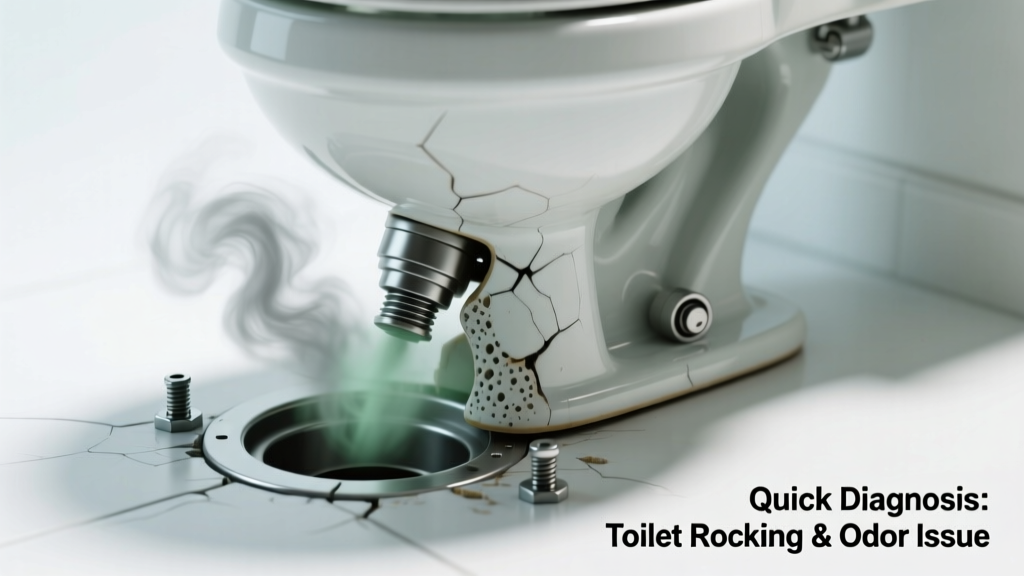
You’re standing in the bathroom, and as you shift your weight, the toilet rocks slightly — then a sharp, rotten-egg stench hits your nose. It’s not just unpleasant; it’s a red flag that something’s seriously wrong beneath the floor. Don’t panic: this combo of movement and odor almost always points to one or two specific failures — and most are fixable in under two hours.
Quick Checklist
- Does the toilet rock side-to-side or front-to-back when you press down on the tank or bowl?
- Is there visible water pooling around the base — even just a damp spot after flushing?
- Does the smell worsen after flushing or when running water in nearby sinks or showers?
- Can you hear a faint gurgling sound from the toilet or adjacent drain when water runs elsewhere?
- Has the wax ring been replaced in the last 5–7 years? (Most degrade after 5 years)
- Are the closet bolts visibly corroded, stripped, or missing?
- Is the subfloor around the toilet soft, discolored, or spongy when pressed?
Possible Causes
Failed Wax Ring Seal
Confirm by rocking the toilet gently while watching for gaps between the base and floor — if you see light or feel air movement, the seal is broken. A failed wax ring lets sewer gas escape directly into your bathroom. Severity: DIY-friendly for most homeowners with basic tools. Replace the wax ring requires removing the toilet, cleaning the flange, and reinstalling with a new ring or rubber gasket.
Cracked or Warped Toilet Flange
Inspect the PVC or cast-iron flange beneath the toilet: look for hairline cracks, rust-through (on metal), or a flange sitting more than 1/4″ below the finished floor. A compromised flange prevents proper compression of the wax ring. Severity: Moderate DIY if using a repair ring like the Oatey PVC Flange Repair Kit; otherwise, call a pro — especially if subfloor access is limited. Flange repair options vary by material and damage level.
Rotted Subfloor Under the Toilet
Press firmly around the base with your thumb — if the floor feels spongy or flexes, or if you detect musty, damp odors *before* flushing, rot is likely present. According to the National Association of Home Builders’ 2022 Residential Construction Defect Report, 23% of bathroom water-damage claims stem from undetected subfloor rot under toilets. Severity: Pro-required. Structural integrity is at risk — don’t delay. Subfloor replacement steps involve demolition, framing, and moisture remediation.
What to Do First
Stop using the toilet immediately if rocking is pronounced *and* odor is strong — especially if you suspect sewer gas. Turn off the water supply valve behind the toilet, flush once to empty the tank, then sponge out remaining water. Place towels around the base to absorb any seepage. Then, tighten the closet bolts *just enough* to stop motion — but don’t overtighten, or you’ll crack the porcelain.
"A rocking toilet isn’t just annoying — it’s actively venting hydrogen sulfide gas into your living space. The EPA identifies chronic low-level exposure as linked to headaches and respiratory irritation." — U.S. Environmental Protection Agency, Indoor Air Facts No. 4, 2021
What NOT to Do
- Don’t caulk around the base to hide the rock — it traps moisture and hides the real problem.
- Don’t keep flushing while ignoring the smell — each flush pushes more sewer gas into your home.
- Don’t use chemical drain cleaners hoping to ‘clear the smell’ — they won’t fix a broken seal and can damage pipes.
- Don’t assume tightening bolts alone will fix it — if the flange is damaged or floor is rotten, bolts won’t hold.
Why does my toilet rock only when I sit down?
That’s classic evidence of uneven compression — usually because the wax ring has flattened or shifted over time, or the flange is no longer level. Weight application reveals the gap. Check bolt torque first, but plan for a full reseal if rocking returns within days.
Can a bad smell come from the tank instead of the base?
Rarely — tank odors usually point to mold in the overflow tube or stagnant water in the fill valve. But if the smell is strongest at floor level and intensifies after flushing, it’s almost certainly coming from the base seal. Confirm by sniffing *at the joint* between bowl and floor, not near the tank.
Is it safe to use a rubber gasket instead of a wax ring?
Yes — and often preferable. Modern rubber gaskets (like Fluidmaster Better Than Wax) compress more evenly, tolerate minor flange height mismatches, and are reusable during repositioning. They cost ~$12 vs. $4 for wax, but reduce rework risk. Just ensure flange bolts are properly aligned before setting.
How long does a wax ring typically last?
Most manufacturers rate wax rings for 5 years, but real-world lifespan depends on humidity, floor movement, and installation quality. In high-moisture bathrooms or homes with shifting foundations, failure can occur in as little as 2–3 years. The U.S. EPA estimates that 14% of household water usage is from leaks — many starting as silent seal failures like this one.
Could this be a vent pipe issue instead?
Possibly — but vent problems usually cause gurgling *without* rocking or floor-level odor. If multiple drains gurgle and the toilet doesn’t rock, suspect the vent. Here, the physical movement + localized stink strongly points to the base seal or flange. Rule out seal failure first before climbing onto the roof.
What’s the average cost to fix a rocking, smelly toilet?
DIY: $15–$35 for wax ring, gasket, bolts, and flange repair kit. Pro service: $180–$320 (includes inspection, removal, reseal, and flange adjustment). If subfloor rot is found, add $450–$1,200 depending on extent. According to Angi’s 2023 Home Services Report, 68% of toilet-related service calls involving odor were resolved with a $25 part and 90 minutes of labor.
| Solution | Lifespan | Best For | Reusability |
|---|---|---|---|
| Standard wax ring | 5 years | Level flanges, experienced DIYers | No |
| Extra-thick wax ring | 4–5 years | Flanges 1/4″ below floor | No |
| Rubber gasket (e.g., Fluidmaster) | 10+ years | Uneven floors, rental properties, frequent adjustments | Yes (up to 3x) |
| Wax-free silicone seal | 7–10 years | High-humidity climates, mold-prone homes | No |
If the rocking stopped after tightening the bolts but the smell lingers, the wax ring is likely compromised — even if no water is visible. Replace it. If the floor feels soft or you see dark stains spreading outward from the base, shut off the water and call a licensed plumber today. Most cases aren’t emergencies — but sewer gas exposure isn’t something to wait on.