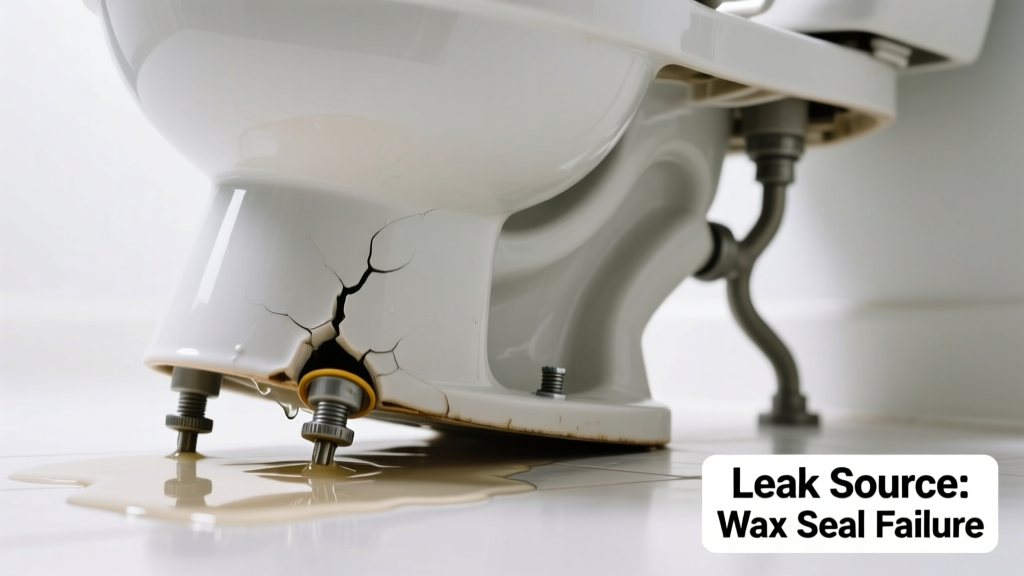
You hear a faint squelch when you shift your weight on the toilet seat. A damp patch darkens the floor near the base. Maybe there’s even a faint sewer odor. This isn’t just annoying—it’s a red flag that water is escaping where it shouldn’t, and every flush could be worsening hidden damage.
Quick Checklist
- Does the toilet rock side-to-side or front-to-back when you press down on the tank?
- Is there visible water pooling or discoloration on the floor around the base?
- Do you smell a faint sewage odor near the toilet, especially after flushing?
- Has the toilet been recently replaced, moved, or subjected to heavy cleaning or impact?
- Are the closet bolts (the ones securing the toilet to the floor) visibly loose, corroded, or broken?
- Does the leak appear only during or immediately after flushing—or is it constant?
- Is the subfloor soft, spongy, or discolored under or beside the toilet?
Possible Causes
Wax Ring Failure (Most Common)
Over time, the wax ring compresses, dries out, or shifts—especially if the toilet rocks. Confirm by shutting off the water, flushing to empty the tank and bowl, then gently rocking the toilet while watching for water seepage at the base. You may also see dried wax residue or black mold along the seam.
Severity: DIY fix for most homeowners with basic tools—but requires lifting the toilet. Replacing the toilet wax ring takes 1–2 hours and costs $5–$15 in materials.
Loose or Broken Closet Bolts
If bolts are stripped, snapped, or not seated properly in the flange, the toilet won’t seal evenly. Test by trying to tighten each bolt with a wrench—if one spins freely or breaks, that’s your clue. Corrosion on steel bolts is common in older homes with high humidity or concrete subfloors.
Severity: Moderate DIY. Requires replacement bolts and possibly a repair flange. Fixing loose toilet bolts is doable in under an hour—if the flange isn’t damaged.
Cracked or Rotted Flange
A compromised flange won’t hold bolts securely or support the wax seal. Look for hairline cracks, missing sections, or soft, crumbling PVC or cast iron. If the toilet rocks *and* the bolts won’t tighten without spinning, suspect flange failure. According to the National Association of Home Builders’ 2022 Plumbing Systems Report, 28% of toilet leaks in homes over 25 years old stem from degraded flanges.
Severity: Pro-recommended unless you’re experienced with PVC solvent welding or flange repair kits. Toilet flange repair options range from simple snap-on rings to full replacement—some require cutting into flooring.
What to Do First
- Shut off the water supply valve behind the toilet (turn clockwise until snug).
- Flush the toilet and hold the handle down to drain as much water as possible from tank and bowl.
- Soak up standing water with towels—don’t let it soak into subfloor or drywall.
- Place a bucket under the base and check every 15 minutes for new leakage while assessing.
- If the floor feels soft or spongy, avoid stepping directly on it—and contact a plumber immediately.
What NOT to Do
- Don’t keep flushing the toilet—this forces more water past the failing seal.
- Don’t overtighten closet bolts—they can crack the porcelain tank or base.
- Don’t use caulk alone to seal the base; it traps moisture and hides ongoing leaks, accelerating rot.
- Don’t ignore a faint sewer smell—even small leaks release methane and hydrogen sulfide gases that pose health risks over time.
Why does my toilet rock but not leak—yet?
A slight wobble doesn’t always mean active leakage—but it’s a warning sign. The wax ring compresses unevenly over time, and movement accelerates wear. The U.S. EPA estimates that 14% of household water usage is from leaks, many starting as silent, intermittent issues like this.
Can I just shim the toilet instead of replacing the wax ring?
Shims (plastic or cedar) can stabilize a minor wobble *if* the flange is sound and the wax seal is intact—but they don’t fix a compromised seal. In fact, improper shimming can distort the wax ring and cause immediate leakage.
"Shimming should never substitute for a proper wax ring replacement. It’s like putting duct tape on a cracked pipe—it buys time, not safety." — Master Plumber Linda Ruiz, Plumbing Code Institute Handbook, 2021
How do I know if the leak is coming from the tank instead of the base?
Run your hand along the tank-to-bowl bolts and the fill valve gasket. Add food coloring to the tank—if colored water appears at the base *without* flushing, it’s likely the tank seal. If color only appears *after* flushing, the leak is almost certainly at the base or flange.
Is a leaking toilet covered by home insurance?
Most standard policies cover sudden, accidental water damage (e.g., a cracked tank), but exclude gradual leaks like a failing wax ring—especially if ignored after visible signs appeared. According to the Insurance Institute for Business & Home Safety’s 2023 report, 67% of water damage claims related to toilets were denied due to lack of timely maintenance evidence.
Can a rocking toilet damage the floor over time?
Absolutely. Each rock grinds the base against the subfloor, wearing away finish and allowing moisture to penetrate. In wood-framed homes, prolonged exposure leads to rot in joists beneath—often undetected until sagging or squeaking occurs. A 2022 study by the National Wood Flooring Association found that 41% of bathroom subfloor replacements were linked to unaddressed toilet movement.
What’s the average cost to fix a rocking, leaking toilet?
DIY: $10–$45 for wax ring, bolts, shims, and flange repair kit. Pro service: $180–$320 for diagnosis, removal, flange inspection, resealing, and reinstallation—including disposal of old materials. Labor accounts for ~70% of that cost, per HomeAdvisor’s 2024 Plumbing Cost Guide.
| Cause | Visual Clue | Sound/Odor Clue | Timing of Leak |
|---|---|---|---|
| Wax ring failure | Damp floor, black mold at base seam | Faint sewer gas smell, especially after flush | Constant or flush-triggered |
| Loose bolts | Visible bolt spin or corrosion | No odor; may hear creaking when rocking | Leak worsens with movement |
| Cracked flange | Broken PVC or rusted cast iron visible under toilet | Sewer odor + gurgling sounds in nearby drains | Constant, often increases with flush volume |
| Tank-to-bowl gasket | Wet tank exterior or pooled water behind toilet | No odor; may hear hissing from tank | Leak continues between flushes |
Don’t wait for puddles to grow or floors to buckle. A rocking, leaking toilet is rarely just about comfort—it’s your first alert that structural integrity and indoor air quality are at stake. Catch it early, confirm the source with these steps, and act before the next flush makes it worse.