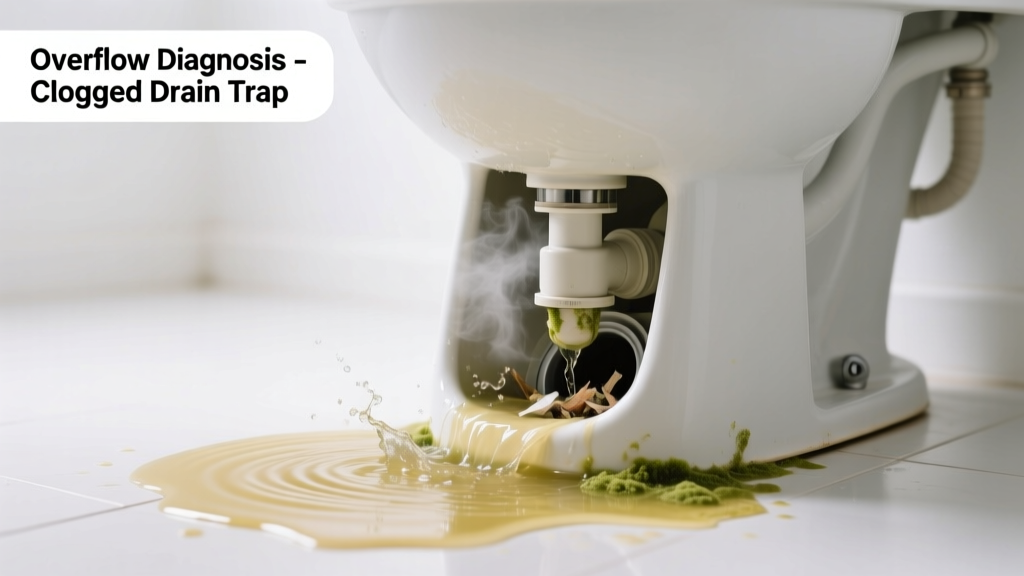
Your toilet gurgles, water rises ominously in the bowl, and a sharp, rotten-egg stench floods the bathroom — sometimes even seeping under the door into the hallway. It’s alarming, yes, but most causes are fixable fast if you act before sewage backs up into your floor.
Quick Checklist
Answer these yes/no questions to narrow the root cause:
- Did the overflow happen *immediately* after flushing — with no prior slow draining?
- Is the smell strongest near the toilet base or floor drain, not just the bowl?
- Are other drains (shower, sink, tub) also slow or gurgling when the toilet flushes?
- Does the odor worsen after heavy rain or during high water usage (e.g., laundry + shower running)?
- Have you recently used chemical drain cleaners or flushed non-degradable items (wipes, cotton pads, toys)?
- Is there visible standing water or dampness around the toilet’s base or nearby flooring?
Possible Causes
Clogged Trap or Drain Line (Most Common)
Confirm it: Plunge vigorously — if water recedes and flushes cleanly afterward, the clog was shallow. A wet/dry vac may pull out paper or debris just past the trap. Severity: DIY-friendly for 80% of cases. Fix a toilet clog.
Blocked or Damaged Vent Stack
Confirm it: Gurgling from other drains *during* or *right after* a toilet flush — especially sinks or showers — points to vent restriction. Climb onto the roof (safely) and check for bird nests, ice, or debris in the vent pipe opening. Severity: Moderate DIY; if pipe is cracked or corroded, call a pro. Clear a blocked vent stack.
Sewer Line Backup (Urgent)
Confirm it: Multiple fixtures backing up simultaneously, sewage odor in basement floor drains, or wastewater surfacing in yard cleanouts. According to the U.S. EPA, 14% of household water usage is lost to leaks — but sewer backups cost homeowners an average of $4,500 in repairs when ignored (IBHS Sewer System Report, 2022). Severity: Call a licensed plumber *immediately*. Do not attempt DIY.
What to Do First
Stop using the toilet — shut off the water supply valve behind the base (turn clockwise until tight). Place towels around the base to absorb seepage. If water is rising fast and won’t drain, carefully scoop out excess with a cup into a bucket — never use the plunger yet if water is near the rim. Open windows for ventilation, but avoid running fans that could aerosolize contaminants.
What NOT to Do
- Don’t flush again — this forces more waste toward the blockage.
- Don’t pour boiling water or caustic drain chemicals — they can crack porcelain or damage pipes.
- Don’t ignore a musty odor lingering *after* water recedes — that’s biofilm or sewer gas escaping, not just residual smell.
- Don’t assume it’s “just a clog” if your basement floor drain bubbles when the toilet flushes — that’s a red flag for main line issues.
Why does my toilet overflow *and* smell like sewage?
The smell isn’t from the overflow itself — it’s sewer gas entering your home because water in the P-trap has been siphoned away or displaced by pressure from a blocked vent or main line. When water can’t flow freely downstream, air (and gas) gets forced backward through traps.
Can a bad wax ring cause both overflow and odor?
No — a failed wax ring causes leakage *around the base*, not overflow *upward*. But it *does* allow sewer gas to escape constantly, which may coincide with a separate clog. Check for damp flooring or rocking toilet — then replace the wax ring after resolving the blockage.
Why does the smell get worse at night or early morning?
Air pressure changes and lower household water usage overnight reduce airflow in drains — letting trapped sewer gases concentrate and rise. This is common with partial vent obstructions or dry traps in infrequently used bathrooms.
Is the rotten-egg smell dangerous?
Yes — hydrogen sulfide (H₂S), the primary compound behind that odor, becomes hazardous above 10 ppm. Chronic low-level exposure causes headaches and nausea. The CDC warns that concentrations over 100 ppm impair judgment and pose immediate health risks. Always ventilate and evacuate if odor is overwhelming or accompanied by dizziness.
Could tree roots be causing this?
Yes — especially if your home is older (pre-1970s clay or cast iron pipes) or near mature trees. Roots infiltrate cracks, swell, and create total blockages. Signs include recurring clogs, slow drains across multiple floors, and gurgling after rain. Camera inspection is required — root removal options range from hydro-jetting to trenchless pipe lining.
What’s the difference between sewer gas and mold smell?
Sewer gas hits your nose instantly — sharp, sulfurous, like rotten eggs or stagnant swamp water. Mold smells musty, damp, or like wet cardboard, often localized to walls, ceilings, or behind cabinets. If you smell both, you may have a leak *plus* a clog — moisture from a failing seal feeds mold growth while gas escapes.
| Symptom | Clog Only | Vent Issue | Main Sewer Line Failure |
|---|---|---|---|
| Overflow location | Bowl only | Bowl + gurgling elsewhere | Bowl + basement drain backup + yard cleanout overflow |
| Odor timing | During/after flush | Worse after multiple fixtures used | Persistent, worsens with rain or laundry |
| DIY success rate | 85% | 60% | <5% — requires camera inspection & excavation |
"If your toilet overflows *and* you smell sewer gas, assume the P-trap is compromised — either by siphoning or evaporation. Never wait for the smell to 'go away.' That gas is telling you your drainage system is fundamentally unsealed." — Licensed Master Plumber, Plumbing Code Institute Field Manual, 2021
Act quickly, but don’t panic — most overflowing, smelly toilets stem from simple, solvable issues. Start with the checklist, isolate the cause, and move step-by-step. Delaying action risks structural damage, mold growth, and costly remediation. You’ve got this — and if you’re unsure, find a vetted local plumber before the next flush.