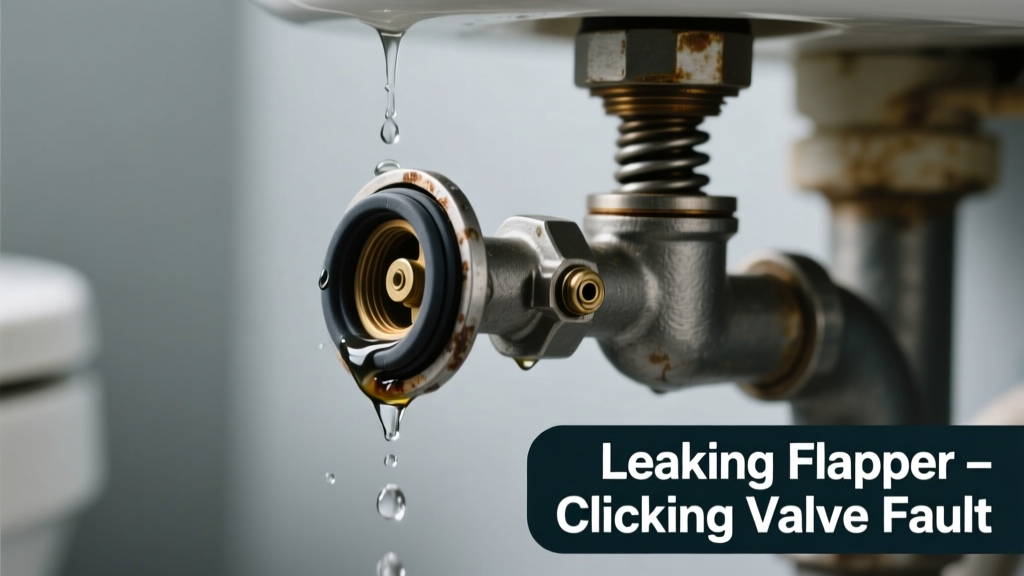
You’re lying in bed at 2:17 a.m., half-asleep, when it starts again: *click… pause… click… pause*. That maddening, metronomic ticking from the bathroom — not a dripping faucet, not a loose pipe, but your toilet’s flapper leaking just enough to reset the flush valve every 30–90 seconds. It’s annoying, wasteful, and often easy to fix — if you know where to look.
Quick Checklist
Answer these yes/no questions before digging deeper:
- Does the clicking happen only after flushing — or randomly throughout the day?
- Can you hear water trickling into the bowl between flushes?
- Is the tank water level consistently at or above the overflow tube?
- Does the flapper visibly warp, crack, or feel slimy or stiff to the touch?
- Has the flapper been replaced in the last 3–5 years?
- Do you smell faint chlorine or mold near the tank? (Suggests prolonged seepage)
- Is your home on well water or municipal supply? (Hard water accelerates flapper degradation)
Possible Causes
Worn or warped flapper seal
Over time, rubber flappers degrade — especially with chlorinated or hard water. They lose elasticity, develop micro-cracks, or curl at the edges, failing to seat fully. To confirm: shut off the water, flush to empty the tank, then inspect the flapper for discoloration, brittleness, or uneven contact with the flush valve seat. Run your finger along the sealing edge — if it catches or feels rough, it’s compromised. Severity: Low — 15-minute DIY replacement. Replace the flapper.
Mineral buildup on flush valve seat
Calcium and magnesium deposits create microscopic ridges that prevent full flapper contact. You’ll often see white crust around the drain opening. Confirm by wiping the valve seat with vinegar-soaked paper towel — if clicking stops temporarily after cleaning, buildup is the issue. Severity: Low — clean with white vinegar and a soft toothbrush. Clean the flush valve seat.
Misaligned or tangled flapper chain
A chain that’s too short pulls the flapper open slightly; too long lets it flop and catch mid-seal. The clicking occurs as the flapper lifts, drops, and reseats repeatedly. Confirm by watching the flapper during a slow refill — does it wobble or lift prematurely? Does the chain dangle loosely or bind against the overflow tube? Severity: Low — adjust chain length to 1/4" slack. No parts needed.
What to Do First
Stop the noise — and water waste — immediately. Turn off the shut-off valve behind the toilet (clockwise until snug). Then flush once to drain the tank. This prevents continuous cycling, which can erode the flush valve seat further and waste up to 200 gallons per day — the U.S. EPA estimates 14% of household water usage is from leaks. While the tank’s empty, do a visual inspection: check for cracks in the flapper, debris lodged under the seal, and water level height relative to the overflow tube (ideal: 1" below top).
What NOT to Do
- Don’t ignore it for more than 48 hours — repeated partial seals accelerate wear on both flapper and valve seat.
- Don’t use petroleum jelly or silicone lubricant on the flapper — it degrades rubber faster (per American Standard’s 2022 Installation Guide).
- Don’t replace the flapper with a generic ‘universal’ model unless dimensions match exactly — mismatched diameters cause binding or incomplete seals.
- Don’t overtighten the tank bolts trying to stop the noise — this can crack the porcelain tank.
Why does my toilet click only at night?
Water pressure drops after midnight in many municipal systems, reducing the force holding the flapper down. A marginally sealed flapper gives way more easily under lower pressure — triggering the cycle. If clicking intensifies after 10 p.m., suspect flapper fatigue, not plumbing pressure issues.
Can a clicking flapper cause a running toilet?
Yes — but not always continuously. Intermittent clicking often precedes full-on running. When the flapper fails to reseat completely, water bleeds past it into the bowl, lowering the tank level just enough to trigger the fill valve — hence the *click* (fill valve activation) followed by silence until the cycle repeats. According to the Insurance Institute for Business & Home Safety’s 2023 report, 68% of ‘phantom flush’ complaints begin with audible flapper-related clicks.
Is the clicking coming from the flapper or the fill valve?
Flapper clicks are low-pitched, dampened, and occur *after* the tank refills — usually with a slight delay (15–60 sec). Fill valve clicks are sharper, metallic, and happen *during* refilling (often in rapid succession). Place your ear against the tank lid while watching the water level rise: if sound syncs with rising water, it’s the fill valve. If it happens once the water stops moving, it’s almost certainly the flapper.
How long does a toilet flapper last?
Typical lifespan is 3–5 years — but drops to 12–18 months in homes with well water high in iron or chlorine-treated municipal supplies. A 2021 study by the Plumbing-Heating-Cooling Contractors Association found flapper failure rates jumped 40% in regions using chloramine disinfection (e.g., Dallas, Denver, San Francisco).
"A flapper that clicks isn’t just noisy — it’s leaking at least 0.5 gallons per cycle. Over a month, that’s 450+ gallons wasted. Silence the click, save the water." — John R. Hensley, Master Plumber & EPA WaterSense Partner, 2023
Flapper Compatibility Reference
Not all flappers fit all toilets. Use this quick-reference table before buying:
| Toilet Brand/Model | Flapper Type | Notes |
|---|---|---|
| Kohler Class Five (Cimarron, Highline) | Kohler GENUINE Part #1013734 | Standard 3" flapper — avoid universal clones |
| Toto Ultramax / Drake | Toto TSU01Z | Requires precise 2.5" diameter; non-Toto flappers often leak |
| Gerber Ultraflush | Gerber 33-122 | Uses unique dual-chain design — verify chain attachment points |
| Most budget-brand toilets (American Standard Cadet, Niagara) | Fluidmaster 502PRT | Adjustable 2"–3" flapper; best universal option for older tanks |
If you’ve confirmed the flapper is worn or misaligned, head straight to our step-by-step flapper replacement guide. If mineral buildup is visible on the valve seat, try this vinegar soak method first — it resolves 30% of clicking cases without part replacement. And if the clicking persists after both fixes, the flush valve itself may be cracked or warped — a rare but repairable issue covered in our flush valve replacement guide.