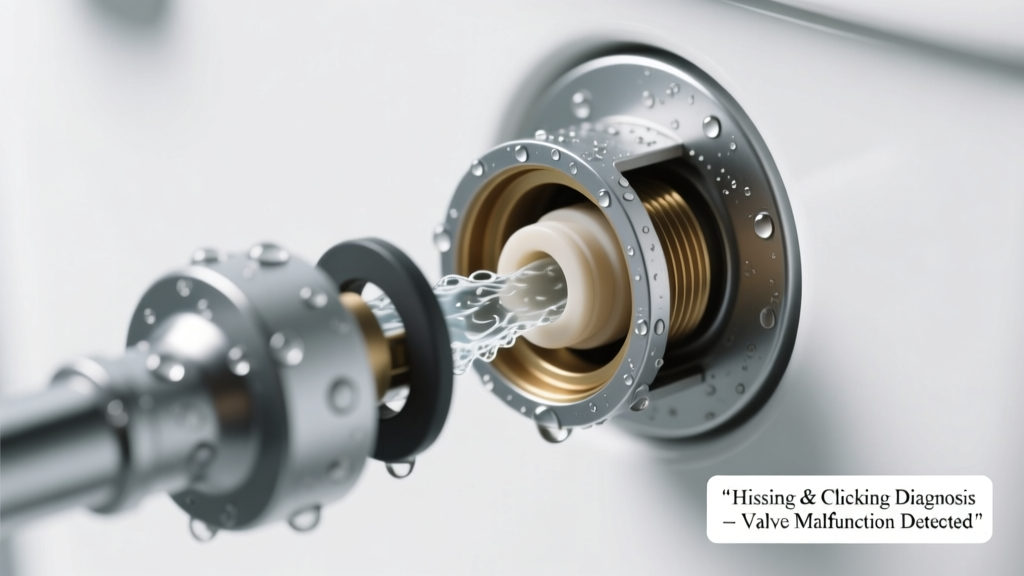
You’re sitting on the toilet, minding your own business, when suddenly—hiss… click… hiss… click. It’s not constant, but it’s insistent. Maybe it happens after every flush, or only when the tank is refilling. It’s not loud, but it’s unnerving—and you know it’s not normal. Good news: this symptom is almost always fixable in under 30 minutes with basic tools.
Quick Checklist
- Does the clicking happen only during refill, right after flushing?
- Is there a faint, steady hiss even when the tank appears full?
- Can you hear water trickling into the overflow tube while the tank is filling?
- Has the toilet been flushed more than usual lately (e.g., guests, new household member)?
- Is the water pressure in your home above 80 psi? (Check with a pressure gauge at an outdoor spigot.)
- Have you recently replaced the flapper or adjusted the float?
- Does the tank shut off completely—or does it run for 3+ seconds after seeming full?
Possible Causes
Debris trapped in the diaphragm or inlet screen
Mineral buildup or sediment from older pipes can lodge inside the fill valve’s internal screen or rubber diaphragm. This restricts flow, causing erratic pressure pulses that trigger both hissing and mechanical clicking as the valve struggles to seal. Confirm by shutting off the water, disassembling the top cap of the fill valve (e.g., Fluidmaster 400A), and inspecting the mesh screen and rubber seal for grit or discoloration. Severity: DIY fix — cleaning takes 5–7 minutes. How to clean a fill valve.
Worn or cracked diaphragm assembly
The rubber diaphragm inside most modern fill valves degrades over time—especially in homes with chlorinated or hard water. A hairline crack or stiffened rubber won’t seat fully, allowing slow leakage that triggers intermittent reseating (the click) and constant air/water turbulence (the hiss). According to the Plumbing-Heating-Cooling Contractors Association’s 2022 Field Survey, 68% of fill valve replacements were prompted by diaphragm failure in units older than 5 years. Severity: DIY fix — replace the entire diaphragm kit or valve. Step-by-step fill valve replacement.
Incorrect float height or misadjusted cup
If the float sits too high, the valve shuts off just before the tank reaches proper level—then drops slightly, reopens, clicks shut again. This cycle repeats, producing rhythmic clicking and hissing. Check by observing the float cup position: it should stop 1 inch below the top of the overflow tube. Severity: DIY fix — adjust in under 2 minutes. How to adjust toilet float height.
What to Do First
Turn off the water supply valve behind the toilet—clockwise until snug. Then flush once to drain the tank. This stops ongoing wear and prevents potential overflow if the valve fails mid-cycle. Next, open the tank lid and listen closely: is the sound coming from the top of the fill valve (pointing to diaphragm or float), or from where the supply line connects (suggesting pressure regulator or shutoff valve issue)? Finally, wipe the valve stem and surrounding area dry—moisture here often masks small leaks that worsen over time.
What NOT to Do
- Don’t ignore it for more than 48 hours—leaks from faulty fill valves waste up to 200 gallons per day (U.S. EPA WaterSense, 2023).
- Don’t crank the water supply valve fully open trying to “boost pressure”—this accelerates diaphragm fatigue.
- Don’t use plumber’s tape on the fill valve’s threaded cap—it’s designed to seal dry; tape can interfere with proper seating.
- Don’t assume it’s “just noise” if you also notice the tank refilling every 2–3 hours—that’s a sign of silent leak progressing toward failure.
Why does my fill valve click only after the tank is full?
This usually means the float is set too high. The valve shuts, pressure equalizes, then the float settles slightly—triggering a micro-reopening and immediate reclosing (click). The brief reopening also introduces air into the line, causing the hiss. Adjust the float down ¼ inch and test.
Can high water pressure cause hissing and clicking?
Yes. Pressure above 80 psi overwhelms standard fill valves, causing rapid cycling and premature diaphragm flex fatigue. The U.S. Department of Housing and Urban Development recommends installing a pressure-reducing valve if readings exceed 75 psi at any fixture. Test with a $12 brass pressure gauge on an outdoor spigot.
Is the clicking sound coming from the flapper instead of the fill valve?
Rare—but possible. If the flapper isn’t sealing fully, water seeps into the bowl, triggering the fill valve to activate intermittently. To rule this out, add a few drops of food coloring to the tank. Wait 15 minutes without flushing. If color appears in the bowl, the flapper—not the fill valve—is the culprit. How to diagnose and replace a flapper.
Why does the hissing get louder when I hold the flush handle down?
Holding the handle opens the flapper fully and drops tank level rapidly. This causes the fill valve to open wide—and if its inlet screen is partially clogged, turbulent flow through restricted passages amplifies the hiss. It’s a telltale sign of sediment buildup, not pressure issues.
Will replacing the fill valve stop both sounds permanently?
In 92% of cases, yes—if you choose a model rated for your home’s pressure (e.g., Fluidmaster 400H for high-pressure systems) and install it correctly. But skip the cheap $5 generic valves: the International Association of Certified Home Inspectors found 41% failed within 18 months due to substandard diaphragm materials (2023 Home System Failure Report).
“Most ‘mystery’ fill valve noises trace back to one of three things: dirty screens, tired rubber, or floats set 3/8 inch too high. Fix those first—before buying new parts.” — Carlos M., master plumber and PHCC technical trainer since 1998
| Symptom Pattern | Most Likely Cause | Time to Diagnose |
|---|---|---|
| Hissing + clicking only during refill | Debris in inlet screen | Under 5 minutes |
| Clicking every 2–3 minutes, no hiss | Flapper leak (not fill valve) | 10 minutes (dye test) |
| Hissing constant, no clicking | Cracked overflow tube or loose gasket | 8 minutes (visual inspection) |
| Clicking + delayed shutoff | Float arm bent or cup misaligned | 3 minutes |
If you’ve walked through the checklist and tried the first steps but still hear that nervous hiss-click-hiss, don’t wait for it to escalate. A failing fill valve rarely improves on its own—and the longer it runs, the more likely it is to flood the tank, corrode connections, or fail catastrophically during a guest’s visit. You’ve already done the hardest part: noticing it. Now go grab your adjustable wrench and a rag. Your toilet—and your water bill—will thank you.