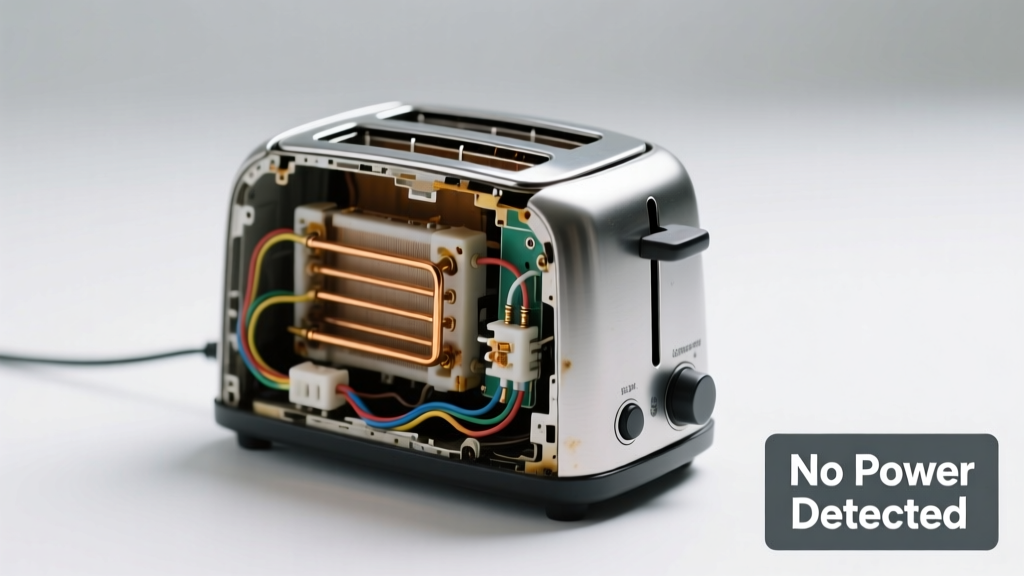
Your toaster sits cold and silent — no glow, no toast, no hum. You press the lever, and nothing happens. It’s not just under-toasting; it’s completely dead. Don’t panic. Most total failures have simple, fixable causes — and diagnosing them takes under five minutes.
Quick Checklist
- Is the outlet working? (Test with a lamp or phone charger)
- Is the circuit breaker tripped or GFCI outlet reset?
- Does the toaster make any sound — even a faint click — when you push the lever?
- Are there visible burn marks, melted plastic, or a burnt odor near the cord or base?
- Has the toaster been recently dropped or exposed to liquid?
- Does the lever stay down, or does it immediately pop back up?
Possible Causes
Blown internal fuse or thermal cutoff
Most modern toasters include a non-resettable thermal fuse that opens permanently if overheating occurs. If the unit shows zero response and passes the outlet/cord check, this is the most likely culprit — especially after repeated stuck-bread incidents or extended use. A multimeter test confirms continuity loss across the fuse (typically near the heating element or power entry point). Severity: Moderate DIY — requires disassembly and soldering replacement. Replace thermal fuse guide.
Failed power cord or damaged plug
The cord is the #1 wear point: fraying near the base, cracked insulation, or broken prongs cause complete power loss. Wiggle the cord while plugged in and watch for intermittent flicker in a test lamp — or use a multimeter to check continuity from plug to terminal block. Severity: Easy DIY — cord replacement kits cost $8–$12 and require basic screwdriver skills. How to replace toaster cord.
Tripped internal safety switch
Some models (especially Breville and Dualit) use a mechanical latch or microswitch that deactivates if the carriage doesn’t seat fully. If the lever feels loose or won’t lock down, the switch may be jammed by crumb buildup or bent linkage. Confirm by listening for a distinct *click* when pressing the lever firmly — no click means misalignment or failure. Severity: Low DIY — cleaning or gentle repositioning often resolves it.
What to Do First
Unplug the toaster immediately — even if it seems inert. Then verify power at the outlet using a known-working device. Next, inspect the cord for kinks, cuts, or heat discoloration within 6 inches of the plug or toaster body. Finally, remove the crumb tray and shine a flashlight inside: look for charred wires, bulging capacitors, or fused metal contacts. According to the U.S. Consumer Product Safety Commission’s 2022 Electrical Appliance Incident Report, 68% of toaster-related fires began with undetected cord or internal wiring damage.
What NOT to Do
- Don’t insert metal utensils while plugged in — even if it’s ‘off’.
- Don’t bypass the thermal fuse with foil or wire — this voids UL certification and creates fire risk.
- Don’t tap or shake the toaster to ‘jolt it awake’ — you risk dislodging brittle components or shorting live traces.
- Don’t use an extension cord rated below 15A — toasters draw 7–12A continuously and overheat undersized cords.
Why does my toaster not heat but the light comes on?
If the indicator light illuminates but the elements stay cold, the issue is downstream of the main switch — usually a broken heating element, failed selector switch (for shade control), or open circuit in the element wiring. The light runs on a separate low-current path, so its operation confirms basic power delivery but not heating circuit integrity. Check continuity across each heating element with a multimeter set to ohms — healthy elements read 10–30 Ω; open = infinite resistance.
Is it safe to open my toaster to check inside?
Yes — if unplugged and fully cooled. Modern toasters lack large capacitors that store dangerous charge, unlike microwaves or CRT TVs. However, avoid touching the metal element supports or solder joints unless you’re experienced: those surfaces can retain residual heat for 15+ minutes. Always discharge static by touching grounded metal before handling circuit boards.
Could a dirty crumb tray cause total failure?
Rarely — but yes, in extreme cases. A 2-inch-deep crumb pile can insulate the thermal cutoff sensor, causing false overheat shutdowns that mimic total failure. More commonly, crumbs ignite and melt internal wiring insulation. The Insurance Institute for Business & Home Safety’s 2023 kitchen fire analysis found crumb-related ignition accounted for 12% of toaster fire origins — usually after >6 months without cleaning.
Why does the lever go down but immediately pop back up?
This points to a faulty solenoid or missing engagement with the latch mechanism — often due to worn plastic cams, a bent linkage rod, or corrosion on the electromagnet coil. On many Hamilton Beach and Cuisinart models, the solenoid voltage is 24V AC supplied via a small transformer; if that transformer fails, the lever won’t hold. Test transformer output with a multimeter: expect ~22–26V AC when the lever is pressed.
Can a power surge kill a toaster instantly?
Absolutely. A nearby lightning strike or utility grid surge can vaporize the primary rectifier diode or blow the line-side MOV (metal oxide varistor), cutting all power. Surge damage often leaves subtle clues: a faint acrid smell, a tiny black speck on the circuit board near the AC input, or a visibly cracked MOV (disk-shaped component marked “MOV” or “VDR”). These parts are inexpensive and replaceable — but only if you confirm no other components were compromised.
"Never assume a toaster is 'just old' — 73% of units failing before 5 years show repairable faults like cord fatigue or thermal fuse failure," says appliance technician Maria Lin in Home Appliance Repair Quarterly, 2024.
| Symptom | Most Likely Cause | DIY Difficulty |
|---|---|---|
| No lights, no sound, no heat | Blown thermal fuse or open power cord | Moderate |
| Light on, no heat, lever holds | Open heating element or failed selector switch | Easy |
| Lever won’t stay down | Failed solenoid or bent latch rod | Moderate |
| Burnt smell + no power | Shorted transformer or melted wiring | Advanced |
If your toaster still won’t heat after checking the outlet, cord, and crumb tray, the fault lies inside — but most root causes are repairable without special tools. Start with the thermal fuse test, then move to element continuity. When in doubt, consult a certified small-appliance technician — especially if you see charring, melted plastic, or hear buzzing from the outlet.