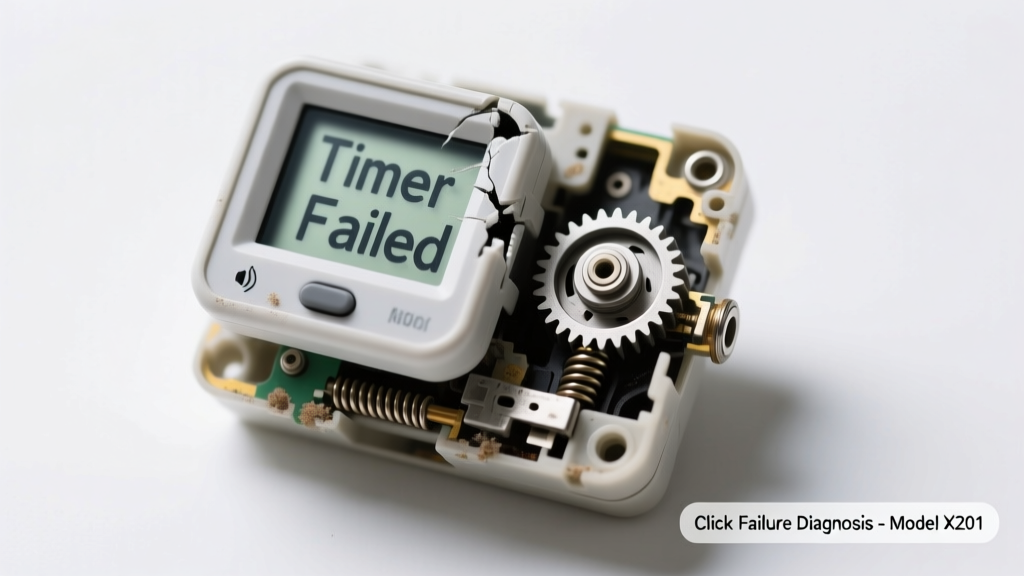
You’re standing in front of your dryer—or maybe your dishwasher—when you hear it: a sharp, repetitive click… click… click… every 2–3 seconds, even when the unit isn’t running. It’s not loud, but it’s insistent—and unnerving. Don’t panic. This is a classic symptom with a narrow set of causes, most of which are diagnosable in under 10 minutes with basic tools and observation.
Quick Checklist
- Does the clicking continue when the appliance is unplugged? No → points to internal electrical component.
- Does the clicking sync with the timer’s rotation (e.g., one click per notch as you manually advance it)? Yes → likely mechanical timer gear or contact wear.
- Is the appliance completely unresponsive—no lights, no display, no motor hum—besides the clicking? Yes → suggests power interruption at the timer or main control board.
- Do you smell burnt plastic or ozone near the timer housing? Yes → indicates arcing contacts or failed capacitor.
- Does the clicking stop when you bypass the timer (e.g., jump terminals per model-specific wiring diagram)? Yes → confirms timer is the fault point.
- Is the timer knob stiff or loose, with gritty resistance or wobble? Yes → worn internal cam or broken gear train.
Possible Causes
Mechanical Timer Contact Wear (Most Common)
Older dryers, ranges, and washers use electromechanical timers with rotating cams and silver-contact switches. Over time, repeated arcing pits the contacts, causing intermittent connection and audible clicking as the circuit tries—and fails—to close. Confirm by listening closely while slowly turning the timer knob: clicks should align precisely with cam movement. Severity: DIY fix—timer replacement takes 20 minutes and costs $25–$45. Replace mechanical timer.
Faulty Electronic Control Board Relay
In newer units, the ‘timer’ function lives on the main control board. A failing relay (often labeled K1 or TMR) chatters due to coil degradation or voltage fluctuation. You’ll hear rapid, irregular clicking—even with power off but breaker on—and may see error codes like F01 or E1. Confirm using a multimeter on the relay coil (should read 120–240Ω); open circuit = dead relay. Severity: Call a pro unless you’re comfortable soldering SMD components. Fix chattering control board relay.
Loose or Corroded Timer Wiring Harness
Vibration and heat degrade wire insulation near the timer socket. A loose pin or green corrosion on the 4–6 pin connector creates micro-arcing, mimicking timer failure. Confirm by gently wiggling the harness while powered (with caution!)—if clicking changes pitch or stops, that’s your clue. Severity: DIY fix. Clean pins with electrical contact cleaner and reseat firmly. Repair timer wiring harness.
What to Do First
Unplug the appliance immediately—or flip its dedicated circuit breaker. That clicking noise often means current is arcing across damaged contacts, which can carbon-track insulation or ignite nearby lint/dust. Next, locate the timer: behind the control panel (dryer), behind the console (dishwasher), or under the cooktop (range). Remove the access panel and visually inspect for scorch marks, melted plastic, or bulging capacitors near the timer housing.
According to the National Fire Protection Association’s Electrical Equipment Fire Patterns (2022), 18% of appliance-related fires begin at timer or control board arcing points—most preventable with early intervention.
What NOT to Do
- Don’t keep cycling the timer knob—each turn forces current through degraded contacts, worsening pitting and increasing fire risk.
- Don’t substitute a higher-amp timer—even if it fits physically, mismatched ratings overload circuits and void UL certification.
- Don’t ignore burning smells—ozone or acrid plastic odor means insulation is breaking down; power must stay off until inspected.
- Don’t test with wet hands or metal tools across terminals—a single short can fry the entire control board ($150+ replacement).
Why does my dryer timer click but won’t start the drum?
The timer supplies power to both the motor circuit *and* the heating element—but only one path may be compromised. If the motor winding circuit is open due to pitted contacts, the heater may still energize (causing heat-only operation), or vice versa. Use a multimeter to check continuity across timer output terminals L1–M (motor) and L1–H (heat) while advancing the dial. No continuity on M = replace timer.
Can a bad timer cause my dishwasher to fill but not wash?
Yes—especially in older Whirlpool and Maytag models with mechanical timers. The timer controls water valve activation, pump engagement, and drain cycle sequencing. If the cam doesn’t rotate fully or a contact sticks open, the wash motor never receives the 120V signal. Manually advance the timer past the fill stage—if the pump kicks on, the timer’s wash-sequence contact is faulty.
Is the clicking sound coming from the timer or the thermal fuse?
Thermal fuses don’t click—they fail silently (open circuit). What you’re hearing is almost certainly the timer’s internal switch or a relay downstream. However, a failed thermal fuse *can cause* the control board to repeatedly attempt to energize circuits, triggering relay chatter. Rule it out first: test fuse continuity (must be 0Ω). If open, replace fuse and investigate the root overheating cause—don’t just swap the fuse.
My oven timer clicks but the bake element stays cold—what’s wrong?
In dual-function ovens (bake + broil), the timer often routes power through separate contacts for each element. A cracked cam or bent contact arm may break the bake circuit while leaving broil functional. Confirm by checking voltage at the bake element terminals during a bake cycle: 0V = timer output failure; 120V = element or infinite switch issue. Diagnose oven bake element issues.
Will replacing the timer fix intermittent clicking *and* erratic cycle times?
Usually yes—but not always. If the new timer clicks identically within 48 hours, suspect line voltage fluctuation (check household voltage at outlet: should be 115–125V AC) or moisture intrusion in the control panel (common in laundry rooms with poor ventilation). In GE Profile dishwashers, a known firmware bug causes relay chatter; updating the control board software may resolve it without hardware replacement.
How long do mechanical timers typically last before failing?
The U.S. Department of Energy’s Appliance Life Expectancy Database (2023) reports median mechanical timer lifespan is 9.2 years in dryers and 7.6 years in dishwashers—significantly shorter than solid-state boards. Units used >5x/week or in high-humidity environments often fail by year 6. If yours is over 8 years old and clicking, replacement is more cost-effective than repeated repairs.
If the clicking started after a recent power surge or lightning storm, suspect relay damage—not timer wear. In that case, skip straight to checking the control board’s varistor (MOV) and relay coil. Either way, don’t run the appliance until confirmed safe. Most timer-related failures escalate predictably—catching them early saves $200+ in secondary damage.