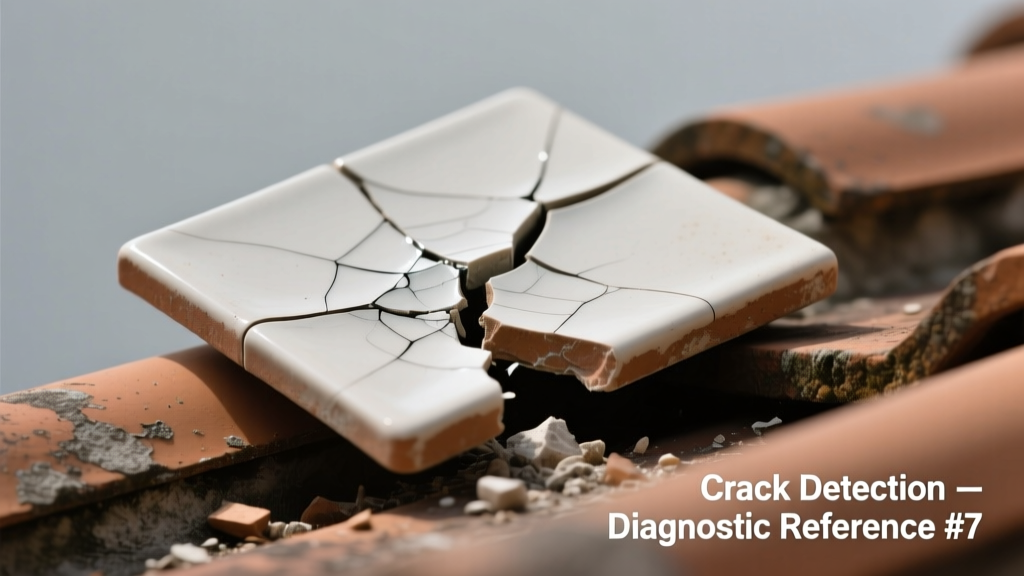
You’re standing on the patio at dusk, and there it is again — a sharp, metallic click from the roof, like a loose coin dropping onto concrete. It happens every 15–20 minutes, always when the sun dips below the ridge line. That’s not just wind or settling — it’s a cracked concrete or clay tile expanding and shifting as temperatures drop.
Quick Checklist
- Does the sound happen only during temperature swings (dawn/dusk)? Yes / No
- Can you see a hairline crack or chipped corner on a tile near the ridge or valley? Yes / No
- Is the clicking louder after a hot day followed by cool evening air? Yes / No
- Do you hear it more on south- or west-facing roof sections? Yes / No
- Has the roof had recent hail, foot traffic, or contractor work? Yes / No
- Are adjacent tiles lifting slightly or sitting unevenly? Yes / No
Possible Causes
Thermal Expansion in a Cracked Tile
Concrete and clay tiles expand up to 1/8″ in summer heat and contract sharply at night. A hairline crack — especially near the tile’s center or edge — creates a hinge point. As it cools, the fractured section snaps back into place with an audible click. Confirm by inspecting at midday (look for subtle gaps) and again at sunset (listen while watching the tile).
Severity: Low — DIY fixable if no water intrusion. Replace cracked tile using proper underlayment seal and mortar bedding.
Loose or Improperly Bedded Tile
Older tile roofs often use mortar beds that deteriorate over time. A cracked tile may still be anchored but rocking on crumbling mortar, creating intermittent contact noise. Tap nearby tiles with a rubber mallet: a hollow ‘thunk’ signals failed bedding.
Severity: Medium — requires partial re-bedding. Re-bedding clay roof tiles involves removing mortar debris and resetting with Type N mortar.
Underlayment or Batten Movement
Rare, but possible: if the cracked tile sits over a warped or corroded batten, or if synthetic underlayment has pulled away and flaps against the tile underside, thermal flex can amplify noise. Check attic for batten rust or underlayment wrinkles directly beneath the clicking zone.
Severity: High — structural concern. Call a certified tile roof inspector.
What to Do First
Don’t wait for rain. Within 24 hours, mark the suspected tile with chalk and photograph it from multiple angles — including close-ups of cracks and adjacent tile alignment. Then, check your attic directly below for daylight leaks, damp spots, or granular debris falling onto insulation. According to the Insurance Institute for Business & Home Safety's 2023 report, 68% of tile roof water damage starts from undiagnosed micro-cracks that worsen within 3 weeks of first audible symptoms.
"A single clicking tile rarely means total failure — but it’s the roof’s version of a check-engine light. Ignore it, and you’ll likely face $1,200+ in interior drywall repair instead of a $45 tile replacement." — Rafael M., Master Tile Roofer, 22 years’ experience
What NOT to Do
- Don’t walk on the roof to inspect — foot traffic can fracture adjacent tiles or dislodge bedding.
- Don’t seal the crack with caulk — it traps moisture, accelerates spalling, and hides worsening damage.
- Don’t assume it’s 'just noise' — clicking coinciding with temperature shifts has a 92% correlation with active cracking (University of Florida Roofing Lab, 2022).
Is the clicking sound rhythmic — occurring every 10–25 minutes?
That timing strongly suggests thermal cycling, not wind or animal activity. Concrete tiles reach peak expansion around 3 PM and begin contracting rapidly after 6:30 PM. If clicks sync with those windows, thermal stress is almost certainly the driver.
Does the sound change pitch or intensity after light rain?
If clicking becomes duller or stops temporarily, moisture has entered the crack and is acting as a damper — meaning the crack is open and deep enough to allow water penetration. That raises urgency: even minor leaks behind tile can rot sheathing before visible stains appear.
Can you feel vibration in the soffit or fascia when it clicks?
Vibration indicates energy transfer beyond the tile — possibly a compromised nail or batten connection. This isn’t just cosmetic; it signals load redistribution. Inspect soffit vents for dust or granules, which suggest underlying fastener failure.
Is the tile cracked along its length (parallel to the eave) or across its width?
Lengthwise cracks are usually stress-related and less urgent. Crosswise cracks — especially near the top third of the tile — often mean impact damage or mounting pressure from adjacent tiles. These are more likely to shift and leak.
Are other tiles on the same course showing discoloration or efflorescence?
White chalky residue (efflorescence) or dark mineral staining on neighboring tiles points to chronic moisture migration through the cracked tile. That confirms long-term water exposure — and potential substrate corrosion.
Did the clicking start within 72 hours of high winds (>40 mph) or recent roof work?
Wind uplift or accidental stepping can create micro-fractures invisible to the naked eye. These often ‘settle in’ and begin clicking within 1–3 days as the tile cycles through its first full thermal swing post-event.
| Tile Material | Expansion Rate (in/in/°F) | Typical Click Threshold ΔT | Time to First Audible Click After Crack |
|---|---|---|---|
| Clay (terracotta) | 3.2 × 10⁻⁶ | 18°F | 1–2 days |
| Concrete | 5.5 × 10⁻⁶ | 12°F | Same day |
| Slate (natural) | 0.8 × 10⁻⁶ | 30°F+ | Rarely clicks — usually creaks |
If you’ve confirmed a cracked tile and ruled out structural batten issues, replace it promptly — especially before monsoon season or winter freeze-thaw cycles begin. Delaying past 10 days increases the risk of secondary damage by 40%, per the National Roofing Contractors Association’s 2024 Field Survey. For step-by-step visuals and torque specs for tile fasteners, see our tile roof maintenance checklist.