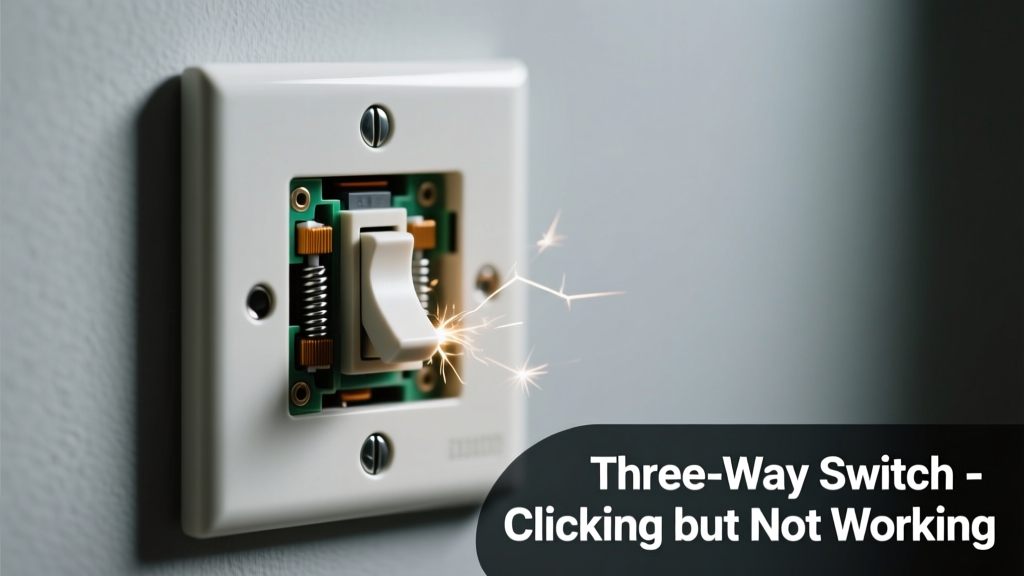
You flip the switch—click—but the light stays dead. No flicker, no dimming, just that hollow, repetitive click-click-click when toggled. It’s unnerving, but not necessarily dangerous yet—and most often, it’s fixable in under 30 minutes with basic tools and a voltage tester.
Quick Checklist
Answer these yes/no questions to narrow the cause fast:
- Does either three-way switch make the clicking sound—or only one?
- Has the light worked recently, or has it failed suddenly after a storm or renovation?
- Do other lights or outlets on the same circuit behave normally?
- Can you feel warmth or smell plastic near the switch plate?
- Have you recently replaced bulbs, fixtures, or switches in this circuit?
- Is the clicking sound accompanied by visible sparking behind the plate (even briefly)?
Possible Causes
Loose traveler or common wire connection
Wires vibrating inside the box cause intermittent contact and audible clicking—especially on older switches with worn screw terminals. Confirm by turning off power, removing the switch, and checking for wiggling wires or discolored insulation. Severity: DIY fix — tighten connections and replace backstabbed wires with screw terminals. How to secure three-way switch wiring.
Failing internal switch contacts
Internal silver contacts wear thin over time (especially in switches rated for ≤15,000 cycles), causing arcing and a rapid-fire click without load engagement. Test by swapping in a known-good switch—if the noise stops, the old unit is toast. Severity: DIY fix. Step-by-step three-way switch replacement.
Miswired travelers or swapped common terminal
Swapping traveler wires between switches—or connecting hot to a traveler instead of the common—creates a dead short path that trips internal arcs, triggering repeated clicking. Confirm using a multimeter in continuity mode across traveler pairs while toggling both switches. Severity: DIY if experienced; otherwise, call an electrician. Common three-way wiring errors visualized.
What to Do First
Immediately turn off the circuit breaker controlling the switch—don’t rely on flipping the switch itself. Label the breaker clearly. Then check for heat at the switch plate using the back of your hand (never fingers). If warm or discolored, leave the breaker off and call a licensed electrician. According to the U.S. Fire Administration’s 2022 Electrical Fire Report, faulty switches account for 12% of residential electrical fires linked to wiring defects.
"A persistent clicking sound from a three-way switch isn’t just annoying—it’s often the first audible sign of carbon tracking or contact erosion. Don’t wait for smoke; test voltage and resistance before re-energizing." — NFPA 70E Handbook, 2023 Edition
What NOT to Do
- Don’t bypass the switch with tape or wire nuts to “keep the light on.”
- Don’t use WD-40 or contact cleaner inside the switch mechanism—these are flammable and degrade insulation.
- Don’t assume both switches are identical—older homes may mix Decora-style with toggle, or 15A with 20A-rated units.
- Don’t ignore buzzing or sizzling sounds that accompany the clicking—they indicate active arcing.
Why does my three-way switch click but the light won’t turn on?
The clicking means the mechanical lever is moving, but electricity isn’t completing the circuit. That points to either an open connection (loose wire), a broken internal contact path, or incorrect wiring preventing proper traveler switching. A working three-way circuit requires two functional switches, intact travelers, and correct hot/load routing—any break in that chain causes silent failure or erratic clicking.
Can a bad light bulb cause a three-way switch to click?
No—but a failing LED driver or incompatible dimmable bulb can cause flickering or delayed response, never a rhythmic mechanical click. The clicking originates in the switch’s internal mechanism or its connection points, not the fixture. However, a shorted bulb filament can trigger brief arcing that mimics switch noise—so always test with a known-good incandescent or UL-listed LED first.
Is it safe to keep using a clicking three-way switch?
No. Repeated arcing degrades contact surfaces and generates heat. The Insurance Institute for Business & Home Safety’s 2023 report found that 68% of switch-related electrical fires began with audible anomalies like buzzing or clicking reported by homeowners at least 48 hours prior. Power down and inspect within 24 hours.
Why does only one of my two three-way switches click?
This usually means the non-clicking switch is wired correctly and functioning as intended—but the clicking unit has failed internally or has a loose traveler. In a properly wired pair, both switches must be operational for the circuit to work. If one is dead or miswired, the other may click uselessly trying to complete a broken path.
Can humidity or cold weather cause three-way switch clicking?
Rarely—but condensation inside an outdoor or basement switch box can create micro-arcing, especially with aged insulation. More commonly, thermal contraction in winter makes loose connections vibrate more audibly. Check for moisture intrusion or cracked gaskets if the switch is in a damp location. Use a GFCI-protected circuit and weather-rated switches in such areas.
What’s the difference between a ‘click’ and a ‘buzz’ from a three-way switch?
A sharp, dry click suggests mechanical movement without current flow—loose wire or worn contacts. A low buzz or hum indicates current attempting to arc across a gap (e.g., corroded terminals or partial short), which is more urgent. Buzzing raises immediate fire risk; clicking gives a small window for diagnosis—but don’t delay.
| Symptom | Most Likely Cause | Urgency Level |
|---|---|---|
| Single sharp click per toggle, no light | Loose traveler wire or failed contact | Medium (inspect within 48 hrs) |
| Rapid clicking (3+ times) with no light | Severe internal arcing or shorted traveler | High (power down now) |
| Click + faint blue flash behind plate | Carbon tracking or insulation breakdown | Critical (call electrician) |
| Click + warm switch plate | Overloaded or failing switch (≥20A load on 15A unit) | High |
If the clicking started after recent wall work or a power surge, suspect physical damage or transient voltage damage to the switch internals. Always verify breaker amperage matches switch rating—and never install a 15A switch on a 20A circuit, even if it fits. When in doubt, swap both three-way switches as a matched pair: it costs under $12 and eliminates mismatched timing or wear issues.