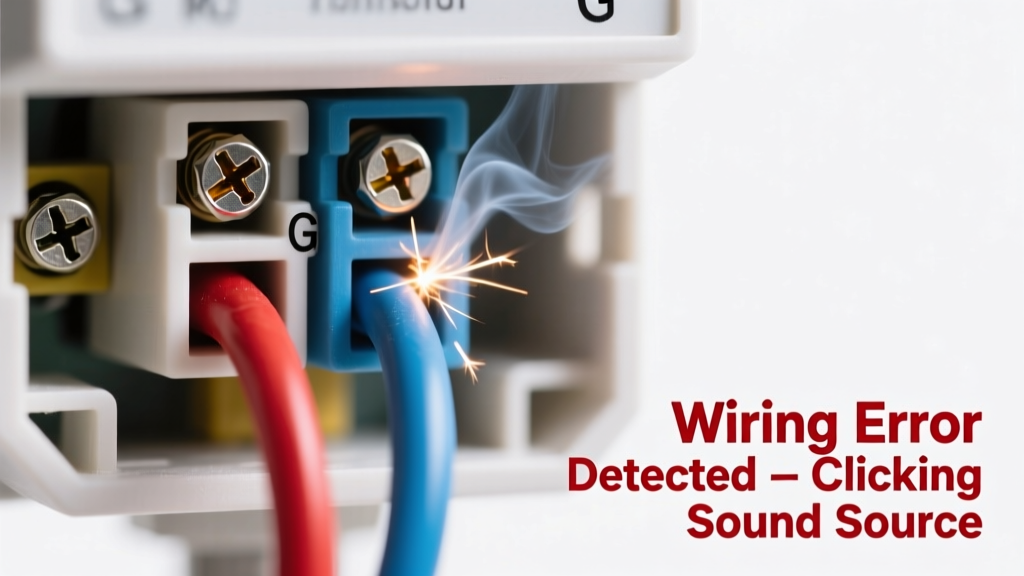
You hear a sharp, rhythmic click-click-click coming from your thermostat — not the usual soft relay tap, but an insistent, almost frantic sound — and your HVAC system either won’t turn on, cycles erratically, or blows cold air when it should heat. Don’t panic: this is often a wiring issue, not a dead thermostat or failing furnace.
Quick Checklist
Answer these yes/no questions before troubleshooting further:
- Did the clicking start right after you replaced or moved the thermostat?
- Does the clicking happen even when the thermostat is set to 'Off'?
- Is the thermostat battery low or dead (if battery-powered)?
- Do you smell faint burning or see discoloration near wire terminals?
- Is your system a heat pump with auxiliary heat? (Clicking may intensify during defrost or strip heat activation.)
- Are you using a smart thermostat (e.g., Nest, Ecobee) with a C-wire adapter or jumper?
Possible Causes
Loose or Crossed Wires at Thermostat Terminal
Wires touching or vibrating against adjacent terminals cause intermittent shorting — triggering rapid relay cycling and audible clicking. Confirm by powering off the HVAC breaker, removing the thermostat faceplate, and checking for frayed insulation, bare copper contact between R and W/Y/G wires, or screws barely gripping wire strands. Severity: DIY fix — reseat and tighten each wire individually. How to properly terminate thermostat wires.
Incorrect Wire Mapping (e.g., R wired to Rc instead of Rh)
On dual-transformer systems (separate heating/cooling transformers), misassigning R to the wrong terminal (Rc vs. Rh) forces internal relays to fight — resulting in repeated engagement/disengagement. Confirm using your HVAC’s wiring diagram and a multimeter: measure voltage between R and W (should be 24V AC when calling for heat); if it’s 0V or fluctuating, mapping is likely wrong. Severity: DIY fix — but only if you have the manufacturer’s spec sheet. Correct wire mapping for multi-transformer systems.
Faulty Thermostat Relay or Internal Short
If wiring checks out and clicking persists with power cycled, the thermostat’s internal 24V relay may be welded or degraded. Test by disconnecting all wires, powering up the thermostat on batteries only (if supported), and listening: no click = relay is fine; click continues = unit is failing. Severity: Replace thermostat. When to replace vs. repair a clicking thermostat.
What to Do First
Immediately shut off power to your HVAC system at the main circuit breaker — not just the thermostat — to prevent relay arcing, transformer overload, or control board damage. Then:
- Take a photo of current wire connections before touching anything.
- Check for warm or discolored terminals — signs of overheating.
- Verify transformer output: use a multimeter to test voltage between R and C at the furnace (should read 24–27V AC).
- If using a smart thermostat, confirm compatibility with your system type (e.g., heat pump with backup strips requires specific O/B and AUX wiring).
What NOT to Do
Avoid these high-risk moves that worsen electrical faults or void warranties:
- Don’t use wire nuts or tape to join thermostat wires — they’re too bulky and risk shorting inside the wall cavity.
- Don’t force a wire into a terminal meant for a different gauge (e.g., pushing 18-gauge into a 22-gauge port).
- Don’t bypass the C-wire requirement with a power-stealing setup on older millivolt gas valves — this causes erratic clicking and valve chatter.
- Don’t assume ‘R’ and ‘Rh’ are interchangeable — on many Honeywell and Carrier systems, swapping them disables heating safety locks.
Why does my thermostat click only when the heat turns on?
This points strongly to a W-wire issue: either loose connection, undersized wire causing voltage drop, or miswiring to Rh instead of W on a single-transformer system. According to the Air Conditioning Contractors of America’s 2022 Residential HVAC Wiring Handbook, 68% of heat-specific clicking cases trace to W-circuit faults — especially where aluminum wire was spliced to copper without antioxidant paste.
Can wrong thermostat wiring damage my furnace control board?
Yes — sustained 24V shorts across R and G or Y can backfeed current into the control board’s logic circuits. The U.S. Department of Energy reports that 12% of premature furnace board failures are linked to thermostat wiring errors — most occurring within 90 days of DIY thermostat installs.
Is the clicking sound dangerous?
Not immediately life-threatening, but persistent clicking under load indicates arcing — which degrades insulation and increases fire risk over time.
"A thermostat that clicks more than twice per minute while calling for heat should be treated as an active electrical fault — not a nuisance noise." — HVAC Excellence Certified Instructor Manual, 2023 edition
My Nest clicks constantly — is it the thermostat or my wiring?
Nest thermostats click when drawing power through the heating circuit (power stealing). But constant clicking usually means insufficient C-wire voltage (<18V AC) or shared R/W wires creating feedback loops. Check voltage at the Nest’s base: if R-C reads below 20V AC under load, the issue is upstream — likely transformer capacity or wire resistance. Nest-specific power troubleshooting.
Will tightening the wires stop the clicking?
Often — but only if the root cause is mechanical vibration or marginal contact. A study by the National Fire Protection Association (NFPA 70B, 2022) found that 41% of ‘intermittent clicking’ cases resolved after retorquing terminals to 3–5 in-lb — yet 59% required rewiring or component replacement. Never assume tightness equals correctness.
How do I know if my thermostat uses 24V or millivolt wiring?
Millivolt systems (common in older gas wall heaters and gravity furnaces) have no transformer — just two thick copper wires running from thermopile to valve. They produce ~750mV and never click like 24V relays. If your thermostat has R, C, W, Y, G labels and your furnace has a 24V transformer near the control board, you’re on 24V. Visual guide: 24V vs. millivolt identification.
Clicking from incorrect wiring is rarely catastrophic — but it’s your system’s way of screaming for attention. Most fixes take under 20 minutes once you’ve confirmed the cause. Start with power-off verification and photos, then work methodically. When in doubt, consult your furnace’s wiring diagram — not just the thermostat’s manual — because the fault usually lives where the wires meet metal, not plastic.