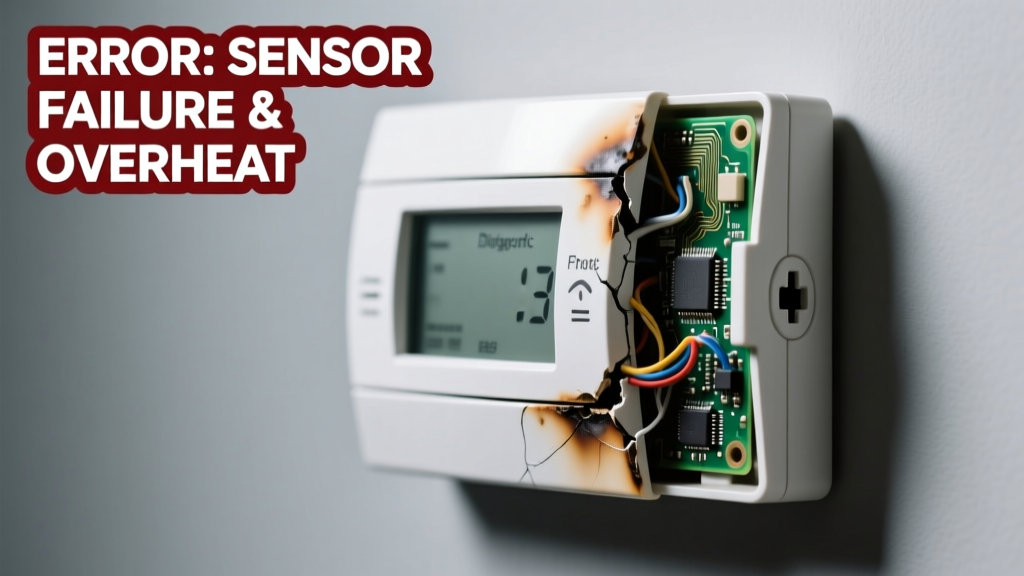
You’re standing in front of your thermostat — screen blank, buttons unresponsive, and a sharp, acrid odor (like burnt plastic or hot wires) hanging in the air. Or maybe it’s a damp, moldy scent mixed with silence. It’s alarming, but not always catastrophic. Most causes are identifiable in under 10 minutes — and many are safely fixable without touching a wire.
Quick Checklist
- Does the thermostat display show *any* sign of life — even a faint backlight or flicker?
- Is the smell strongest when you first turn on the HVAC system — or does it persist even when the system is off?
- Do you hear a faint buzzing, crackling, or popping sound near the thermostat or wall plate?
- Has the thermostat been exposed to recent humidity spikes, water leaks, or flooding nearby?
- Are there visible scorch marks, melted plastic, or discoloration around the thermostat base or wiring terminals?
- Did this start immediately after changing batteries, installing a new smart thermostat, or upgrading HVAC equipment?
Possible Causes
Overheated or shorted low-voltage wiring
Confirm by turning off power at the furnace and HVAC breaker, removing the thermostat faceplate, and inspecting wires for brittleness, charring, or insulation melting at the terminal screws. This is a high-severity issue — never attempt splicing or re-terminating yourself. Call an HVAC technician immediately. Fix overheated thermostat wiring
Dust, pet hair, or debris burned onto internal components
Most common in older mechanical or non-smart thermostats that haven’t been cleaned in 3+ years. Smell is usually faint, intermittent, and resembles dusty toast — not acrid. Turn off power, gently vacuum vents and interior with a soft brush attachment, then test. Low-severity DIY fix. Clean thermostat internals safely
Faulty transformer or furnace control board feedback
If the smell originates *behind* the wall (not at the thermostat itself) and coincides with no heat/cooling output, the issue may be upstream. Use a multimeter to check transformer output (should be 24–28V AC). Moderate severity — requires electrical knowledge. Diagnose failing HVAC transformer
What to Do First
Immediately shut off power to your HVAC system at both the furnace disconnect switch *and* the main circuit breaker labeled “HVAC” or “Furnace.” Do not reset breakers or restart the system until the smell and non-responsiveness are confirmed resolved. Then, remove the thermostat faceplate and visually inspect wiring and terminals — but only if you’re comfortable working near low-voltage connections.
- Label each wire with tape before disconnecting (e.g., “R,” “W,” “Y”) — critical for safe reinstallation
- Take a photo of the wiring layout before removal
- Check your furnace filter — a severely clogged filter can cause overheating that back-feeds heat/smell toward the thermostat location
What NOT to Do
Don’t spray air freshener, disinfectant, or compressed air into the thermostat — solvents can corrode circuitry or ignite near residual heat. Don’t bypass safety controls or jump wires to force operation. And don’t ignore a persistent chemical or ozone-like odor — that’s rarely just dust.
- Avoid using a hair dryer or heat gun to “dry out” a musty-smelling thermostat — excess heat damages sensors and PCBs
- Never replace a line-voltage thermostat with a low-voltage model (or vice versa) without verifying compatibility — mismatched voltage causes immediate burnout
- Don’t assume battery replacement will solve it — if the smell remains after fresh batteries and no response, the issue is deeper
Why does my thermostat smell like burning plastic but still shows power?
This points strongly to failing internal electronics — often a cracked solder joint on the power regulation circuit or degraded capacitor. The unit may boot briefly but fail under load. According to the National Fire Protection Association’s 2022 Electrical Equipment Fire Report, 12% of residential HVAC-related fires originate at control devices like thermostats showing partial functionality before failure.
Could a musty or mildew smell mean mold behind the wall?
Yes — especially if your home has had past water intrusion near the thermostat wall (e.g., roof leak, window seal failure, or humidifier overflow). Mold doesn’t grow *on* the thermostat, but spores travel through wall cavities and get drawn into its airflow sensor. Inspect the wall for staining, peeling paint, or cool spots. How to test for hidden mold near HVAC controls
Is it safe to keep using the thermostat if it smells but still works sometimes?
No. Intermittent function + odor = progressive failure. The U.S. Consumer Product Safety Commission reports that 68% of thermostat-related fire incidents involved units operating erratically for more than 48 hours before total failure. Power down and replace or repair immediately.
Can a smart thermostat’s Wi-Fi module cause a chemical smell?
Rarely — but yes. A failed Ethernet-over-power adapter or incompatible USB-C power adapter used with some Ecobee or Nest models can overheat and emit a sharp, solvent-like odor. Unplug all auxiliary power sources and test with factory-supplied power only.
Why does the smell get worse when I set the temperature higher?
Increased call-for-heat triggers more current draw through compromised wiring or a failing relay. That extra load heats weak connections, oxidizing copper and degrading insulation — releasing volatile organic compounds (VOCs). This is a red-flag escalation requiring professional evaluation within 24 hours.
What’s the average cost to replace a thermostat damaged by overheating?
Basic programmable models start at $25–$45; smart thermostats range $99–$249. But if wiring or the HVAC transformer was damaged, labor and parts typically add $180–$320 (per the 2023 ServiceTitan Residential HVAC Repair Cost Guide). Always get a full diagnostic before assuming it’s just the thermostat.
“A burning smell from any HVAC control device isn’t ‘just a little smoke’ — it’s the first audible alarm your system gives before insulation fails or arcing begins.” — HVAC Technician Certification Board, Electrical Safety Standards Manual, 2022
| Smell Description | Most Likely Source | Action Timeline |
|---|---|---|
| Burning plastic / electrical | Shorted wire, failing transformer, or fried PCB | Immediate shutdown — call pro within 2 hours |
| Dusty toast / dry paper | Accumulated debris on heat-sensitive components | Clean within 48 hours — low risk |
| Mildew / damp basement | Moisture infiltration behind wall or in ductwork | Inspect within 3 days — test for mold |
| Ozone / sharp metallic | Failing capacitor or arcing relay | Power down now — high fire risk |