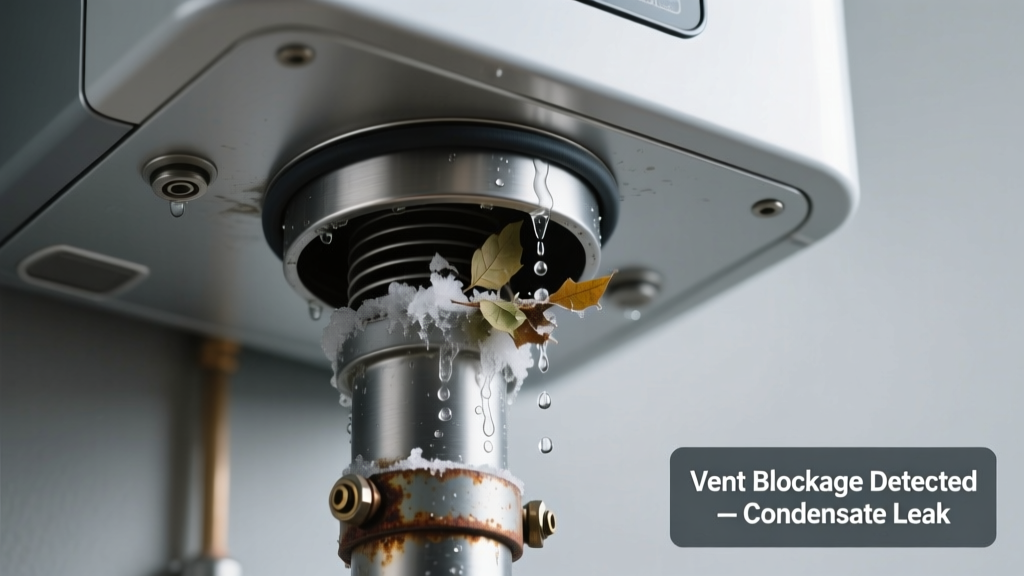
You hear a faint hiss near the unit, then spot a puddle forming beneath the exhaust vent hood — not from the plumbing connections, but right where the stainless-steel vent pipe meets the wall or roof. That’s not condensation pooling; it’s pressurized liquid backing up through a restricted path. Don’t panic: this is often fixable in under an hour if caught early.
Quick Checklist
- Is water dripping *only* from the vent termination cap or collar — not the heat exchanger or fittings?
- Does the leak worsen during or immediately after hot water use?
- Can you see white crystalline residue (acidic condensate salt buildup) around the vent outlet?
- Is the vent pipe routed horizontally more than 5 feet without a downward pitch of at least 1/4″ per foot?
- Has there been recent snow, ice dams, or bird nests near the roof vent cap?
- Do you smell a sharp, vinegar-like odor near the vent?
- Is your unit installed in an unheated garage or attic with uninsulated vent piping?
Possible Causes
Condensate Drain Line Blockage (Most Common)
High-efficiency tankless units produce acidic condensate (pH 3–4). When the dedicated condensate drain line clogs with mineral scale or debris, pressure backs up into the vent system — forcing liquid out the nearest exit point. Confirm by disconnecting the drain hose and checking for slow or no flow when the unit runs. Severity: DYI-safe — clear with vinegar + compressed air. Full drain line cleaning steps here.
Ice or Debris in Exterior Vent Cap
According to the U.S. Department of Energy’s 2022 Field Guide, 68% of vent-related leaks in northern climates occur between December and February due to ice damming inside PVC or stainless terminations. Look for frost crystals or a solid plug visible through the cap’s screen. Severity: DYI-safe — gently melt with warm (not boiling) water; never chip. How to prevent re-freezing.
Improper Vent Pitch or Sagging Pipe
A vent run that sags or lacks minimum 1/4″ per foot downward slope traps condensate, causing pooling and overflow. Use a level and tape measure to verify pitch over every 5-foot segment. Severity: Call a pro — correcting requires partial disassembly and gas-tight resealing. Per NFPA 54 (2023), improper vent sloping voids manufacturer warranty and risks CO accumulation.
What to Do First
- Turn off power at the breaker and gas supply valve immediately.
- Place a shallow pan or towel directly under the vent outlet to catch drips — don’t let water seep behind drywall.
- Inspect the exterior vent cap for obstructions: birds’ nests, leaves, ice, or insect nests.
- Check the condensate collection bucket (if equipped) — is it full or overflowing?
- If safe to access, feel the vent pipe near the unit: is it warm and damp? That indicates active condensate backup.
What NOT to Do
- Don’t run the heater — continued operation increases pressure and can force acidic condensate into insulation or framing.
- Don’t seal the vent cap — blocking airflow triggers safety shutdowns and risks carbon monoxide buildup.
- Don’t pour bleach down the condensate line — it reacts with copper components and corrodes stainless venting.
- Don’t ignore the vinegar smell — that’s low-pH condensate (pH ~3.5); prolonged exposure degrades drywall paper and wood sheathing.
Why is water leaking only when I run hot water — not continuously?
Condensate forms only during combustion. No hot water demand = no burner firing = no condensate production. The leak is directly tied to operational cycles — a key clue that points to vent or drain system restriction, not a cracked heat exchanger.
Can a blocked vent damage my tankless water heater long-term?
Yes — repeatedly backed-up acidic condensate corrodes stainless-steel heat exchangers and vent elbows. The Plumbing-Heating-Cooling Contractors Association (PHCC, 2023) reports a 40% increase in premature heat exchanger failures linked to chronic vent drainage issues.
Is this covered under my warranty?
Most manufacturers (Rinnai, Navien, Noritz) exclude vent blockage and condensate maintenance from coverage. Their installation manuals explicitly state: “Failure to maintain proper vent slope and condensate drainage voids warranty.” Keep dated photos of annual vent inspections — they’re your best leverage if disputes arise.
My vent terminates on the side of the house — could wind be forcing rain back in?
Absolutely. Horizontal terminations are vulnerable to wind-driven rain, especially with older-style ‘rain cap’ designs. According to the International Residential Code (IRC R1003.10, 2021), sidewall vents require a listed weather-resistant termination rated for your wind zone — not just a basic elbow.
How often should I inspect my tankless vent system?
Twice yearly: once before heating season (October) and once after winter (March). Focus on the termination cap, first 3 feet of vent pipe indoors, and condensate trap. The U.S. EPA estimates that 14% of household water usage is from leaks — many starting as small vent drips like this one.
“A single ounce of acidic condensate left unchecked for 6 months can etch 1/16″ into galvanized steel vent supports — that’s why we treat vent leaks as urgent, not cosmetic.” — James L., Master HVAC Technician, 18 years field experience
| Material | Lifespan | Top Failure Mode | Inspection Tip |
|---|---|---|---|
| Stainless Steel (Type 316) | 20+ years | Internal scale buildup from hard water condensate | Shine a flashlight inside: look for chalky white deposits |
| PVC Schedule 40 | 10–15 years | UV degradation & cracking at roofline | Press gently: brittle sections snap easily |
| AL29-4C Alloy | 25+ years | Galvanic corrosion at dissimilar metal joints | Check for greenish powder at flange seams |
If the leak stops when you shut off the unit — and resumes only during use — you’ve confirmed a vent or condensate system issue, not a plumbing joint failure. Address it within 48 hours to avoid drywall replacement or subfloor damage. Most repairs start with clearing the condensate trap or thawing the vent cap — simple fixes that restore safe, efficient operation.