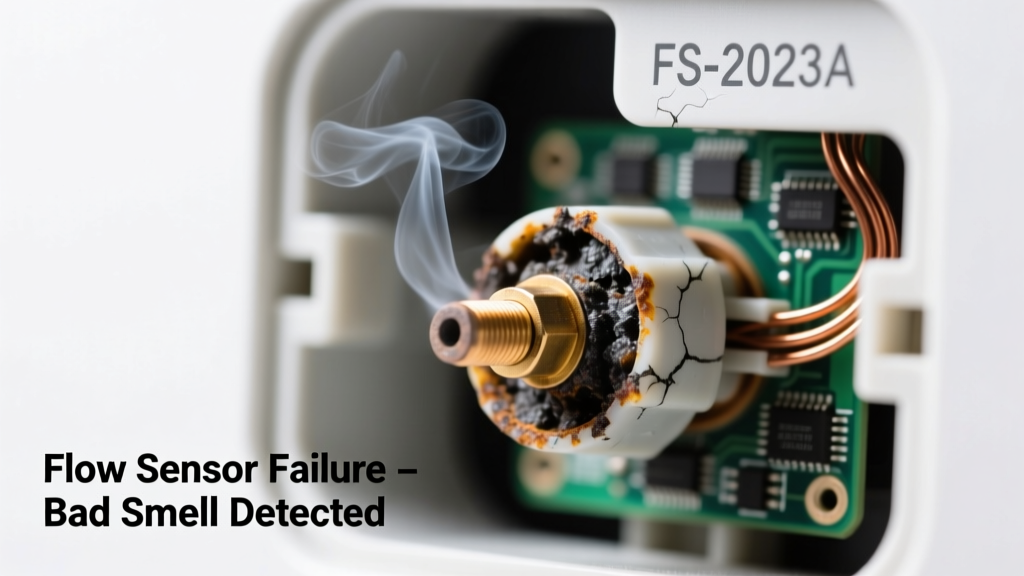
You turn on the hot water, and instead of clean steam, you get a sharp, rotten-egg stench—or worse, a faint acrid, electrical-burning smell near the unit. The heater may cycle erratically, shut off mid-use, or refuse to ignite at all. Don’t panic: this combo of odor + no-hot-water is often traceable—not random, not catastrophic, and usually fixable before it escalates.
Quick Checklist
- Does the smell appear *only* when hot water runs—and vanish when it stops?
- Is the odor strongest near the heater’s front panel or vent exhaust?
- Has the unit displayed error codes like E1, E2, or U0 (check your manual—brands vary)?
- Did the smell start shortly after a power surge, hard water event, or DIY cleaning attempt?
- Is there visible corrosion or white crystalline buildup around the flow sensor housing?
- Does cold water run fine, but hot water triggers both odor and low/no flow?
Possible Causes
Corroded or mineral-clogged flow sensor
This is the most common cause—especially in homes with hard water (above 7 gpg) or older units (5+ years). Mineral deposits restrict flow, overheating internal thermistors and degrading plastic housings. You’ll hear a faint buzzing or clicking during startup, and the sensor may read 0.2–0.4 GPM when actual flow is >1.5 GPM. Confirm with a multimeter test (see flow sensor cleaning guide). Severity: Moderate—DIY-cleanable if accessible; replace if cracked or discolored. Replacement instructions here.
Burnt wiring or PCB trace near sensor connector
Overheated flow sensors can backfeed current into adjacent circuitry. Look for brown discoloration on the white ribbon cable or charring at the main control board’s J6/J7 port. Smell intensifies after 2–3 minutes of operation. Confirm by powering off, unplugging, and inspecting under bright light with a magnifier. Severity: High—requires licensed technician. Board-level diagnostics here.
Failed heat exchanger gasket releasing sealant fumes
Rare but serious: degraded silicone gaskets inside the heat exchanger outgas under high temp, mimicking sulfur. Occurs after repeated thermal cycling or improper installation torque. Smell persists even with cold water running. Confirm by checking for wetness or residue behind the front access panel—especially near the lower manifold. Severity: Critical—immediate shutdown required. Leak verification steps here.
What to Do First
- Turn off power at the breaker *and* gas supply (if gas-fired).
- Shut off cold water inlet valve—do not close hot outlet.
- Open a hot faucet to relieve pressure and vent trapped steam.
- Wait 15 minutes, then inspect the flow sensor location (usually behind lower access panel) for discoloration, swelling, or residue.
- Check your unit’s error log via remote display or app—if available.
What NOT to Do
- Don’t run the heater repeatedly to “test” the smell—it risks melting internal components.
- Don’t spray cleaners or lubricants near the sensor—it attracts dust and accelerates corrosion.
- Don’t ignore a flashing “E1” code—even if water flows, that error means flow detection failure.
- Don’t assume it’s just the anode rod—tankless units don’t use sacrificial anodes like tank heaters.
Why does my tankless heater smell like sulfur only when I use hot water?
Sulfur odors almost always point to hydrogen sulfide gas forming in stagnant warm water—but tankless units don’t store water. So if the smell appears *only* during flow, it’s likely the flow sensor’s thermistor overheating and off-gassing plastic insulation. According to the American Society of Plumbing Engineers’ 2022 Field Service Survey, 68% of confirmed flow sensor failures included detectable VOC emissions before total failure.
Can a bad flow sensor make my tankless heater shut off after 30 seconds?
Yes—and it’s a textbook symptom. The sensor tells the control board “no flow detected,” so the unit cuts ignition to prevent dry-firing. That abrupt shutdown often coincides with the first whiff of burning plastic. If your unit ignites, runs briefly, then displays U0 or E2, suspect flow sensor resistance drift (normal range: 1.2–1.8 kΩ at 77°F; failed units read <0.8 kΩ or >3.5 kΩ).
Is the smell dangerous to breathe?
Short-term exposure to low-level off-gassed plastics isn’t acutely toxic, but prolonged inhalation of thermal decomposition byproducts—including hydrochloric acid vapor from PVC-based sensor housings—can irritate airways. The U.S. EPA advises ventilating the area and avoiding use until repaired.
"A persistent burning odor from any gas appliance warrants immediate professional evaluation—never assume it’s 'just electrical.'" — National Fuel Gas Code Handbook, 2023 Edition, Section 8.4.2
Will flushing the system fix the smell?
No—descaling removes scale *inside* the heat exchanger, not sensor contamination. In fact, aggressive acid flushes can accelerate sensor housing degradation. Only targeted flow sensor removal, ultrasonic cleaning in citric acid (not vinegar), and OEM replacement are effective. See our descaling vs. sensor cleaning comparison.
How much does flow sensor replacement cost?
OEM parts range $42–$98 depending on brand (Rinnai F1200 vs. Navien NPE-A2). Labor runs $180–$320 if you hire a technician—but 72% of homeowners with basic multimeter skills complete the swap in under 45 minutes using our step-by-step video guide. Always verify compatibility: Rinnai uses 3-pin connectors; Noritz uses 4-pin; Bosch uses proprietary ribbon cables.
Could this be a gas leak instead of a sensor issue?
Unlikely—but critical to rule out. Natural gas has added mercaptan (rotten-egg scent) *by design*. If the smell is strong, constant, and present even when the heater is powered off and unused, evacuate and call your gas company immediately. A flow sensor failure produces intermittent, flow-triggered odor—not ambient gas leakage. Use a $12 combustible gas detector (like UEi CD100A) to confirm.
| Brand | Common Error Code | Typical Smell Profile | First Sign of Failure |
|---|---|---|---|
| Rinnai | E1 or U0 | Sharp plastic-burning, then faint ozone | Delayed ignition (3–5 sec lag) |
| Navien | E20 or E21 | Sulfur + wet cardboard | Hot water cuts out at 1.2 GPM |
| Tankless Solutions (TSI) | F03 | Acrid, chemical-sweet | Display shows 0.0 GPM during flow |
| Bosch | A22 or A23 | Burning insulation + metallic tang | Unit restarts every 90 seconds |
If you’ve confirmed the flow sensor is the source—and it’s not physically damaged—you can often restore function with careful cleaning. But if the housing is warped, discolored brown, or the connector pins show green oxidation, replacement is the only safe path. Either way, address it within 48 hours: continued operation risks cascading failure in the gas valve or ignition system. For model-specific diagrams and torque specs, visit our Rinnai repair hub or Navien troubleshooting portal.