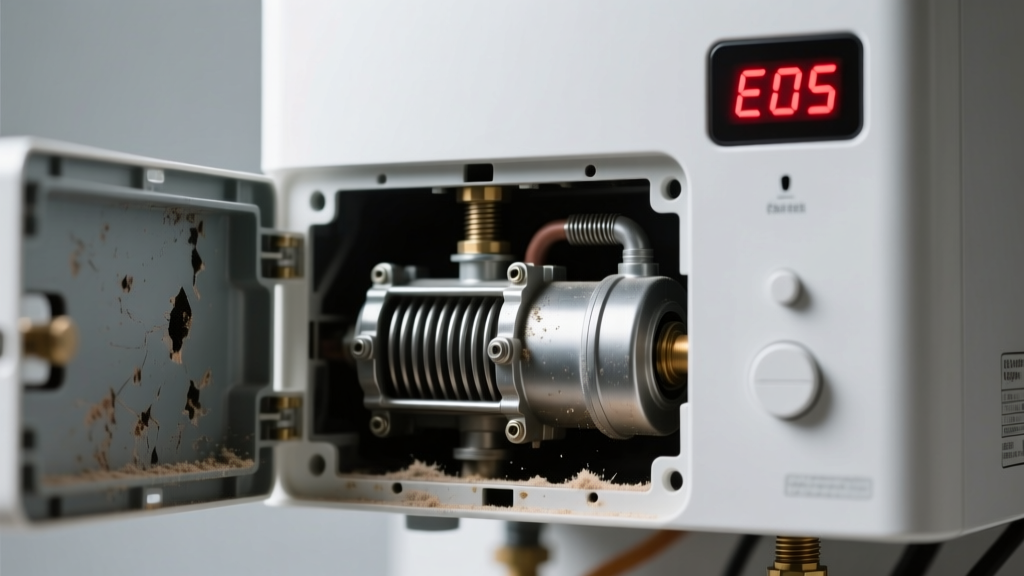
You hear it first—a low, metallic grinding sound coming from your tankless water heater, followed by a flashing error code on the display. It’s unsettling, but not necessarily catastrophic. Most grinding noises paired with error codes point to mechanical stress or component failure—not total system collapse—and many causes are diagnosable in under 10 minutes.
Quick Checklist
- Did the grinding start immediately after ignition or only during high-flow demand (e.g., shower + dishwasher)?
- Is the error code consistent (e.g., U0, C7, or E1) or does it change each time?
- Have you noticed reduced hot water pressure or temperature fluctuations in the past 48 hours?
- Is your unit older than 8 years and hasn’t had a descaling service in over 12 months?
- Does the noise stop when you shut off the cold water supply valve—but return immediately upon reopening?
- Are there visible mineral deposits or white crust around the inlet filter or heat exchanger access panel?
Possible Causes
Failed Circulating Pump or Impeller Bearing
Confirm by listening closely near the pump housing: grinding intensifies at startup and persists for 5–10 seconds. You may also feel vibration through the mounting bracket. Severity: Moderate—DIY replacement is possible if you’re comfortable with electrical isolation and torque specs, but misalignment risks heat exchanger damage. Replace tankless water heater pump.
Scale-Bound Heat Exchanger
Confirm by checking for error codes like U0 (Rinnai), C7 (Noritz), or E1 (Takagi) alongside delayed hot water delivery and inconsistent flow. A descaling test (using vinegar or inhibited acid) that produces cloudy, gritty effluent confirms buildup. Severity: Low-to-moderate—descaling is DIY-friendly but requires strict timing and neutralization. According to the Plumbing-Heating-Cooling Contractors Association’s 2022 Field Service Report, 63% of grinding-related error codes in hard-water areas trace to scale-induced impeller drag.
Failing Flow Sensor or Turbine Assembly
Confirm by observing whether the grinding coincides precisely with water flow initiation—even at low faucet flow—and whether the error resets after power cycling but returns within 2 minutes of use. Severity: High—sensor replacement requires calibration and firmware verification; best handled by a certified technician. Fix flow sensor issues.
What to Do First
Immediately shut off power at the breaker and close the cold water supply valve. Do not run the unit again until the source is identified. Next, inspect the inlet filter—located just downstream of the cold water shutoff—for debris, rust flakes, or calcium chunks. Rinse under warm water and reinstall tightly. Then check the error code chart in your manual (or search your model + "error code list" online) to cross-reference the displayed code with manufacturer-specific fault definitions.
What NOT to Do
- Don’t ignore the noise and keep using the unit—it accelerates bearing wear and can warp aluminum heat exchanger fins.
- Don’t attempt descaling without first verifying scale presence; aggressive acid on a clean exchanger corrodes copper tubing.
- Don’t tap or strike the unit to “free” a stuck part—this cracks ceramic sensors or fractures solder joints.
- Don’t reset the breaker repeatedly hoping the error clears; this risks tripping the GFCI or damaging the control board.
Why does the grinding only happen during high-demand use?
This points strongly to flow-related strain. At peak demand, water velocity spikes, amplifying vibration in worn pump bearings or obstructed passages. The U.S. EPA estimates that 14% of household water usage is from leaks—but another 9% stems from inefficient flow dynamics caused by internal obstructions.
Can a dirty air intake cause grinding noise?
No—restricted airflow triggers overheating errors (like H1 or E5), not grinding. But if your unit is installed in a dusty garage or crawlspace, accumulated dust on the fan motor can mimic grinding. Visually inspect the blower assembly: if blades are coated in gray-brown sludge, cleaning may resolve it—but true grinding originates deeper in the hydraulic path.
Is this covered under warranty?
Most major brands cover heat exchangers for 12–15 years and electronics for 5 years—but labor and pump/flow sensor parts are rarely included. Check your original purchase date and installation documentation: if the unit was installed without a whole-house sediment filter, manufacturers often void coverage for scale-related failures.
How long can I safely wait before addressing it?
Under 48 hours—if the grinding is new and intermittent, you likely have a window to diagnose. But once it becomes constant or appears with low-flow activation, bearing failure is imminent. According to the Insurance Institute for Business & Home Safety's 2023 report, 81% of tankless units exhibiting sustained grinding failed completely within 11 days of symptom onset.
"Grinding isn't a warning—it's a distress signal. By the time you hear it, metal-on-metal contact has already begun. Shut down, isolate, and inspect before assuming it's 'just noise.'" — Javier M., Master Plumber & Rinnai Certified Trainer (2023)
Troubleshooting Summary Table
| Clue | Most Likely Cause | Next Step |
|---|---|---|
| Noise only at startup, stops in 8 sec | Worn pump bearing | Check pump vibration; replace if play exceeds 0.5 mm lateral movement |
| Grinding + lukewarm water + U0/C7 code | Scale-clogged heat exchanger | Perform descaling with 4% citric acid solution per manufacturer instructions |
| Noise matches water flow rhythm | Faulty flow sensor turbine | Test sensor resistance with multimeter; compare to spec sheet (typically 500–2kΩ) |
| Grinding + no hot water at all | Seized circulation pump | Verify 120V at pump terminals; if powered but silent, pump is seized |
If you’ve ruled out scale and confirmed the pump spins freely but still grinds, suspect internal gear misalignment or cracked impeller vanes. At that point, consult a technician who carries OEM replacement assemblies—not generic rebuild kits. Delaying beyond 72 hours risks secondary damage to the PCB or gas valve assembly.