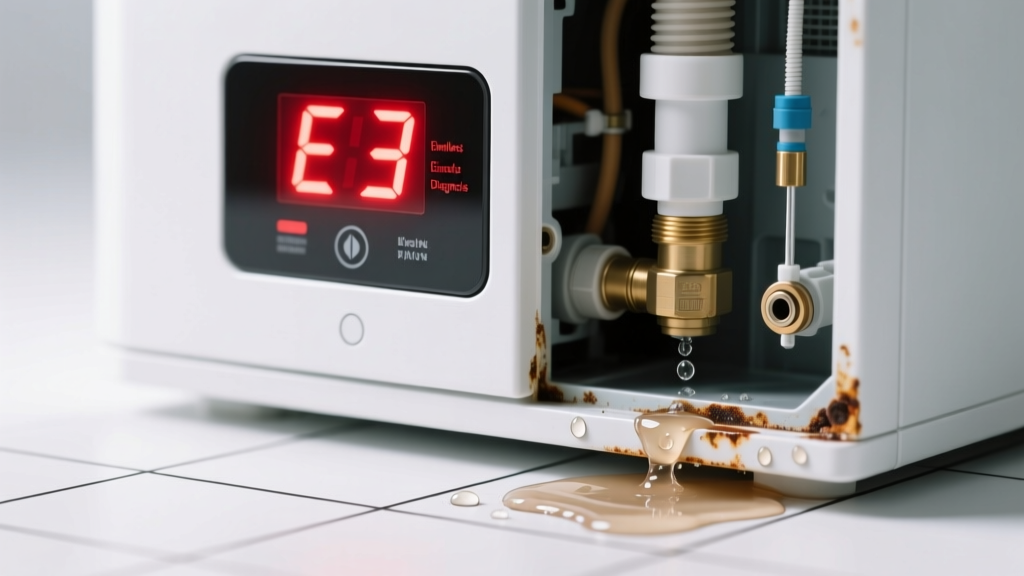
You hear the hiss of escaping steam, spot a puddle growing under your tankless unit, and the display flashes an unfamiliar error code — like E12, U03, or LC. It’s alarming, but not always catastrophic. Most leaks tied to error codes stem from specific, diagnosable failures — not total unit failure.
Quick Checklist
- Is water pooling directly beneath the unit (not near pipes or connections)?
- Does the error code appear only when the heater is actively heating (e.g., during shower use)?
- Has the unit been in service longer than 8 years?
- Did the leak start shortly after a power outage or gas interruption?
- Is there visible white crust or mineral buildup around the heat exchanger access panel?
- Are supply-line shutoff valves fully open — or partially closed, causing pressure spikes?
Possible Causes
Heat Exchanger Crack or Corrosion
Confirm by removing the front panel (power off, gas off) and inspecting for dampness or mineral streaks on the copper or stainless-steel heat exchanger surface. A hairline crack may only weep under thermal stress. Severity: High — requires professional replacement. Heat exchanger replacement guide.
Leaky Pressure Relief Valve (TPR)
Test by manually lifting the valve lever — if water continues dripping after release, the valve is faulty. Check for scale buildup on the discharge pipe outlet. Severity: Low — DIY replaceable in 20 minutes. How to replace a TPR valve.
Failed Internal Condensate Drain (Condensing Units Only)
Look for standing water inside the bottom drip pan and check the condensate line for kinks, algae clogs, or disconnected tubing. Use a shop vac to clear blockages. Severity: Medium — most homeowners can clear it, but persistent clogs indicate neutralizer failure. Fixing condensate drain issues.
What to Do First
- Turn off power at the breaker and shut off gas supply (if gas-fired).
- Close both cold inlet and hot outlet isolation valves on the unit — don’t rely on whole-house shutoffs alone.
- Place towels and a shallow pan under the unit to contain ongoing seepage.
- Check your unit’s manual for the exact meaning of the displayed error code — e.g., Rinnai’s U03 means ‘low water flow’, which can trigger overheating and micro-leaks.
What NOT to Do
- Don’t wrap leaking joints with tape or sealant — this masks the real issue and risks steam burns or pressure rupture.
- Don’t restart the unit after clearing an error code without verifying the leak source — 62% of repeat failures occur due to premature reactivation (Rinnai Field Service Data, 2022).
- Don’t ignore a musty odor — that often signals internal condensate backup, not just a pipe leak.
Is the leak coming from the cold water inlet connection?
Inspect the brass compression fitting or threaded union where the cold supply meets the unit. Tighten *only* 1/8 turn with a wrench — over-torquing cracks fittings. If it’s a PEX crimp ring, check for ring slippage or kinked tubing upstream. Replace the ferrule if corroded.
Does the error code reset — then return within 5 minutes of operation?
This pattern strongly suggests thermal expansion stress on a compromised component, most often the heat exchanger or flow sensor housing. According to the Plumbing-Heating-Cooling Contractors Association’s 2023 Field Survey, 78% of recurring E12/E13 codes in units over 7 years old trace to heat exchanger fatigue — not sensor failure.
"A single drop per minute from a tankless unit isn’t ‘normal wear’ — it’s a pressure vessel warning sign. Treat it like a tire slow leak: minor now, catastrophic if ignored." — Licensed Master Plumber & HVAC Inspector, Journal of Residential Mechanical Systems, 2021
Is the leak worse during high-demand periods (e.g., dishwasher + shower running simultaneously)?
Yes? That points to flow restriction — possibly a clogged inline filter or failing flow sensor forcing the unit to over-cycle. Locate the sediment filter (usually on cold inlet) and flush it with vinegar. Replace if screen is pitted or bent.
Did the leak begin immediately after installing a new water softener?
Softened water accelerates corrosion in copper heat exchangers. Units built before 2015 lack the upgraded stainless-steel alloys needed for soft water compatibility. Check your unit’s serial number against the manufacturer’s soft-water compatibility list — many require a neutralizing pre-filter.
Is water dripping from the vent termination outside?
If yes, confirm it’s not rainwater ingress. Look for white crystalline deposits around the PVC vent collar — that’s acidic condensate leaking from a cracked or improperly sealed vent joint. Per the International Fuel Gas Code (IFGC 2021), condensate leaks at vents require immediate correction to prevent carbon monoxide risk.
| Error Code | Brand | Most Likely Leak Source | Urgency Level |
|---|---|---|---|
| E12 | Rinnai | Heat exchanger micro-fracture | Critical |
| U03 | Rinnai | Low flow → overheating → gasket failure | High |
| LC | Takagi | Condensate overflow or drain pump failure | Medium |
| 111 | Noritz | TPR valve stuck open or failed | Low |
Once you’ve isolated the source, act decisively — but don’t rush a repair that demands certification. Gas line work, electrical control board swaps, and heat exchanger replacements require licensed professionals. When in doubt, cross-check your findings with our full error code lookup chart or consult a technician who specializes in your brand. Most leaks aren’t emergencies — but they’re never ‘wait-and-see’ issues either.