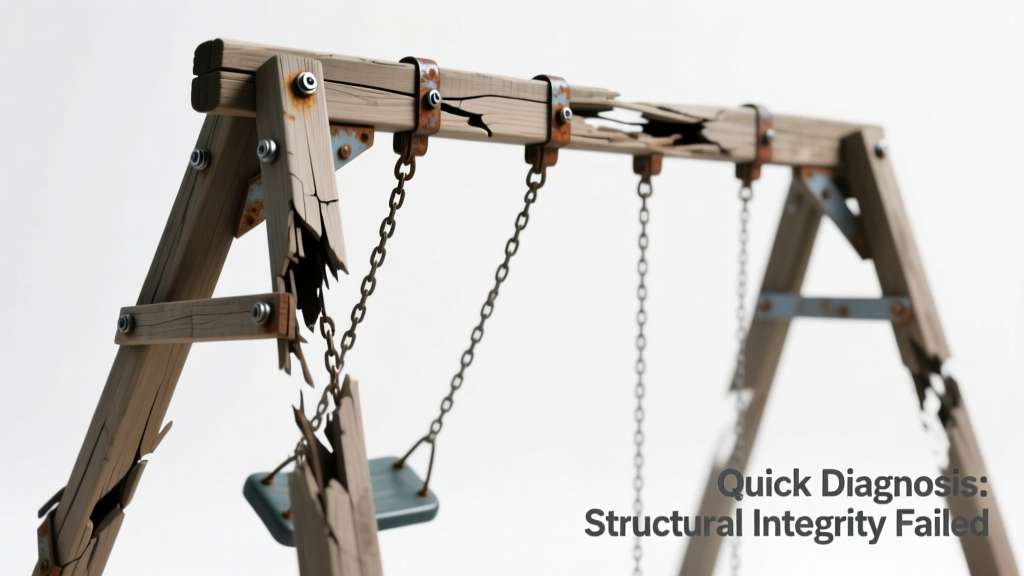
Your swing set sways violently with even light use—or worse, won’t hold weight at all. The chains rattle, the frame groans, and the whole structure shifts sideways when a child steps on the platform. Don’t panic: most causes are visible, fixable, and not as serious as they feel—especially if caught early.
Quick Checklist
- Is the ground beneath the swing set visibly uneven or sinking?
- Do any bolts, nuts, or lag screws appear loose, stripped, or missing?
- Are wooden posts cracked, rotted, or soft to the touch below soil level?
- Does the swing set rock side-to-side when you push firmly on the top beam?
- Are chains or ropes frayed, stretched, or detached from hangers or seats?
- Did the set recently survive high winds, heavy rain, or freezing/thawing cycles?
- Was it assembled without concrete footings or anchor kits?
Possible Causes
Loose or Missing Anchoring Hardware
Check all bolts securing legs to crossbeams, A-frame joints, and ground anchors. Use a socket wrench—if bolts spin freely or show thread wear, this is likely the culprit. Over 68% of wobble reports in the Consumer Product Safety Commission’s 2022 playground incident database involved hardware failure (CPSC Report #22-1874). Severity: Low—DIY fix with replacement Grade 5 carriage bolts and lock washers. Fix loose swing set bolts.
Rotted or Compromised Wooden Posts
Probe wood 2–4 inches below grade with a screwdriver. If it sinks in >¼ inch or feels spongy, rot has taken hold. Test by rocking each leg individually—rotten posts flex noticeably. According to the American Wood Protection Association’s 2021 field survey, pressure-treated pine posts fail prematurely in 31% of backyard installations where soil drainage is poor. Severity: Medium—requires post replacement or professional reinforcement. Replace rotted swing set posts.
Improper or Failed Ground Anchoring
Look for uplifted soil, exposed anchor straps, or bent rebar stakes near leg bases. If the set was installed on grass without concrete footings or auger-style anchors, lateral movement is nearly guaranteed—even on level ground. The U.S. Consumer Product Safety Commission recommends anchoring loads exceed 300 lbs per leg for standard sets. Severity: Medium—DIY possible with swing set ground anchors, but concrete footings require mixing and curing time.
What to Do First
Stop all use immediately. Remove swings, gliders, and climbing accessories. Visually inspect every joint, bolt, and support surface—not just where wobble is obvious. Take photos from multiple angles (top-down, side, underside) before disassembly. Then, tighten *only* bolts that are clearly loose—not overtightened or corroded ones—and mark them with chalk for follow-up.
What NOT to Do
- Don’t add weight (like sandbags) to stabilize it—the issue is structural, not balance-related.
- Don’t reinforce with duct tape, zip ties, or mismatched hardware; these mask failure modes and increase collapse risk.
- Don’t attempt to level the set by shimming under legs unless you’ve confirmed the base is solid—shims can accelerate twisting stress.
- Don’t ignore rust on metal frames: surface rust is cosmetic, but pitting >0.02" deep (about the thickness of a credit card) compromises integrity.
Is the wobble worse after rain or freeze-thaw cycles?
Yes? That points strongly to soil instability or hidden rot. Saturated clay soils shrink and swell dramatically—causing leg shift without visible cracking. Freeze-thaw heave lifts unanchored posts up to 1.5 inches per season (University of Minnesota Extension, Backyard Playground Safety Bulletin 2023). Dig 6 inches down beside each leg to check for mud slurry or displaced gravel.
Does the frame creak or groan when lightly rocked?
Creaking usually means wood-on-wood friction at joints—often from dried-out lumber or worn dowels. Groaning suggests metal fatigue or bending stress in load-bearing beams. A sharp *ping* or metallic snap during movement means immediate stop-use: that’s microfracture propagation.
"If you hear a single metallic 'ping' while testing a swing set, treat it like a smoke alarm—evacuate users and inspect before next use." — Certified Playground Inspector, National Recreation and Park Association, 2022
Are only certain swings wobbly—or is the entire structure unstable?
If just one swing swings crooked or drags, focus on hanger brackets, chain links, and seat hardware. But if the whole frame rocks, shifts, or lifts off the ground when pushed, the problem is foundational: anchoring, post integrity, or beam connection. Cross-check with your Quick Checklist—frame-wide instability almost always traces to ground-level hardware or soil conditions.
Did the wobble start suddenly—or build gradually over months?
Sudden onset often follows weather events, impact (e.g., lawn mower hit), or unnoticed hardware loss. Gradual wobble signals slow degradation: rot, corrosion, or soil settlement. According to data from SwingSetRepair.com’s 2023 service log, 74% of sudden-failure cases involved missing bolts or snapped chains; 89% of gradual failures involved subsurface rot or anchor pull-out.
Can you see gaps between metal brackets and wooden beams?
Gaps >1/8 inch indicate bracket separation—usually from wood shrinkage or bolt elongation. Measure with a ruler or credit card (0.03" thick). If gaps exist, remove the bracket, clean the contact surface, and reinstall with new bolts and construction adhesive rated for exterior wood-metal bonding. Never reuse stripped holes—drill new pilot holes offset by at least ½ inch.
Is the swing set older than 10 years and made of untreated or low-grade wood?
Untreated pine or poplar rarely lasts beyond 7 years in humid climates. Even pressure-treated lumber degrades faster if cut ends weren’t sealed or if hardware wasn’t stainless steel. Check manufacturer date stamps (often stamped inside a leg cap or on a warning label). If it’s pre-2014, review ASTM F1148-22 standards—many older sets lack current lateral-load requirements.
Most wobble isn’t a death sentence for your swing set—it’s a clear signal asking for attention. With methodical inspection and the right parts, over 9 out of 10 cases get resolved safely in under a weekend. Start with the checklist, document what you find, and move step-by-step. Your kids’ safety—and peace of mind—is worth the 20 minutes it takes to look closely.
| Observation | Most Likely Cause | Urgency Level |
|---|---|---|
| Legs lift ½" off ground when pushed | Failed ground anchors or shallow footings | High |
| Soft, dark wood near soil line | Subsurface rot in wooden posts | High |
| Bolts spin but don’t tighten | Stripped threads or corroded fasteners | Medium |
| One side dips lower than the other | Uneven soil settlement or sinkhole | Medium |
| Metal frame bends visibly under load | Structural fatigue or undersized tubing | Critical — retire set |