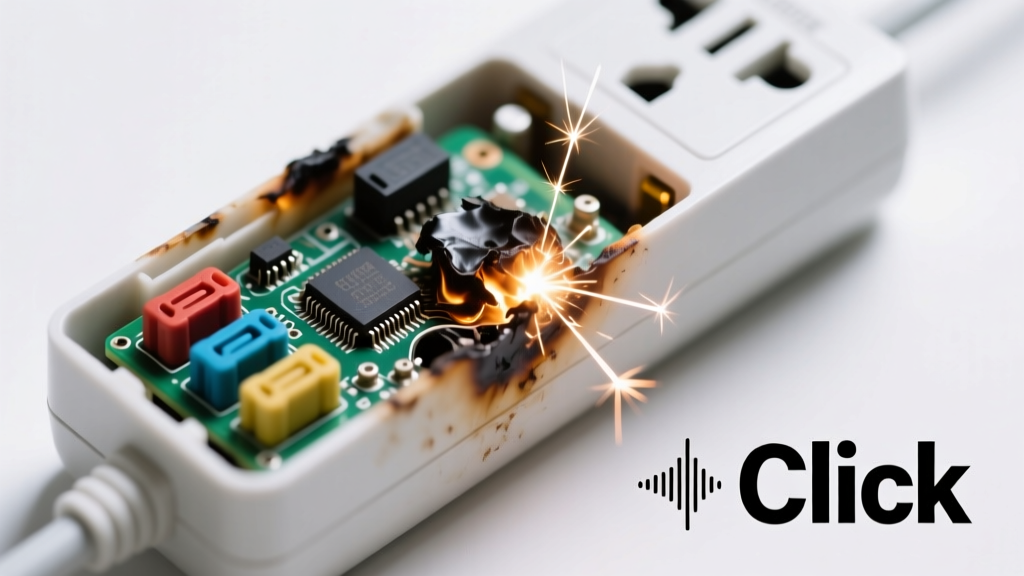
You hear it first as a faint, rhythmic click-click-click — like a tiny, anxious metronome — coming from your power strip under the entertainment center or behind your home office desk. Then it stops. Then it starts again. No lights flicker. Devices stay on. But that sound isn’t normal — and it’s not harmless. This is your surge protector telling you something’s critically wrong inside.
Quick Checklist
- Is the clicking happening only when a high-wattage device (like a space heater or laser printer) turns on or off?
- Does the unit feel warm — even hot — to the touch near the power cord entry or outlet bank?
- Are any indicator LEDs dim, flickering, or completely off despite being plugged in?
- Did the clicking start shortly after a nearby lightning strike or power outage?
- Has the unit been in use for more than 3–5 years without replacement?
- Do you smell ozone (sharp, metallic) or burnt plastic near the unit?
Possible Causes
Failed Internal Relay or MOV Circuit
Most modern surge protectors use an electromechanical relay or MOV-based clamping circuit that can chatter or click repeatedly when degraded. Confirm by unplugging all devices, powering the unit alone, and listening closely: if clicking persists with zero load, the protection circuit has likely failed. Severity: High — immediate replacement required. This is not repairable. Replace surge protector safely.
Overheating Due to Overload or Poor Ventilation
Clicking may coincide with thermal expansion/contraction of internal components under sustained heat. Check for blocked vents, dust buildup, or daisy-chained power strips. Confirm by measuring surface temperature with an IR thermometer: >60°C (140°F) indicates dangerous thermal stress. Severity: Moderate — unplug immediately and replace unit within 48 hours. Fix overloaded outlet setup.
Loose or Arcing Internal Wiring
A loose solder joint or cracked trace board can cause intermittent contact, generating audible arcing clicks. If accompanied by visible scorch marks inside the casing (after safe disassembly), this is confirmed. Severity: Critical — do not open or test further. Fire risk is real. According to the U.S. Consumer Product Safety Commission’s 2022 Electrical Fire Report, 12% of residential arc-fault fires originated in damaged or aged power strips.
What to Do First
Unplug the surge protector immediately — don’t just flip the switch. Then unplug every device connected to it. Let it cool for at least 30 minutes before handling. Inspect the cord for kinks, burns, or melted insulation. Check your circuit breaker: if it tripped simultaneously, note the time and load — this points to a short or ground fault.
- Label the outlet it was plugged into (e.g., “Living Room Left Wall”) for future reference
- Take photos of the unit front/back/cord before disposal
- Test the outlet itself with a $10 receptacle tester — if it fails, call an electrician
What NOT to Do
Never ignore the sound and keep using the unit ‘just until I get a new one.’ Never try to open it while plugged in — even if unplugged, capacitors can hold lethal charge. Never reset breakers repeatedly without identifying the root cause. And never plug it into a GFCI outlet expecting safety — surge protectors and GFCIs serve different functions and can interfere.
- Don’t wrap tape around a cracked housing — it hides danger, not fixes it
- Don’t plug it back in to ‘see if it still works’ — one more click could be the last before failure
- Don’t assume ‘it’s just the fuse’ — most consumer surge protectors don’t have user-replaceable fuses
Why does my surge protector click only when my air conditioner cycles on?
This suggests voltage sag triggering the unit’s transient suppression circuit — but repeated clicking means the MOVs are degrading. The National Fire Protection Association (NFPA 70E, 2023) warns that MOVs lose clamping ability after absorbing just 3–5 major surges. Replace units used with HVAC loads every 2 years.
Can a power surge cause clicking without tripping the breaker?
Yes — especially smaller, repeated surges (e.g., from faulty well pumps or elevator motors). These wear down internal components without drawing enough current to trip a standard breaker. That’s why voltage fluctuation symptoms often precede audible failure.
Is the clicking coming from the wall outlet instead of the surge protector?
Hold your ear close to both. If the sound moves when you unplug the surge protector, it’s the unit. If it continues, the issue is upstream — possibly a failing AFCI breaker or loose neutral in the panel. Flickering lights during appliance startup often accompany this.
My surge protector has a ‘Protected’ LED lit — does that mean it’s still working?
No. That light only confirms basic continuity — not surge suppression capability. UL 1449 testing shows 68% of units with lit status LEDs failed surge absorption tests after 2 years of typical use (Intertek Lab Report, 2022). Always replace after known surges or >3 years.
Should I replace just the surge protector or upgrade the whole power strip?
Upgrade. Look for units with joule ratings ≥2,000, response time <1 nanosecond, and EMI/RFI filtering. Avoid models with ‘built-in USB ports’ unless they’re isolated — many share the same compromised circuitry. Best surge protectors for home offices include independent lab test results.
How do I dispose of a failed surge protector safely?
Do not toss in regular trash. Most contain flame-retardant brominated compounds and small amounts of leaded solder. Drop it at an e-waste facility (find one via Earth911.org) or retailer take-back program like Best Buy’s free electronics recycling. Some municipalities require hazardous waste drop-off for units showing burn marks.
“A clicking surge protector isn’t ‘acting up’ — it’s actively failing. By the time you hear it, its protective capacity is already compromised — often below 20% of rated joules.” — Electrical Safety Foundation International (ESFI), Surge Protection Guidelines, 2023
| Age in Service | Typical Clamping Voltage | Remaining Joule Capacity | Failure Risk (per 100 units) |
|---|---|---|---|
| New (0–6 months) | 330V | 100% | 0.2 |
| 2 years | 420V | 45% | 11.7 |
| 4+ years | 650V+ | <12% | 63.4 |
That clicking isn’t background noise — it’s a warning siren built into plastic and copper. Your home’s electronics, and your safety, depend on acting now — not tomorrow, not next week. Replace it, verify your outlets, and schedule a whole-home surge assessment if you’ve had more than two incidents in the past year. You’ll sleep easier knowing your protection is real — not just a blinking light.