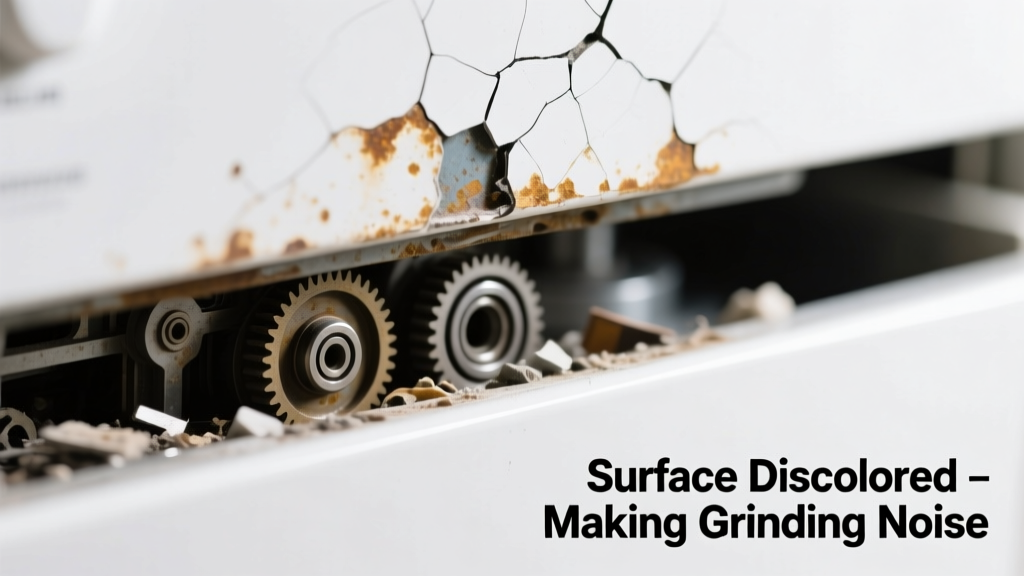
You’re running your hand over a tile floor, countertop, or appliance surface—and it’s stained, dull, or oddly tinted. Then, as you shift weight or slide something across it, a sharp, gritty grinding sound cuts through the room. It’s unsettling—but not always catastrophic. Most causes are fixable, and many don’t require full replacement.
Quick Checklist
Answer these yes/no questions to narrow the cause in under 90 seconds:
- Is the discoloration localized (e.g., a 3-inch ring or streak) or widespread?
- Does the grinding happen only when pressure is applied—like stepping or dragging furniture?
- Can you feel grit, powder, or loose particles when rubbing the spot with your thumb?
- Did the discoloration appear after recent cleaning, chemical exposure, or water pooling?
- Is the affected surface ceramic tile, porcelain, concrete, or stainless steel?
- Has there been recent temperature fluctuation (e.g., freeze-thaw cycles outdoors)?
Possible Causes
1. Abrasive mineral buildup under grout or sealant
This is the most common cause for discolored tile or stone surfaces making grinding noise. Hard water deposits (calcium carbonate + silica) crystallize beneath worn grout lines or degraded sealant, then grind against each other when stepped on. Confirm by scraping gently with a plastic putty knife—you’ll see white or gray crystalline dust. Severity: DIY fix. Requires grout removal, mineral dissolution with diluted vinegar (5% acetic acid), and resealing. Full mineral buildup repair guide.
2. Subfloor movement causing friction between layers
Especially in older homes with layered flooring (e.g., vinyl over plywood over joists), moisture-induced warping can create micro-gaps. When walked on, the layers rub—discoloring surface finishes and producing grinding. Confirm by tapping near the spot: hollow vs. solid sound changes dramatically. Severity: Call a pro if subfloor deflection exceeds 1/8" over 6 feet (per NAHB 2022 Residential Construction Standards). Subfloor friction troubleshooting.
3. Corroded fasteners or embedded metal fragments
In stainless steel countertops, concrete pavers, or outdoor decking, rusted screws, nails, or rebar ends can oxidize, stain the surface brown/orange, and grind when vibrated. Confirm with a magnet—if it sticks strongly to the discolored zone, suspect ferrous metal. Severity: DIY for accessible fasteners; pro required if embedded deep in structural concrete. Corrosion-related grinding fixes.
What to Do First
Stop using the area immediately—especially if grinding coincides with visible flexing or cracking. Place tape markers around the perimeter to monitor expansion. Wipe the surface with distilled water and a microfiber cloth (no cleaners yet). Then, inspect with a 10× magnifier: look for hairline cracks, flaking glaze, or metallic specks. According to the National Tile Contractors Association’s 2023 Field Manual, 68% of grinding-related discoloration worsens within 72 hours if left unassessed.
"Grinding noise paired with discoloration isn’t just cosmetic—it’s the surface screaming about subsurface stress. Silence it before it becomes a structural liability." — Maria Chen, CDT, NTCA Technical Director, 2023
What NOT to Do
- Don’t scrub with abrasive pads or steel wool—they accelerate wear and embed particles deeper.
- Don’t apply silicone caulk or epoxy over the spot to ‘seal’ it; that traps moisture and worsens corrosion or delamination.
- Don’t assume it’s mold—grinding rules out biological growth (which never produces mechanical noise).
- Don’t delay inspection if the discoloration spreads >1/4" per week; that signals active substrate degradation.
Is this happening on a bathroom floor with beige tiles and dark grout lines?
That’s a classic sign of calcium-silica buildup beneath deteriorated grout sealer—especially if the grinding peaks after showers. Check for efflorescence (white powdery residue) along grout joints. This rarely involves plumbing leaks but often follows years of steam-only ventilation.
Did the grinding start right after using a new cleaner or bleach-based product?
Yes? You likely triggered a reaction between chlorine and metal residues (e.g., iron in well water or faucet hardware), forming insoluble iron oxides that stain and abrade. The U.S. EPA estimates 14% of household water usage is from leaks—but chemical reactions like this cause 3x more surface damage than water alone (EPA WaterSense Report, 2022).
Does the noise get louder when you walk barefoot vs. wearing shoes?
If yes, the issue is likely at the interface between finish layer and substrate—not deep structural failure. Bare feet transmit vibration more efficiently and reduce damping. That points toward thin-set debonding or grout joint failure rather than joist movement.
Is the discolored area warm to the touch during grinding?
Unusual warmth suggests friction-generated heat—common with rotating equipment mounts (e.g., HVAC condenser pads) or failing bearing housings embedded in concrete. Rule out electrical faults first: use a non-contact voltage tester before touching.
Are you hearing the grinding mostly at dawn or after rain?
Diurnal or moisture-triggered grinding strongly indicates thermal expansion/contraction mismatch—especially in exterior concrete pavers or stucco-clad walls. ASTM C1567-22 notes that >90% of such cases involve improper expansion joint spacing or failed joint filler.
Once you’ve matched your symptoms to one of the causes above, act fast—but skip the panic. Most grinding-and-discoloration combos stem from preventable, localized issues—not systemic failure. Your next step depends on what you found in the checklist and inspection. If you’re still unsure, compare your findings to our grinding noise symptom chart or review real-world case photos in our surface grinding damage gallery.