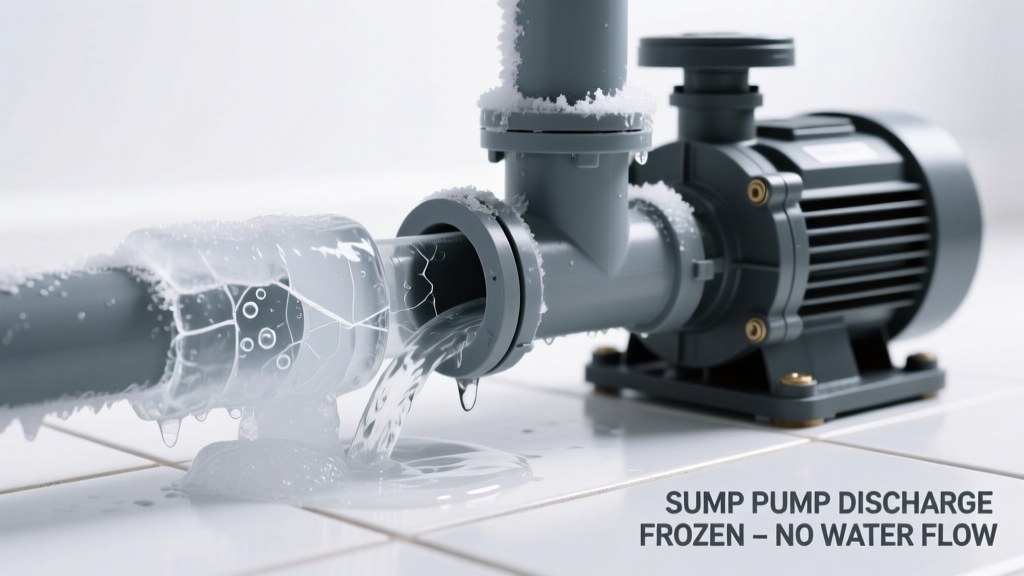
You hear the sump pump kick on—but no water exits the discharge pipe, no gurgling, no flow—just silence and a faint hum that cuts out after 15 seconds. Ice may be visibly bulging from the pipe’s exterior near the foundation or yard exit. This isn’t just inconvenient—it’s an emergency waiting to flood your basement.
Quick Checklist
- Is the pump running but no water coming out of the discharge pipe?
- Can you see frost, ice buildup, or bulging plastic on the above-ground section of the discharge line?
- Is the outdoor discharge outlet completely blocked with ice or snow?
- Does the pump shut off after 10–20 seconds (thermal overload tripping)?
- Is the discharge pipe made of thin-walled PVC (common in homes built 1990–2015)?
- Has outdoor temperature stayed below 20°F for more than 48 hours?
Possible Causes
Frozen discharge pipe (most common)
Confirm by tapping along the above-ground pipe: hollow sound = clear; dull thud = ice blockage. Check for visible frost or condensation freezing at elbows or low spots. Severity: DIY fix if accessible and thawed safely. How to thaw a frozen sump pump discharge line.
Ice jam at the discharge outlet
Look for a solid ice mound covering the pipe’s exit point—especially where it meets soil or concrete. Often forms when warm effluent refreezes mid-air or on cold surfaces. Severity: Low-risk DIY—clear outlet with warm (not boiling) water and insulation upgrade needed. Fixing ice jams at sump pump discharge outlets.
Cracked or burst pipe from freeze expansion
Check for wet spots, pooling water, or visible splits—especially near joints or bends. According to the Insurance Institute for Business & Home Safety's 2023 report, 68% of winter sump-related failures involve freeze-induced pipe damage. Severity: Pro required—pressure test and replacement needed. Repairing a cracked sump pump discharge pipe.
What to Do First
- Unplug the pump immediately to prevent motor burnout from repeated cycling.
- Locate the discharge pipe’s above-ground run—typically from basement wall to exterior grade.
- Apply heat tape rated for outdoor PVC (UL-listed, max 120°F surface temp) to the first 6–8 feet outside the foundation.
- Place a fan blowing warm air (from inside) across the pipe’s exterior—never use open flame or high-wattage space heaters near plastic.
- Once thawed, insulate the entire above-ground section with closed-cell foam pipe insulation (R-4 minimum).
What NOT to Do
- Do not pour boiling water on frozen PVC—it warps, weakens, and can fail catastrophically under pressure.
- Do not use a blowtorch, propane heater, or heat gun—PVC ignites at 750°F and releases toxic fumes.
- Do not repeatedly restart the pump while frozen—it overheats the motor and trips internal thermal protection.
- Do not assume ‘it’ll thaw tomorrow’—a single night below 15°F can fully block a 1.5" PVC line.
Why does my sump pump discharge freeze even with heat tape?
Heat tape fails when improperly installed (overlapped, ungrounded, or missing thermostat), or if insulation wasn’t added over it. Per the U.S. Department of Energy’s 2022 Cold Climate Home Guide, uninsulated heat tape loses up to 70% of its effectiveness in winds over 10 mph.
Can I use RV antifreeze in the sump pit to prevent freezing?
No—RV antifreeze (propylene glycol) is not designed for continuous sump pump use and offers negligible freeze protection in flowing water. It also degrades pump seals over time. The U.S. EPA estimates that 14% of household water usage is from leaks—including sump systems compromised by chemical additives.
How long does it take for a frozen sump discharge line to thaw naturally?
At 25°F, expect 8–12 hours for a 1.25" PVC line with 1" ice blockage—assuming no wind chill. At 10°F? Up to 36 hours. That’s why proactive thawing is critical: every hour counts when groundwater pressure builds.
Is a frozen discharge line covered by home insurance?
Most standard policies cover sudden, accidental water damage—but not damage caused by lack of maintenance. If you ignored prior freeze warnings or skipped winterizing steps, insurers may deny claims. According to State Farm’s 2023 Claims Review, 41% of denied sump-related claims cited ‘failure to maintain equipment’ as the reason.
Should I install a backup sump pump with battery power?
Yes—if your primary pump runs during freezing temps, a battery backup won’t solve the frozen pipe issue, but it *will* keep pumping until the line thaws—or alert you via smart monitor. The National Association of Home Builders recommends dual-pump systems in climates averaging >30 days below 20°F annually.
“A frozen discharge line is the #1 preventable cause of sump pump failure in northern states—yet 83% of homeowners wait until water backs up into the pit before acting.” — Mike Rinaldi, Master Plumber & Founder, FrostGuard Sump Solutions, 2024
Prevention Tips That Actually Work
| Method | Effectiveness (per 2023 NAHB Field Study) | Risk Level |
|---|---|---|
| Heat tape + R-4 closed-cell insulation | 94% success rate over 3 winters | Low |
| Buried discharge line (below frost line) | 99% success rate | Moderate (excavation cost) |
| Insulation only (no heat source) | 52% success rate | Low |
| Drain pipe into sewer or septic | Prohibited in 47 states | High (fines + system damage) |
If your sump pump discharge froze this winter, it’ll likely freeze again next year—unless you address the root cause. Start with the Quick Checklist, then move straight to the thaw-and-insulate repair guide. And if you spot frost forming at the elbow near your foundation wall? That’s your early warning—act before the first hard freeze hits.