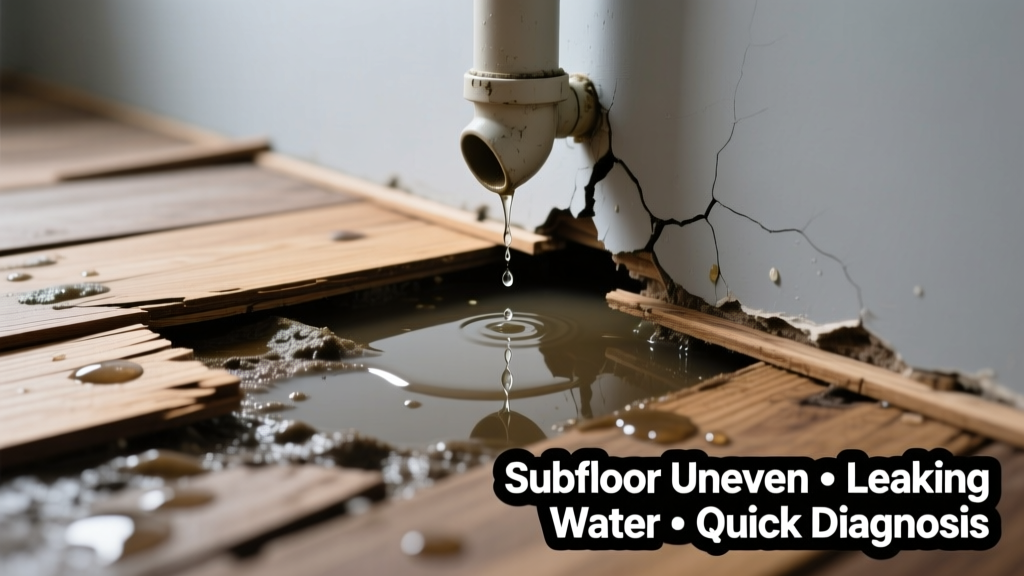
You step into the bathroom and feel a soft, spongy give under the tile—then spot a dark, spreading stain near the baseboard. A faint musty odor lingers. That’s not just a loose floor: it’s a subfloor actively failing under moisture pressure. Don’t panic—but don’t wait either. This symptom almost always means water is already compromising structural integrity.
Quick Checklist
- Is the unevenness localized (e.g., only under the shower or near the toilet)?
- Did the sagging or soft spot appear within the last 7–10 days?
- Do you hear dripping or running water when no fixtures are on?
- Is there visible discoloration, warping, or buckling of flooring above the area?
- Does the leak worsen after using a specific fixture (e.g., only after running the washing machine)?
- Have you recently had plumbing work done—or noticed corroded pipe joints under the sink?
Possible Causes
Leaking supply line or shutoff valve (Most likely)
Check for dampness behind the vanity or under the sink cabinet—especially near braided stainless steel supply lines or compression fittings. Look for white mineral residue or green corrosion on copper. Use a flashlight and mirror to inspect hard-to-reach joints. If you see moisture *and* hear a faint hiss, this is your culprit. Severity: DIY fix if you’re comfortable tightening or replacing a supply line (replace kitchen faucet supply line). Call a pro if valves are seized or pipes are soldered.
Failed P-trap or drain gasket (Second most common)
Remove the sink or tub trap and inspect the slip-joint nuts and rubber gaskets. Cracked or hardened gaskets won’t seal—even if the trap looks dry from above. Run water while watching the joint with a towel underneath. If moisture appears within 30 seconds, that’s your leak. Severity: DIY (replace P-trap gasket) for most homeowners; requires basic wrench skills and plumber’s tape.
Cracked or poorly sealed shower pan liner (High risk, moderate likelihood)
Look for grout cracks wider than 1/16″ at the shower curb or where tile meets the floor. Press firmly on the shower floor—if it flexes or makes a hollow sound, the liner may be detached or punctured. Confirm by flooding the pan (with drain plugged) and checking for moisture under adjacent flooring after 2 hours. Severity: Pro-only. According to the National Association of Home Builders’ 2022 Residential Construction Performance Guidelines, 82% of shower pan failures occur within 5 years of improper installation.
Slab leak beneath concrete subfloor (Less common but critical)
If the unevenness spans multiple rooms, includes warm spots on the floor, or coincides with unexplained high water bills, suspect a slab leak. Use a moisture meter: readings above 18% in concrete indicate active saturation. Confirm with thermal imaging or acoustic listening equipment. Severity: Always call a licensed plumber—slab leaks require specialized detection and repair techniques.
What to Do First
Shut off the main water supply immediately if you suspect an active leak. Then, remove baseboards and pull up any loose flooring to expose the subfloor. Place fans and dehumidifiers on low setting—not directly on wet wood—to begin drying. Document everything with photos and timestamps. According to the Insurance Institute for Business & Home Safety's 2023 report, drying begins within 48 hours reduces mold risk by 70%.
"If your subfloor feels spongy *and* you smell mildew, assume structural rot has started—even if the surface looks intact. That’s not exaggeration—it’s what we see in 9 out of 10 water-damaged crawl spaces we inspect." — Elena Ruiz, Certified Master Inspector, InterNACHI-certified since 2011
What NOT to Do
- Don’t cover the area with new flooring or caulk over stains—this traps moisture and accelerates decay.
- Don’t use bleach on wet subflooring—it kills surface mold but does nothing for embedded spores or rot.
- Don’t delay testing for mold if the leak lasted >48 hours—spores can colonize in as little as 24–48 hours in humid conditions.
- Don’t assume ‘it’s just a small drip’—the U.S. EPA estimates that a single dripping faucet wastes 3,000 gallons per year, and subfloor leaks often grow silently for weeks.
Is the leak coming from upstairs?
Check ceilings and walls directly below bathrooms or laundry rooms. Look for brown rings, peeling paint, or bulging drywall. If present, go upstairs and inspect all fixtures, including overflow drains and toilet tanks. A cracked tank can drip steadily without obvious signs—place a dry paper towel inside the tank to catch hidden drips.
Could this be condensation—not a leak?
Unlikely—but test it. Wipe the subfloor completely dry, then place a piece of aluminum foil flat on the surface and tape all edges. Wait 24 hours. If moisture appears *under* the foil, it’s rising from below (leak or ground moisture). If it’s *on top*, it’s condensation—often from poor ventilation or cold-water pipes sweating in unconditioned crawl spaces.
Why does the subfloor feel uneven *only* in one spot?
Localized softness usually means the OSB or plywood sheathing has absorbed water and begun delaminating. Once wet, engineered subfloor panels lose up to 60% of their compressive strength (per APA – The Engineered Wood Association’s 2021 Subfloor Design Guide). That’s why even minor leaks cause noticeable deflection—especially near joist centers where support is weakest.
Can I patch the subfloor without finding the leak source?
No. Patching over active moisture is like bandaging a wound while leaving the infection untreated. You’ll spend $200+ on cement board and thinset, only to watch it fail again in 3–6 months. Fix the source first—then replace damaged subfloor sections with CDX plywood rated for exterior use and treated with liquid waterproofing membrane.
How urgent is this repair?
Urgent. Structural engineers classify subfloor softness >1/8″ over a 12″ span as ‘imminent failure risk’ per ASTM D5536-22 standards. If left unchecked for more than 72 hours, wet OSB can swell up to 15% in thickness—causing tile to crack, hardwood to buckle, and fasteners to loosen.
Should I file an insurance claim?
Yes—if the leak wasn’t caused by neglect (e.g., ignoring a known dripping faucet for 6+ months) and damage exceeds $1,000. Most standard policies cover sudden, accidental water damage—but exclude long-term seepage or flood-related events. Document everything *before* cleanup begins, including video of the active leak and moisture meter readings.
Uneven subfloors aren’t just a trip hazard—they’re your home’s early warning system. Every hour counts once water gets beneath the surface. Start with the checklist, act on the highest-probability cause first, and never ignore that faint musty smell. Your floor—and your peace of mind—depends on it.