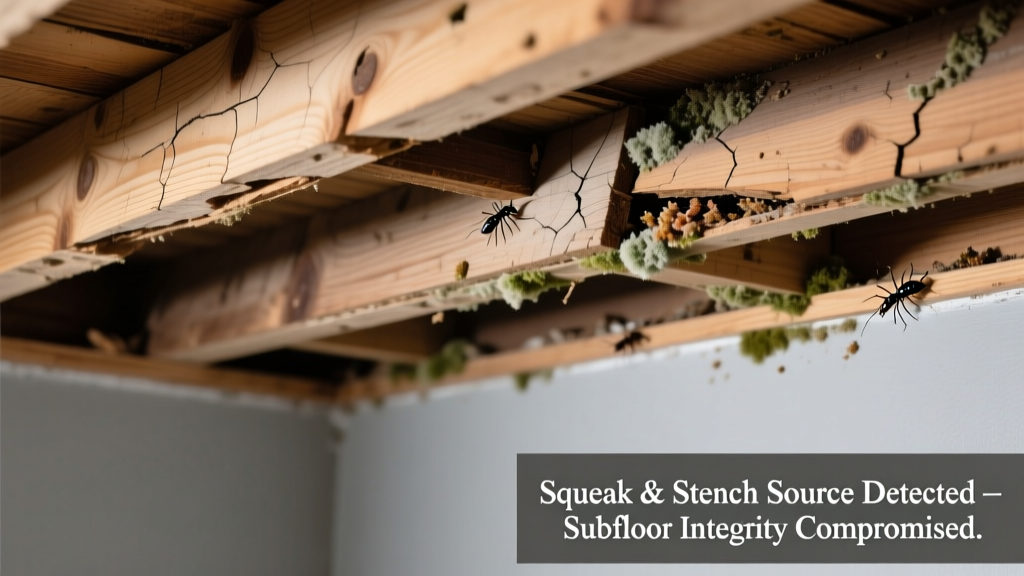
You step into the hallway—and hear that familiar, high-pitched squeak… followed by a sour, musty, or even ammonia-like stench rising from the floorboards. It’s unsettling, invasive, and often worse after rain or high humidity. Don’t panic—this combo is diagnosable, and many causes are fixable before they escalate.
Quick Checklist
- Does the squeak happen only in one spot—or multiple areas?
- Is the odor strongest near baseboards, vents, or under rugs?
- Have you noticed discoloration, dark staining, or soft spots on the floor?
- Did the smell appear suddenly—or worsen over weeks/months?
- Is there visible evidence of pests (droppings, gnaw marks, nesting material)?
- Has there been recent plumbing leaks, roof damage, or basement flooding?
- Do you own pets—or have had recent pet accidents on carpet or hardwood?
Possible Causes
Mold or Mildew Growth in Subfloor Sheathing
Confirm with a moisture meter reading >19% MC on subfloor plywood or OSB—and visible black/green fuzzy growth under flooring or along joist edges. Often paired with damp insulation and condensation on cold ductwork. Severity: Moderate—DIY if under 10 sq ft; call a mold remediation pro if larger or behind walls. According to the U.S. EPA, indoor mold exposure contributes to 25% of unexplained respiratory complaints in homes with chronic moisture issues (EPA Indoor Air Quality Guide, 2022).
Wood Rot from Chronic Moisture Exposure
Tap suspect areas with a screwdriver—if the subfloor feels spongy or crumbles, it’s likely dry or wet rot. Check for warped joists, crumbling nail heads, or fungal fruiting bodies near rim joists. Severity: High—requires structural assessment. Subfloor replacement is rarely DIY-safe beyond small patches. The Insurance Institute for Business & Home Safety reports that 68% of wood rot cases in homes originate from undetected plumbing leaks or poor flashing—not roof failures.
Decomposing Animal Carcass or Nest Debris
Smell peaks at dawn/dusk, intensifies in warm weather, and may attract flies or beetles. Use a borescope through an access panel or floor register to inspect joist bays. Severity: Low–Moderate—DIY removal possible *if* located and intact; otherwise, hire wildlife control. A 2023 National Pest Management Association survey found rodent carcasses accounted for 41% of ‘unexplained foul odors’ reported by home inspectors.
Urine Soak in Carpet Padding or Underlayment
Odor clings to concrete slabs or particleboard subfloors beneath old carpet—even after cleaning. Test with a blacklight: yellow-orange fluorescence indicates organic residue. Severity: Low—replace padding and clean subfloor with enzymatic cleaner. The U.S. EPA estimates that 14% of household water usage is from leaks—including unnoticed pet accidents that seep into subfloor layers.
What to Do First
Stop further damage before diagnosis is complete. Ventilate the room using fans pointed *outward*, not recirculating air. Turn off humidifiers and run a dehumidifier set to 40–50% RH. If you find wet insulation or standing water, shut off nearby water lines and document with photos. Then, pull back carpet or lift a floorboard near the worst squeak/smell to inspect joist spacing, fastener condition, and subfloor integrity.
What NOT to Do
- Don’t spray bleach or disinfectants directly on subfloor—this masks odor but doesn’t kill mold roots and can corrode fasteners.
- Don’t seal the area with caulk or paint before identifying moisture source—it traps vapor and accelerates decay.
- Don’t ignore the squeak as ‘just friction’—a new squeak + new odor almost always signals change in subfloor condition.
- Don’t delay inspection if you see efflorescence on concrete or rust on metal joist hangers—these indicate long-term moisture migration.
Is the smell stronger near HVAC vents?
If yes, contaminants may be drawn into ductwork. Inspect return grilles for dust buildup and check duct insulation for mold staining. Consider scheduling a professional duct inspection, especially if occupants report throat irritation or headaches when the system runs.
Does the squeak happen only when weight shifts sideways?
This suggests loose subfloor-to-joist nailing—not just fastener fatigue, but potential shrinkage or warping from moisture cycling. Measure joist spacing: if over 24” OC, undersized subfloor (e.g., 1/2” OSB on 24” joists) may flex and degrade faster. Confirm with a 4-ft level across seams.
Can you smell it more after it rains?
Rain-triggered odor points strongly to exterior moisture intrusion—leaky siding, failed flashing at deck ledger, or clogged foundation drains. Walk the perimeter during or right after rain and look for wet soil against foundation walls or pooling near weep holes.
Is the odor ammoniacal or sweet-rotten?
Ammonia hints at urine-soaked padding or rodent urine; sweet-rotten suggests decaying organic matter (carcass, bird nest, or advanced microbial breakdown). Avoid sniff tests alone—use pH test strips on damp subfloor samples: urine residue reads pH 8–10; moldy wood typically reads pH 4–6.
Do you hear scratching or rustling at night?
That’s not imagination—it’s likely rodents actively nesting in the cavity. Seal all openings >1/4” with steel wool and copper mesh *before* trapping. Never use poison baits in wall cavities—dead animals cause far worse odor problems. Contact a licensed wildlife exclusion specialist for permanent entry-point sealing.
Is the subfloor made of particleboard or OSB?
Particleboard swells irreversibly when wet and emits formaldehyde-like odors as it breaks down. OSB holds up better but delaminates visibly when saturated. Both fail silently—no sagging needed. Replace any subfloor with edge swelling >1/8” or layered separation.
"A squeak isn’t just noise—it’s mechanical feedback. When combined with odor, it’s the subfloor screaming that something has changed at the interface between structure and environment." — Dr. Lena Cho, Building Science Fellow, NAHB Research Center, 2021
| Reading (MC %) | Plywood | OSB | Concrete Slab |
|---|---|---|---|
| <12% | Safe, stable | Safe, stable | Dry (RH <75%) |
| 12–15% | Acceptable, monitor | Acceptable, monitor | Moderate risk for adhesive failure |
| 16–19% | Potential for mold initiation | Swelling begins | High risk for flooring delamination |
| >19% | Active decay likely | Structural compromise probable | Requires vapor barrier evaluation |
Once you’ve ruled out urgent hazards—like active leaks or confirmed rodent infestation—you’ll know whether this is a weekend project or a call to a certified home performance contractor. Most cases improve dramatically with targeted ventilation, moisture control, and precise repair—not wholesale demolition. Trust your nose and your ears—they’re often the first line of defense.